Growing regulatory pressure to eliminate PFAS and rising demand for sustainable packaging solutions accelerate market expansion.
NEWARK, DE / ACCESS Newswire / March 20, 2026 / The global Non-Fluorinated Barrier Technology Market is poised for steady growth over the next decade, expanding from USD 0.9 billion in 2025 to USD 2.2 billion by 2036, registering a CAGR of 8.2% during the forecast period. According to the latest analysis by Future Market Insights (FMI), demand is driven by increasing regulatory mandates to phase out per- and polyfluoroalkyl substances (PFAS), alongside growing adoption of sustainable, repulpable, and compostable packaging solutions across foodservice and retail sectors.
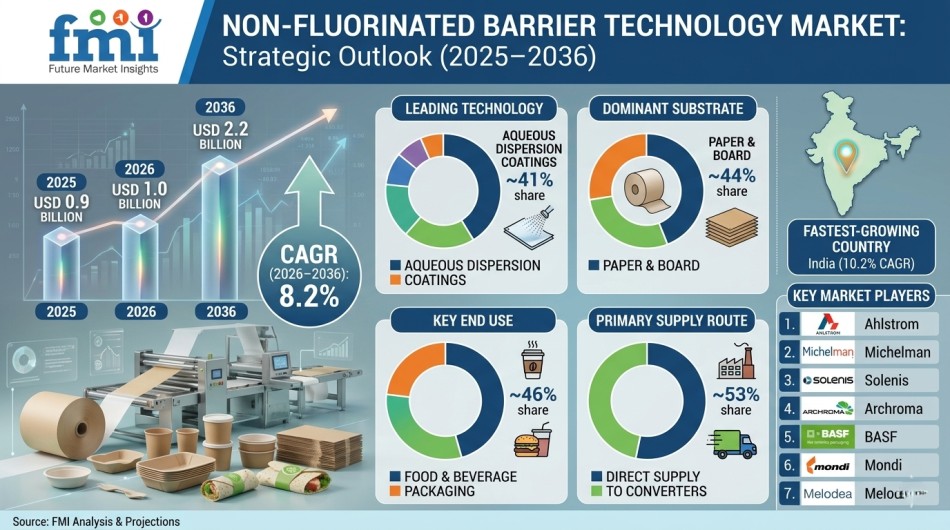
Non-Fluorinated Barrier Technology Market Snapshot (2025-2036)
Market size in 2025: USD 0.9 billion
Market size in 2026: USD 1.0 billion
Market size in 2036: USD 2.2 billion
CAGR (2026-2036): 8.2%
Leading technology: Aqueous dispersion coatings (~41% share)
Dominant substrate: Paper & board (~44% share)
Key end use: Food & beverage packaging (~46% share)
Primary supply route: Direct supply to converters (~53% share)
Fastest-growing country: India (10.2% CAGR)
Get Access of Report Sample: https://www.futuremarketinsights.com/reports/sample/rep-gb-32394
Market Momentum
The Non-Fluorinated Barrier Technology Market begins at approximately USD 0.9 billion in 2025 and crosses USD 1.0 billion in 2026 as major global brands accelerate PFAS elimination strategies. By 2030, widespread adoption of aqueous barrier coatings and increased investments in sustainable packaging infrastructure push the market significantly forward.
Between 2030 and 2036, growth intensifies as high-performance, PFAS-free coatings achieve parity with legacy fluorinated solutions in oil and grease resistance without compromising production efficiency. By 2036, the market reaches USD 2.2 billion, maintaining a steady CAGR of 8.2%.
Why the Market Is Growing
The market is expanding rapidly due to mounting global regulations restricting PFAS in packaging and increasing pressure from major consumer brands to adopt fully transparent, sustainable material systems.
Packaging converters are being forced to upgrade manufacturing infrastructure to support aqueous barrier coatings or risk losing contracts with global buyers. At the same time, expanding municipal composting and recycling frameworks are rejecting materials containing persistent synthetic chemicals, further accelerating the transition.
Technological advancements in high-solids dispersions, low-temperature curing systems, and bio-based polymer formulations are enabling scalable, cost-effective alternatives. These innovations are critical in ensuring compatibility with existing production lines while maintaining operational efficiency.
Segment Spotlight
Technology Platform: Aqueous Dispersion Coatings Lead (~41% Share)
Aqueous dispersion coatings dominate due to their compatibility with existing paper manufacturing infrastructure. Their ability to integrate directly into size presses without major capital investment makes them the preferred solution for rapid industry transition.
Substrate: Paper & Board Lead (~44% Share)
Paper & board remain the dominant substrate, driven by strong demand for recyclable and repulpable packaging formats. Their structural integrity and compatibility with sustainable coatings make them ideal for high-performance applications.
Barrier Function: Oil & Grease Resistance (~34% Share)
Oil and grease barrier functionality represents the primary application area, replacing legacy fluorochemical treatments in foodservice and bakery packaging.
End Use: Food & Beverage Packaging (~46% Share)
This segment leads due to stringent regulatory requirements and immediate substitution pressure from global food brands seeking PFAS-free packaging solutions.
Regional Growth: North America, Europe, and Asia Pacific Drive Expansion
North America advances through strong brand-driven PFAS elimination initiatives and decentralized procurement strategies.
Europe leads regulatory enforcement, with strict compliance frameworks accelerating adoption of sustainable barrier technologies.
Asia Pacific emerges as a key growth hub, driven by export-oriented manufacturing and rapid packaging infrastructure upgrades.
Top Growth Countries:
Country |
CAGR (2026-2036) |
|---|---|
India |
10.2% |
United States |
9.1% |
China |
8.8% |
France |
7.8% |
Germany |
7.4% |
United Kingdom |
7.1% |
Japan |
6.6% |
Drivers, Opportunities, Trends, Challenges
Drivers:
Regulatory bans on PFAS in packaging
Brand-driven sustainability mandates
Expansion of recycling and composting infrastructure
Opportunities:
High-solids, low-energy aqueous dispersions
Bio-based and mineral-based barrier coatings
Molded fiber and recyclable paper packaging innovations
Trends:
Shift toward repulpable, compostable materials
Integration of coatings into existing production lines
Increased collaboration between formulators and converters
Challenges:
Thermal drying limitations in existing infrastructure
Higher energy requirements for water-based coatings
Performance gaps under extreme conditions (heat, grease exposure)
Competitive Landscape
The market features a dynamic competitive environment where success depends on formulation performance, operational compatibility, and regulatory compliance. Leading players are focusing on developing high-performance coatings that can run efficiently on legacy equipment while meeting stringent sustainability standards.
Manufacturers are embedding technical teams directly within converter operations to optimize real-time performance and secure long-term supply agreements. Meanwhile, integrated paper producers are leveraging scale to control pricing and accelerate adoption of standardized barrier solutions.
Key Players in the Non-Fluorinated Barrier Technology Market
Ahlstrom
Michelman
Solenis
Archroma
BASF
Mondi
Melodea
Outlook
The Non-Fluorinated Barrier Technology Market is entering a critical transformation phase as regulatory enforcement tightens and global brands accelerate sustainability commitments. Companies that successfully deliver high-performance, scalable, and energy-efficient PFAS-free solutions will gain a decisive competitive advantage.
As the industry moves toward 2036, the convergence of regulatory pressure, technological innovation, and supply chain restructuring will firmly establish non-fluorinated barrier technologies as the new standard in sustainable packaging.
For an in-depth analysis of evolving formulation trends and to access the complete strategic outlook for the Non-Fluorinated Barrier Technology Market through 2036, visit the official report page at: https://www.futuremarketinsights.com/reports/non-fluorinated-barrier-technology-market
Explore More Related Studies Published by FMI Research:
High-Purity Silane Gases Market: https://www.futuremarketinsights.com/reports/high-purity-silane-gases-market
Graphene-Based Coating Additives Market: https://www.futuremarketinsights.com/reports/graphene-based-coating-additives-market
High-Purity Phosphoric Acid Market: https://www.futuremarketinsights.com/reports/high-purity-phosphoric-acid-market
Engineered Virgin-Equivalent PCR Resin Market: https://www.futuremarketinsights.com/reports/engineered-virgin-equivalent-pcr-resin-market
Electronic-Grade Isopropyl Alcohol (IPA) Market: https://www.futuremarketinsights.com/reports/electronic-grade-isopropyl-alcohol-ipa-market
About Future Market Insights (FMI)
Future Market Insights (FMI) is a leading provider of market intelligence and consulting services, serving clients in over 150 countries. Headquartered in Delaware, USA, with a global delivery center in India and offices in the UK and UAE, FMI delivers actionable insights to businesses across industries including automotive, technology, consumer products, manufacturing, energy, and chemicals.
An ESOMAR-certified research organization, FMI provides custom and syndicated market reports and consulting services, supporting both Fortune 1,000 companies and SMEs. Its team of 300+ experienced analysts ensures credible, data-driven insights to help clients navigate global markets and identify growth opportunities.
For Press & Corporate Inquiries
Rahul Singh
AVP - Marketing and Growth Strategy
Future Market Insights, Inc.
+91 8600020075
For Sales - sales@futuremarketinsights.com
For Media - Rahul.singh@futuremarketinsights.com
For web - https://www.futuremarketinsights.com/
SOURCE: Future Market Insights, Inc.
View the original press release on ACCESS Newswire