The global flavors and fragrances market is entering a new phase of expansion driven by rising FMCG product innovation, increasing demand for natural sensory ingredients, and premiumization across personal care, household care, and packaged food industries.
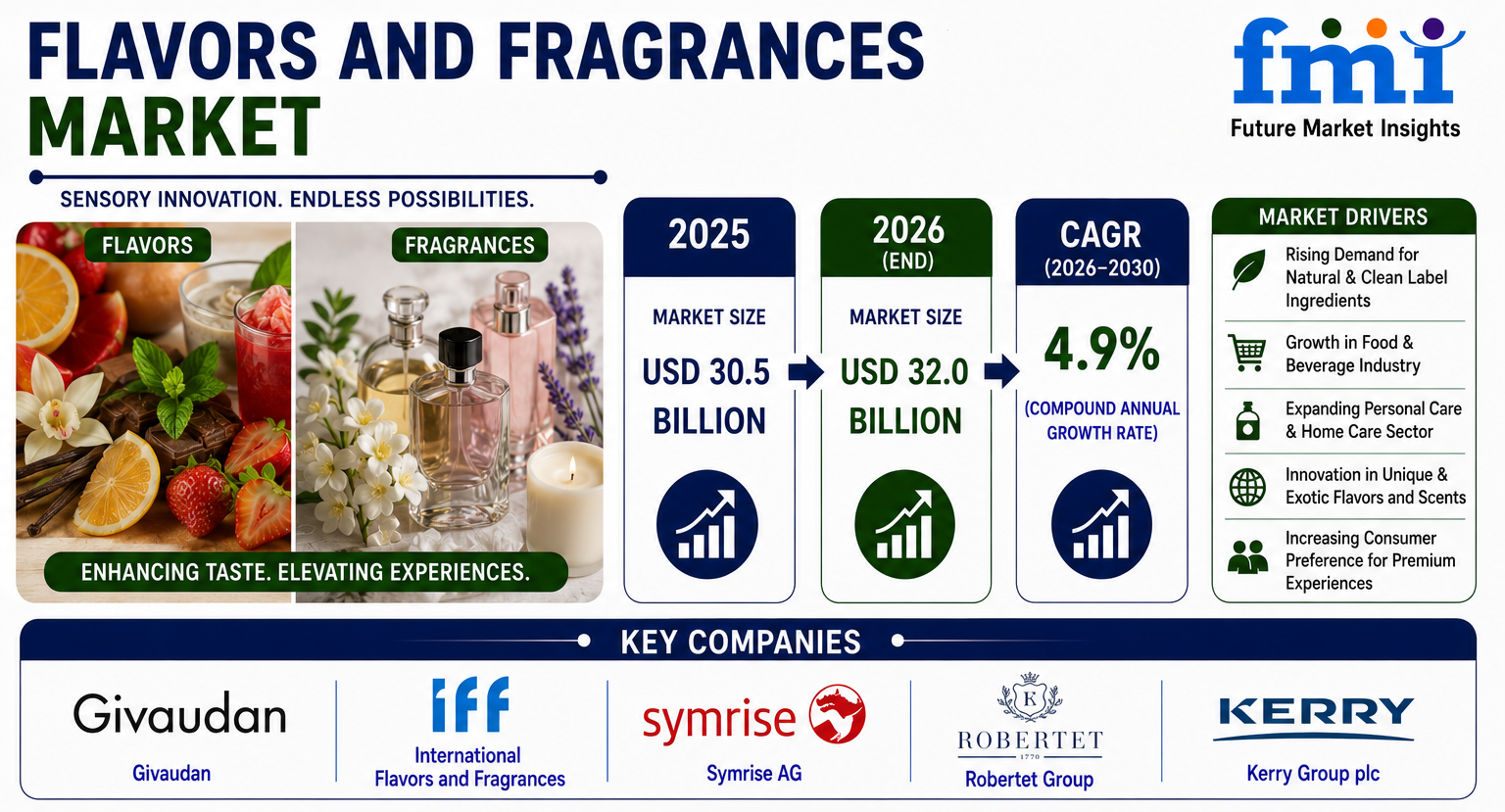
NEWARK, DE / ACCESS Newswire / May 27, 2026 / According to the latest analysis by Future Market Insights (FMI), the global Flavors and Fragrances Market is projected to grow from USD 32.0 billion in 2026 to USD 51.6 billion by 2036, expanding at a CAGR of 4.9% during the forecast period. Growth continues to be supported by sustained procurement demand from cosmetics, personal care, household cleaning, food, beverage, and pharmaceutical manufacturers seeking differentiated sensory experiences and advanced ingredient formulations.
Quick Market Highlights
Market Size (2026): USD 32.0 Billion
Forecast Market Value (2036): USD 51.6 Billion
CAGR (2026-2036): 4.9%
Leading Product Category: Fragrances (63.7%)
Dominant Ingredient Nature: Synthetic (61.3%)
Leading Delivery Format: Liquid (54.7%)
Largest Application Segment: Cosmetics & Personal Care (59.6%)
Fastest Growing Market: China (6.5% CAGR)
Get detailed market forecasts, competitive benchmarking, and pricing trends: https://www.futuremarketinsights.com/reports/sample/rep-gb-16731
FMCG Product Innovation Continues Fueling Ingredient Procurement
Continuous product development across fast-moving consumer goods categories remains one of the strongest structural demand drivers for flavors and fragrances globally.
Consumer brands increasingly rely on sensory differentiation to:
Improve product positioning
Enhance consumer loyalty
Support premium pricing
Accelerate new product launches
Build brand identity
Strengthen emotional consumer engagement
Fragrance compounds continue generating the majority of market revenue because they are widely used across:
Fine fragrances
Skincare
Haircare
Deodorants
Household cleaners
Air fresheners
Fabric softeners
Home care products
Flavor systems remain essential across:
Packaged foods
Dairy products
Beverages
Confectionery
Functional foods
Oral care products
Pharmaceutical taste masking
Natural Ingredient Transition Is Reshaping the Competitive Landscape
One of the most significant transformations in the market is the accelerating shift toward natural, plant-derived, and clean-label ingredients.
FMCG manufacturers are increasingly reformulating products using:
Botanical extracts
Essential oils
Fermentation-derived compounds
Biotechnology-enabled ingredients
Sustainable aroma chemicals
Natural flavor systems
The naturals transition is being driven by:
Consumer demand for clean-label products
Sustainability expectations
Regulatory pressure
Premium product positioning
Transparency requirements
Wellness-focused consumption trends
This shift is creating strong competitive advantages for flavor and fragrance houses with:
Botanical extraction capability
Fermentation technology
Proprietary natural ingredient libraries
Sustainable sourcing networks
Biotransformation expertise
Fragrances Continue Dominating Market Revenue
Fragrances are expected to account for 63.7% of total market revenue in 2026 due to their widespread use in personal care, household products, and fine fragrance applications.
Demand remains particularly strong in:
Prestige perfumes
Masstige fragrance categories
K-beauty formulations
Luxury skincare
Functional home care products
Ambient scenting solutions
Premium personal care expansion continues increasing fragrance loading rates and formulation complexity, creating higher-value procurement opportunities for ingredient suppliers.
Liquid Delivery Formats Remain the Industry Standard
Liquid product formats account for 54.7% of total market demand because they remain the primary delivery mechanism for fragrance compounds and flavor emulsions.
Liquid systems continue dominating because they offer:
Better formulation flexibility
Easier blending
Faster integration into manufacturing lines
Improved dosage control
Stronger sensory dispersion
Compatibility with personal care manufacturing systems
Liquid fragrance oils and flavor emulsions remain central across:
Cosmetics
Haircare
Cleaning products
Processed beverages
Dairy systems
Fine fragrance formulations
Customize insights for your business strategy: https://www.futuremarketinsights.com/customization-available/rep-gb-16731
Cosmetics and Personal Care Lead Global Procurement
The cosmetics and personal care industry continues representing the largest application segment with 59.6% market share.
Personal care brands increasingly prioritize:
Signature scent development
Consumer sensory differentiation
Emotional branding
Premium fragrance accords
Long-lasting fragrance performance
Functional aroma systems
The growth of skincare, wellness beauty, and premium haircare categories is accelerating procurement demand for sophisticated fragrance systems globally.
China Emerges as the Fastest Growing Market
China is projected to remain the fastest-growing market globally with a CAGR of 6.5% through 2036.
Growth is being fueled by:
Expanding domestic FMCG manufacturing
Rising disposable incomes
Urbanization
Premium beauty consumption
Growth in domestic fragrance brands
Increasing packaged food demand
Chinese FMCG companies are increasingly investing in:
Custom fragrance development
Premium flavor systems
Advanced ingredient sourcing
Product differentiation strategies
Government modernization of cosmetics regulations is also improving market access for global ingredient suppliers.
South Korea Benefits from K-Beauty Expansion
South Korea is projected to grow at 5.8% CAGR because of its globally influential K-beauty manufacturing ecosystem.
K-beauty product innovation cycles create sustained demand for:
Rapid fragrance development
Functional sensory systems
Premium cosmetic ingredients
Product-specific fragrance accords
Export-oriented formulations
South Korea continues functioning as one of the most innovation-driven procurement hubs in the global fragrance industry.
United States Remains a Strategic Innovation Hub
The United States continues representing one of the largest and most strategically important markets globally.
Growth is supported by:
Concentrated FMCG headquarters
Advanced R&D infrastructure
Fine fragrance demand
Premium personal care expansion
Naturals reformulation initiatives
Functional food innovation
The transition toward clean-label formulations continues creating premium ingredient procurement opportunities across both flavors and fragrances.
France Maintains Leadership in Fine Fragrance Expertise
France remains globally important because of:
Grasse's historical fragrance leadership
Luxury perfume manufacturing
Advanced fragrance craftsmanship
Botanical extraction expertise
Cosmetic industry procurement demand
French ingredient houses continue benefiting from expertise in complex fragrance accords and premium sensory development.
Industry Challenges: Naturals Scaling and Input Cost Volatility
Despite strong growth, the industry continues facing several operational and commercial challenges.
Natural Ingredient Supply Complexity
Natural ingredient sourcing remains vulnerable to:
Agricultural variability
Weather disruptions
Geographic concentration
Sustainability certification requirements
Yield inconsistencies
Rising procurement costs
Margin Pressure from Commodity Competition
Commodity aroma chemicals and generic flavor systems face pricing pressure from regional producers, especially in East Asia.
Manufacturers increasingly compete through:
Proprietary formulation capability
Technical expertise
Speed-to-market
Sensory innovation
Customer collaboration
Regulatory compliance
Explore In-Depth Food and Beverage Market Insights: https://www.futuremarketinsights.com/industry-analysis/food-and-beverage
Competitive Landscape: Global Leaders Strengthen Technical Capabilities
The market remains highly consolidated among multinational flavor and fragrance houses with extensive formulation libraries and global customer relationships.
Leading Companies Include:
Givaudan
International Flavors and Fragrances
Symrise AG
Robertet Group
Kerry Group plc
Sensient Technologies
Firmenich SA
Emerging competitors continue focusing on:
Biotechnology
Sustainable naturals
Niche fragrance applications
Rapid formulation turnaround
Regional specialization
Givaudan Continues Leading Through Portfolio Breadth
Givaudan maintains the strongest competitive position globally through:
Extensive ingredient libraries
Global production infrastructure
Regulatory expertise
FMCG client relationships
Natural sourcing capability
Advanced sensory science
Meanwhile, International Flavors and Fragrances and Symrise AG continue expanding through specialized application development and regional growth initiatives.
Technology, Biotechnology, and Consumer Insights Will Shape Future Growth
The future of the flavors and fragrances market will increasingly depend on:
Biotechnology-driven naturals production
AI-supported sensory development
Consumer insight integration
Sustainable ingredient sourcing
Rapid customization capability
Fermentation-derived ingredients
Precision formulation systems
Companies capable of scaling natural ingredients while maintaining cost competitiveness against synthetic alternatives are expected to capture disproportionate market share over the next decade.
Explore Industry Insights: https://www.futuremarketinsights.com/industry-analysis
Strategic Outlook
For FMCG Manufacturers: Sensory differentiation will remain essential for brand positioning, especially in premium personal care and packaged food categories.
For Ingredient Suppliers: Naturals capability, formulation speed, and regulatory expertise will increasingly determine competitive positioning.
For Investors: Companies with biotechnology infrastructure, sustainable sourcing networks, and proprietary formulation platforms are expected to outperform.
For Regional Manufacturers: Emerging Asian consumer markets continue representing the strongest long-term procurement opportunity globally.
Executive Summary
The global flavors and fragrances market is projected to reach USD 51.6 billion by 2036
Fragrances remain the dominant product category globally
Natural ingredient demand is fundamentally reshaping supply chains
China and South Korea continue leading global growth momentum
Premium personal care and fine fragrance categories remain major revenue drivers
Biotechnology and sustainable sourcing will define next-generation competitive advantage
Companies combining naturals capability, rapid formulation turnaround, and proprietary ingredient libraries are expected to lead long-term market expansion
Related Reports:
Cassava Syrup Market: https://www.futuremarketinsights.com/reports/cassava-syrup-market
Sweetener Market: https://www.futuremarketinsights.com/reports/sweetener-market
Sea Urchin and Roe Flavor Ingredients Market: https://www.futuremarketinsights.com/reports/sea-urchin-and-roe-flavor-ingredients-market
Raspberry Ketones Market: https://www.futuremarketinsights.com/reports/raspberry-ketones-market
Flavored CBD Powder Market: https://www.futuremarketinsights.com/reports/flavored-cbd-powder-market
About Future Market Insights (FMI)
Future Market Insights (FMI) delivers actionable, decision-focused market intelligence that goes beyond traditional research reports. The company provides:
In-depth pricing and cost benchmarking analysis
Demand forecasting based on real industry inputs
Procurement and buyer behavior insights
Supply chain and trade flow intelligence
Technology adoption trends across industries
FMI follows a robust bottom-up research methodology, combining insights from industry experts, procurement leaders, and technical professionals to ensure accurate and practical market intelligence.
For Press & Corporate Inquiries
Rahul Singh
AVP - Marketing and Growth Strategy
Future Market Insights, Inc.
+91 8600020075
For Sales - sales@futuremarketinsights.com
For Media - Rahul.singh@futuremarketinsights.com
For Web - https://www.futuremarketinsights.com
For Web - https://www.factmr.com
SOURCE: Future Market Insights, Inc.
View the original press release on ACCESS Newswire