The kids apparel market is witnessing strong expansion as parents increasingly prioritize branded clothing, premium fashion trends across global retail and e-commerce markets.
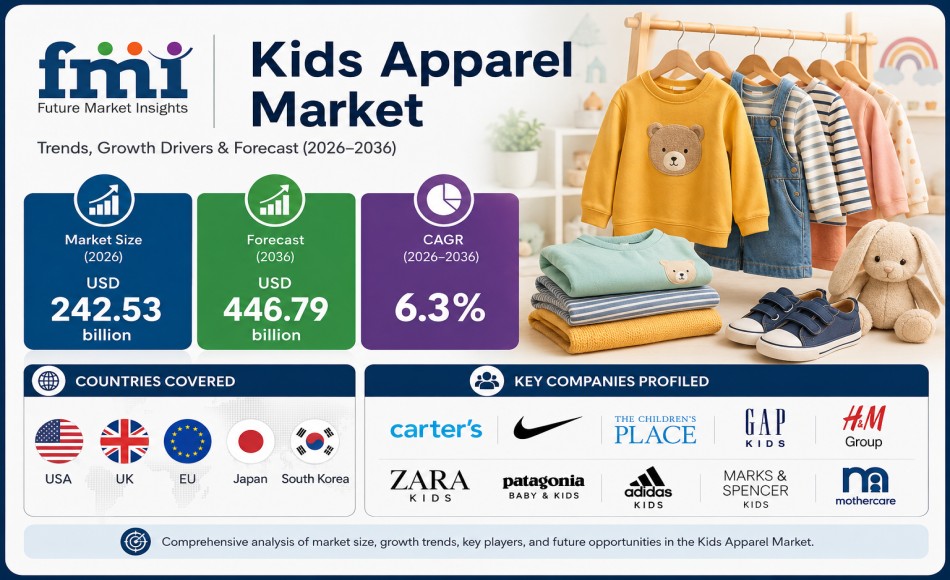
NEWARK, DE / ACCESS Newswire / May 27, 2026 / According to the latest market analysis by Future Market Insights, the global kids apparel market, valued at USD 242.53 billion in 2026 and projected to reach USD 446.79 billion by 2036, is emerging as a rapidly growing consumer apparel segment supported by rising parental spending, growing demand for branded children's wear, expansion of organized retail infrastructure, and increasing penetration of e-commerce platforms globally.
As parents continue to prioritize quality, comfort, sustainability, and fashionable clothing for children, demand for kids apparel is accelerating across both developed and emerging markets. Manufacturers and apparel brands are increasingly focusing on sustainable sourcing, omnichannel distribution, fabric innovation, and premium product positioning to strengthen customer loyalty and long-term market growth.
Quick Stats Snapshot
Market size (2026): USD 242.53 billion
Forecast (2036): USD 446.79 billion
CAGR (2026-2036): 6.3%
Fastest-growing markets: USA and South Korea (6.4% CAGR)
Leading product segment: Casual Wear (54.6% share)
Leading fabric type: Cotton (62.8% share)
Leading end user segment: Girls (51.2% share)
Key sales channels: E-commerce Platforms and Organized Retail Stores
Key consumers: Urban Parents, Premium Buyers, and Digital Commerce Consumers
Get detailed market forecasts, competitive benchmarking, and pricing trends: https://www.futuremarketinsights.com/reports/sample/rep-gb-16718
Market Size and Growth Outlook
The kids apparel market is projected to grow from USD 242.53 billion in 2026 to USD 446.79 billion by 2036, reflecting a CAGR of 6.3%.
Growth is being driven by increasing replacement demand due to child growth cycles, rising consumer spending on branded and premium children's clothing, expanding organized retail infrastructure, and the rapid growth of online apparel commerce.
Growth Drivers: Rising Fashion Awareness and Digital Retail Expansion
1. Increasing Demand for Branded and Quality-Assured Kids Clothing
Parents are increasingly prioritizing durable, stylish, and skin-safe apparel products for children, supporting strong demand for branded casual wear, activewear, and occasion-based clothing.
2. Expansion of E-commerce and Omnichannel Retail
The growth of digital commerce platforms, direct-to-consumer brands, and omnichannel retail strategies is improving product accessibility and increasing brand visibility among urban consumers globally.
3. Sustainability and Organic Fabric Adoption
Growing awareness regarding organic cotton, sustainable sourcing, and chemical-safe fabrics is creating premiumization opportunities across the global kids apparel industry.
Key Challenges: Input Cost Volatility and Fast Fashion Pressure
Despite strong growth momentum, the industry continues to face several operational and competitive challenges:
Cotton and synthetic fiber price volatility
Margin pressure from fast fashion competitors
Supply chain concentration risks
Rising labor and logistics costs
High return rates in online apparel sales
Emerging Opportunities: Sustainable Fashion and Subscription Commerce
The market is witnessing increasing innovation across sustainable apparel, digital retail ecosystems, and premium children's fashion:
Growth of organic cotton and eco-friendly apparel lines
Expansion of subscription-based kids clothing services
Rising adoption of AI-driven inventory and sizing systems
Increasing penetration of direct-to-consumer apparel brands
Growing demand for premium and designer kids fashion collections
Segmentation Insights: Casual Wear and Cotton Fabrics Lead Demand
By Product Type:
Casual Wear is expected to account for 54.6% of the product type segment in 2026, supported by strong demand for everyday wardrobe essentials including t-shirts, tops, jeans, and casual separates.
By Fabric Type:
Cotton leads the fabric type segment with 62.8% share due to strong parental preference for breathable, soft, hypoallergenic, and skin-safe materials.
By End User:
Girls continue to dominate demand with 51.2% share, supported by broader product variety, higher purchase frequency, and premium fashion adoption.
By Distribution Channel:
Online sales platforms continue to gain momentum as consumers increasingly prefer digital shopping experiences with broader size availability, convenience, and subscription-enabled purchasing options.
Customize insights for your business strategy: https://www.futuremarketinsights.com/customization-available/rep-gb-16718
Regional Analysis: USA and South Korea Drive Growth Momentum
United States (6.4% CAGR)
High per capita spending on children's clothing, strong brand loyalty, and established omnichannel retail infrastructure continue to support market expansion.
South Korea (6.4% CAGR)
Growing investment in premium and designer kids fashion, strong digital commerce adoption, and cultural emphasis on branded apparel are accelerating demand growth.
United Kingdom (6.2% CAGR)
Supermarket apparel ranges, sustainability-focused purchasing behavior, and expansion of online subscription models continue to support stable market growth.
European Union (6.3% CAGR)
REACH textile compliance standards and rising demand for organic and sustainably produced children's apparel are strengthening premium product adoption.
Japan (6.2% CAGR)
High consumer focus on garment quality, durability, and design aesthetics continues to drive demand for premium and functional children's apparel.
Competitive Landscape: Sustainability and Omnichannel Reach Shape Competition
The market remains highly competitive, with global apparel brands and children's fashion retailers competing through product innovation, sustainable sourcing, omnichannel retail expansion, and premium positioning.
Key players include:
Carter's, Inc.
Nike, Inc.
The Children's Place, Inc.
Gap Inc.
H&M Group
Zara Kids
Patagonia
Adidas
Competition is increasingly influenced by sustainability credentials, design innovation, pricing competitiveness, digital commerce capabilities, and supply chain efficiency.
Strategic Implications for Industry Leaders
For apparel manufacturers, fashion retailers, and e-commerce operators, key priorities include:
Expanding sustainable and organic fabric product lines
Strengthening omnichannel retail infrastructure
Improving digital inventory and sizing systems
Enhancing direct-to-consumer sales capabilities
Supporting compliance with textile safety and sustainability standards
Future Outlook: Toward Sustainable and Digitally Integrated Kids Fashion Ecosystems
The kids apparel market is expected to evolve into a more digitally connected and sustainability-driven industry supported by growing consumer awareness, premiumization trends, and expansion of online retail ecosystems.
Key future trends include:
Expansion of organic and eco-friendly apparel collections
Growth of AI-enabled inventory and demand forecasting systems
Increasing adoption of subscription-based apparel models
Rising demand for premium and designer children's fashion
Greater integration of digital commerce and personalized shopping experiences
Explore Industry Insights: https://www.futuremarketinsights.com/industry-analysis
Executive Takeaways
Market expected to reach USD 446.79 billion by 2036 at 6.3% CAGR
Casual Wear remains the leading product segment
Cotton continues to dominate fabric type adoption
USA and South Korea drive regional growth momentum
Sustainability and digital commerce accelerate market expansion
Competitive advantage increasingly depends on omnichannel distribution, sustainable sourcing, and design differentiation
In an increasingly fashion-conscious and digitally connected consumer environment, companies that invest in sustainable sourcing, premium design capabilities, omnichannel retail infrastructure, and data-driven inventory management will be best positioned to strengthen market share and capitalize on long-term growth opportunities in the global kids apparel industry.
Explore More Related Studies Published by FMI Research:
Apparel Market: https://www.futuremarketinsights.com/reports/apparel-market
Premium Outdoor Apparel Market: https://www.futuremarketinsights.com/reports/premium-outdoor-apparel-market
Garment Interlining Market: https://www.futuremarketinsights.com/reports/garment-interlining-market
Equestrian Apparel Market: https://www.futuremarketinsights.com/reports/equestrian-apparel-market
Second-hand Apparel Market in Europe: https://www.futuremarketinsights.com/reports/second-hand-apparel-market-in-europe
Explore In-Depth Consumer Product Industry Insights: https://www.futuremarketinsights.com/industry-analysis/consumer-product
About Future Market Insights (FMI)
Future Market Insights (FMI) is a leading provider of market intelligence and consulting services, serving clients in over 150 countries. Headquartered in Delaware, USA, with a global delivery center in India and offices in the UK and UAE, FMI delivers actionable insights to businesses across industries including automotive, technology, consumer products, manufacturing, energy, and chemicals.
An ESOMAR-certified research organization, FMI provides custom and syndicated market reports and consulting services, supporting both Fortune 1,000 companies and SMEs. Its team of 300+ experienced analysts ensures credible, data-driven insights to help clients navigate global markets and identify growth opportunities.
For Press & Corporate Inquiries
Rahul Singh
AVP - Marketing and Growth Strategy
Future Market Insights, Inc.
+91 8600020075
For Sales - sales@futuremarketinsights.com
For Media - Rahul.singh@futuremarketinsights.com
For Web - https://www.futuremarketinsights.com/
For Web - https://www.factmr.com/
SOURCE: Future Market Insights, Inc.
View the original press release on ACCESS Newswire