Barrier tube packaging market is accelerating as brands prioritize sustainable, compliant, high-barrier solutions for product protection and premium packaging performance.
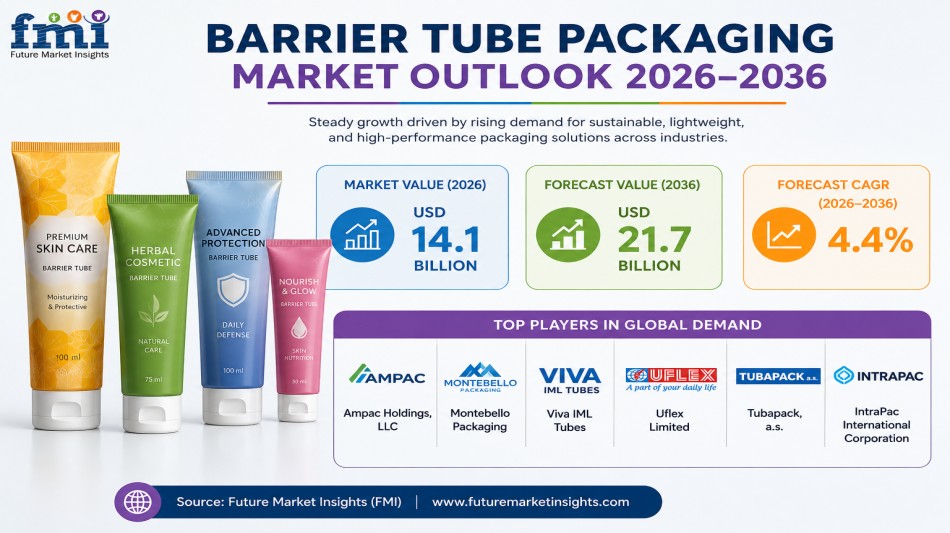
NEWARK, DE / ACCESS Newswire / May 28, 2026 / According to the latest market analysis by Future Market Insights, the global barrier tube packaging market is evolving from a largely volume-driven packaging segment into a specification-focused market shaped by regulatory compliance, sustainability requirements, and performance-driven procurement strategies. Valued at USD 13.5 billion in 2025, the market is projected to reach USD 14.1 billion in 2026 and further expand to USD 21.7 billion by 2036, registering a CAGR of 4.4% during the forecast period.
This growth reflects a broader transformation in global packaging supply chains, where cosmetic manufacturers, pharmaceutical companies, and food brands are increasingly prioritizing product protection, material efficiency, compliance readiness, and long-term operational reliability.
Quick Stats at a Glance
Market size (2025): USD 13.5 billion
Estimated value (2026): USD 14.1 billion
Forecast (2036): USD 21.7 billion
CAGR (2026-2036): 4.4%
Incremental opportunity: USD 7.6 billion
Leading product segment: Laminated Tubes (55.0% share)
Leading application segment: Personal Care and Cosmetics (50.0% share)
Get detailed market forecasts, competitive benchmarking, and pricing trends:
https://www.futuremarketinsights.com/reports/sample/rep-gb-3737
Market Size and Structural Shift
The barrier tube packaging market is entering a sustained phase of specification-led expansion as procurement standards evolve across global end-use industries. While traditional packaging decisions were heavily influenced by volume pricing, purchasing strategies are increasingly centered around quality consistency, barrier performance, regulatory compliance, and sustainability alignment.
Laminated and high-barrier tube formats are gaining preference due to their ability to preserve product integrity, extend shelf life, and support premium branding requirements across cosmetics, pharmaceuticals, and food applications.
As brands face growing pressure to reduce waste, improve packaging efficiency, and comply with stricter safety regulations, barrier tube packaging is becoming a strategic packaging solution rather than a commodity packaging format.
Growth Drivers: Compliance, Product Protection, and Premiumization
Three major forces are accelerating demand across global packaging ecosystems.
1. Tightening Quality and Safety Standards
Regulatory agencies across North America, Europe, and East Asia are implementing stricter packaging standards for cosmetics, pharmaceuticals, and food products. Barrier tube packaging offers enhanced contamination resistance, product stability, and shelf-life protection, making it increasingly attractive for compliance-focused procurement.
2. Rising Demand for Premium Packaging Formats
Beauty and personal care brands are investing heavily in differentiated packaging formats that support premium positioning, convenience, and product protection. Laminated tubes offer superior printability, aesthetics, and barrier performance, supporting adoption across high-value product categories.
3. Expansion of Pharmaceutical and Personal Care Manufacturing
Rapid growth in pharmaceutical production and cosmetic manufacturing across India, China, and Southeast Asia is creating consistent demand for compliant, scalable, and high-performance tube packaging solutions.
Market Constraints: Cost Pressures and Production Complexity
Despite steady growth, the industry faces several operational and commercial challenges.
Higher production costs compared to conventional packaging alternatives remain a major barrier, especially in price-sensitive emerging markets. Multi-layer barrier structures and compliance-grade materials increase manufacturing complexity and input costs.
In addition, qualification requirements for pharmaceutical and cosmetic applications create longer approval cycles and raise the entry barrier for smaller manufacturers.
Supply chain concentration also creates sourcing risks, particularly as a significant portion of global production capacity remains concentrated in East Asia.
Speak to Analyst: Customize insights for your business strategy:
https://www.futuremarketinsights.com/customization-available/rep-gb-3737
Opportunity Landscape: Where Future Value Is Emerging
Several high-value opportunities are expected to shape the next decade of market growth:
Sustainable multilayer packaging solutions with lower material usage
Premium cosmetic and skincare packaging formats
Expansion of pharmaceutical topical and dermatology applications
Growth of localized packaging manufacturing in India and China
Development of recyclable and mono-material barrier tube structures
Smart dispensing and controlled application closures for medical and cosmetic use
As sustainability targets intensify globally, manufacturers capable of balancing barrier performance with recyclability are expected to gain a competitive advantage.
Segment Insights: Where the Market Is Concentrated
By Product
Laminated Tubes are projected to dominate with a 55.0% market share in 2026, supported by strong demand from cosmetic manufacturers and pharmaceutical companies seeking high-performance, visually differentiated packaging solutions.
These formats provide excellent oxygen and moisture barrier properties while supporting attractive branding and extended shelf life.
By Application
Personal Care and Cosmetics will remain the leading application segment with a 50.0% share, driven by rising demand for skincare products, hair care solutions, oral care applications, and premium beauty packaging.
Pharmaceutical and food applications are also expanding steadily as manufacturers seek packaging formats capable of meeting stricter product protection standards.
Regional Dynamics: Growth Patterns Differ Across Markets
India (5.5% CAGR): India is projected to lead global growth, supported by expanding domestic manufacturing capacity, Make in India initiatives, organized retail expansion, and rising personal care consumption.
China (5.3% CAGR): China continues to benefit from large-scale manufacturing infrastructure, export-oriented production capabilities, and increasing demand for quality-focused packaging solutions.
United States (4.0% CAGR): Growth in the U.S. is supported by facility modernization, sustainability-focused procurement strategies, and strong demand for premium cosmetic and pharmaceutical packaging.
Europe: Countries such as Germany and Spain are witnessing demand driven by sustainability compliance, premium packaging standards, and infrastructure modernization supported by EU regulatory frameworks.
Unlock high-growth opportunities with FMI's niche business market insights:
https://www.futuremarketinsights.com/industry-analysis
Competitive Landscape: Reliability and Compliance Define Leadership
Competition in the barrier tube packaging market is increasingly centered on operational reliability, compliance readiness, and integrated manufacturing capabilities.
Leading companies including Ampac Holdings, LLC, Montebello Packaging, Viva IML Tubes, Uflex Limited, Tubapack, a.s., and Tekni-Plex, Inc. are strengthening their market positions through:
Integrated manufacturing infrastructure
Advanced multilayer packaging technologies
Geographic expansion strategies
Broader product portfolios
Compliance-focused production systems
Strong distribution and customer support networks
Operational scale, supplier qualification, and regional certification infrastructure continue to act as major competitive barriers for new entrants.
Strategic Implications for Industry Stakeholders
For packaging manufacturers, future competitiveness will depend on balancing cost optimization with compliance capabilities and product innovation.
For cosmetic and pharmaceutical brands, barrier tube packaging provides improved product protection, enhanced shelf life, and premium shelf appeal while supporting sustainability goals.
For investors, the market offers long-term opportunities across multilayer materials, sustainable packaging technologies, dispensing innovations, and regional manufacturing expansion.
For procurement leaders, supplier selection is increasingly shifting toward reliability, scalability, certification readiness, and total cost of ownership rather than simple unit pricing.
Future Outlook: From Commodity Packaging to Performance Packaging
Over the next decade, barrier tube packaging is expected to evolve into a highly specification-driven packaging category integrated with sustainability goals, advanced materials, and premium product positioning.
Key trends expected to shape the market include:
Wider adoption of recyclable barrier tube structures
Expansion of sustainable multilayer laminate technologies
Growth of pharmaceutical-grade packaging applications
Increased localization of packaging supply chains
Automation and digital integration in tube manufacturing
Greater emphasis on lightweight and low-material packaging formats
As regulatory expectations and consumer quality standards continue to rise, barrier tube packaging is expected to become an increasingly important component of modern packaging ecosystems.
Explore the Latest Packaging Industry Analysis Now:
https://www.futuremarketinsights.com/industry-analysis/packaging
Executive Takeaways
Barrier tube packaging is transitioning from a volume-driven segment to a specification-led market.
Growth is being driven by compliance requirements, premiumization, and product protection needs.
Laminated tubes remain the dominant product category due to superior barrier performance.
India and China are emerging as major growth engines supported by industrial expansion and manufacturing investment.
Sustainability, operational reliability, and integrated supply chains are becoming critical competitive differentiators.
The next phase of market growth will be defined by recyclable materials, localized manufacturing, and compliance-focused procurement strategies.
Related Reports:
Demand for Barrier Tube Packaging in Japan: https://www.futuremarketinsights.com/reports/japan-barrier-tube-packaging-market
Barrier Packaging Market: https://www.futuremarketinsights.com/reports/barrier-packaging-market
Packaging Tubes Market: https://www.futuremarketinsights.com/reports/packaging-tubes-market
Packaging Barrier Film Market: https://www.futuremarketinsights.com/reports/packaging-barrier-films-market
Plastic Tube Packaging Market: https://www.futuremarketinsights.com/reports/plastic-tube-packaging-market
About Future Market Insights (FMI)
Future Market Insights (FMI) is a leading provider of market intelligence and consulting services, serving clients in over 150 countries. Headquartered in Delaware, USA, with a global delivery center in India and offices in the UK and UAE, FMI delivers actionable insights to businesses across industries including automotive, technology, consumer products, manufacturing, energy, and chemicals.
An ESOMAR-certified research organization, FMI provides custom and syndicated market reports and consulting services, supporting both Fortune 1,000 companies and SMEs. Its team of 300+ experienced analysts ensures credible, data-driven insights to help clients navigate global markets and identify growth opportunities.
For Press & Corporate Inquiries
Rahul Singh
AVP - Marketing and Growth Strategy
Future Market Insights, Inc.
+91 8600020075
For Sales - sales@futuremarketinsights.com
For Media - Rahul.singh@futuremarketinsights.com
For Web - https://www.futuremarketinsights.com/
For Web - https://www.factmr.com/
SOURCE: Future Market Insights, Inc.
View the original press release on ACCESS Newswire