Rising EV Production, Automatic Emergency Braking Mandates, and Integrated Brake Control Platforms Accelerate Demand for Advanced Brake ECU Systems Across Passenger Vehicles and Next-Generation Mobility Platforms
NEWARK, DE / ACCESS Newswire / May 28, 2026 / According to the latest market analysis by Future Market Insights, the global brake system control ECU platforms market is entering a more software-defined vehicle growth phase as automakers increasingly prioritize integrated braking intelligence, brake-by-wire capability, and safety-critical vehicle control systems across passenger and commercial vehicle platforms.
The market is evolving from a conventional brake electronics category into a strategic vehicle control ecosystem where OEMs, brake system suppliers, and chassis technology providers increasingly focus on functional safety validation, regenerative brake blending, redundant actuation capability, and integrated chassis software performance before approving new vehicle platform launches.
Quick Stats Snapshot
Global market value (2025): USD 6.4 billion
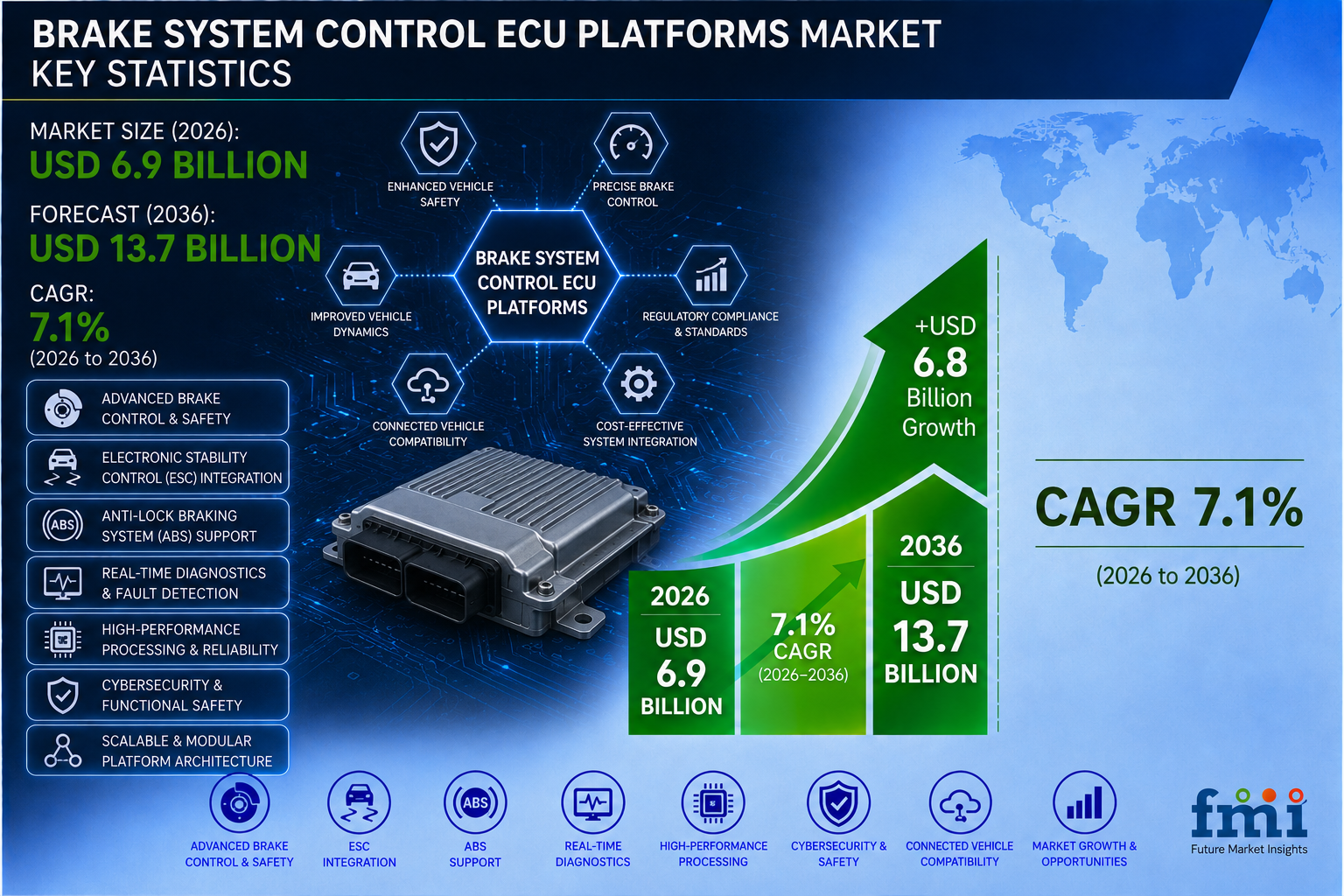
Estimated market value (2026): USD 6.9 billion
Forecast market value (2036): USD 13.7 billion
Global market CAGR (2026-2036): 7.1%
Leading sales channel: OEM Fitment (88.6% share)
Leading vehicle type: Passenger Cars (64.3% share)
Leading platform segment: Integrated Brake Control Platforms (42.8% share)
Leading control function: Stability Control (39.4% share)
Top growth market: China (8.6% CAGR)
Fast-growing automotive market: India (8.4% CAGR)
Leading suppliers: Robert Bosch GmbH and ZF Friedrichshafen AG
Get detailed market forecasts, competitive benchmarking, and pricing trends:
https://www.futuremarketinsights.com/reports/sample/rep-gb-33217
Market Outlook: Brake-by-Wire Integration and Vehicle Electrification Support Long-Term Growth
The brake system control ECU platforms market is projected to witness sustained expansion through 2036 as automakers, brake suppliers, EV manufacturers, and chassis control specialists increasingly prioritize integrated brake electronics capable of supporting automatic emergency braking, regenerative braking coordination, and software-defined vehicle architectures.
Integrated brake control platforms continue dominating commercial demand because they reduce module complexity, improve pressure response management, and simplify safety validation across increasingly electrified vehicle platforms. Automakers are simultaneously increasing brake ECU software investment as electric and hybrid vehicles require smoother coordination between regenerative braking systems and friction braking control.
At the same time, tightening global active safety regulations and growing deployment of automated driving features are creating additional commercial momentum across passenger vehicle and commercial mobility programs.
The category is increasingly positioned as a strategic automotive software and vehicle safety segment supporting brake-by-wire deployment, autonomous safety functions, electric vehicle efficiency, and intelligent chassis control integration.
Growth Drivers: Vehicle Electrification and Active Safety Regulations Accelerate Market Growth
Several structural factors are supporting market expansion:
1. Automatic Emergency Braking Mandates Increase ECU Deployment
Vehicle safety regulations increasingly require advanced braking intervention systems capable of converting sensor inputs into controlled braking action under validated software conditions.
2. Electric Vehicle Platforms Expand Brake Blending Requirements
Battery electric and hybrid vehicles require brake ECUs capable of coordinating regenerative energy recovery with friction braking while maintaining consistent pedal feel.
3. Integrated Brake Platforms Simplify Vehicle Architecture
Automakers increasingly favor one-box brake control systems that combine pressure management, stability control, and brake actuation into a single validated platform.
4. Brake-by-Wire Adoption Strengthens Software Content Value
Next-generation braking systems require redundant electronic actuation, functional safety validation, and fail-safe software architecture capable of supporting automated driving functions.
Customize insights for your business strategy:
https://www.futuremarketinsights.com/customization-available/rep-gb-33217
Key Challenges: Software Validation and Functional Safety Compliance Remain Critical
Despite favorable growth prospects, the industry continues facing several operational and commercial challenges:
Brake software validation complexity
Functional safety compliance requirements
Software recall exposure and liability risks
High development costs for redundant braking systems
Integration challenges across vehicle platforms
Cybersecurity and over-the-air update compliance requirements
Companies capable of combining software reliability, brake-by-wire validation capability, rapid calibration support, and regulatory compliance expertise are expected to strengthen competitive positioning across global automotive markets.
Emerging Opportunities: Software-Defined Braking and By-Wire Systems Expand Commercial Potential
Key opportunities are centered around intelligent vehicle control integration and electronic braking modernization:
Expansion of brake-by-wire vehicle platforms
Increasing adoption of integrated chassis control systems
Rising deployment of one-pedal EV braking architectures
Greater integration between braking and ADAS systems
Growing demand for redundant actuation capability
Increasing software-defined vehicle platform launches
Segmentation Insights: OEM Fitment and Passenger Cars Dominate Market Demand
By Sales Channel
OEM fitment is forecast to capture 88.6% share in 2026 as brake ECU software must be validated during vehicle development and safety approval programs.
By Vehicle Type
Passenger cars are projected to account for 64.3% share in 2026 due to higher production volumes and increasing deployment of electronic safety systems across mainstream vehicle programs.
By Platform Type
Integrated brake control platforms are expected to represent 42.8% share during the forecast period as automakers increasingly consolidate braking and stability functions into single control modules.
By Control Function
Stability control systems are forecast to account for 39.4% share in 2026 because electronic stability intervention remains the foundational brake electronics safety layer across global vehicle platforms.
Customize insights for your business strategy:
Future Market Insights Brake System Control ECU Platforms Market Customization Page
Regional Analysis: China and India Lead Brake ECU Platform Expansion
China (8.6% CAGR)
China remains the leading growth market supported by large-scale new energy vehicle production, rapid brake-by-wire deployment, and increasing adoption of regenerative braking systems across domestic EV platforms.
India (8.4% CAGR)
India continues benefiting from expanding passenger vehicle production, rising active safety adoption, and growing electric vehicle penetration across compact and utility vehicle categories.
South Korea (7.8% CAGR)
South Korea supports strong demand through export-oriented EV manufacturing, advanced chassis control integration, and premium vehicle safety system deployment.
Mexico (7.3% CAGR)
Mexico benefits from North American automotive assembly expansion and increasing localization of brake electronics supply chains supporting regional vehicle production programs.
United States (7.2% CAGR)
The United States market remains supported by automatic emergency braking mandates, large SUV and pickup production volumes, and increasing adoption of advanced driver assistance systems.
Germany (6.7% CAGR)
Germany continues benefiting from premium EV production, brake-by-wire innovation, and strong automotive engineering capability supporting integrated vehicle control systems.
Japan (6.5% CAGR)
Japan maintains stable market growth through hybrid vehicle leadership, advanced braking calibration capability, and long-standing automotive electronics expertise.
Asia-Pacific markets are expected to outperform mature automotive regions due to stronger EV production growth, higher vehicle output, and increasing integration of advanced safety systems.
Explore Industry Insights:
https://www.futuremarketinsights.com/industry-analysis
Competitive Landscape: Brake-by-Wire Validation and Software Safety Shape Competition
The brake system control ECU platforms market remains moderately concentrated, with integrated brake suppliers, automotive electronics manufacturers, and chassis technology companies competing across software-defined braking and vehicle safety programs.
Key companies include:
Robert Bosch GmbH
ZF Friedrichshafen AG
Continental AG
Denso Corporation
Hitachi Astemo Ltd.
Brembo N.V.
Hyundai Mobis Co. Ltd.
Leading suppliers continue strengthening market position through brake-by-wire technology investment, integrated chassis software capability, functional safety validation expertise, and large-scale OEM supply relationships.
Analyst Opinion
Nikhil Kaitwade observes, "Brake system control ECU platforms are increasingly becoming the decision-making layer inside modern vehicle braking systems. Automakers are prioritizing suppliers capable of delivering fast pressure response, stable regenerative blending, and validated software safety performance without creating launch risk. Suppliers with integrated brake-by-wire capability and disciplined software change control will strengthen long-term competitive advantage."
Strategic Implications for Industry Leaders
For automakers, brake system suppliers, EV manufacturers, and automotive electronics providers, the market presents several strategic priorities:
Integrated brake control platforms remain central to software-defined vehicle architecture
Brake-by-wire systems continue expanding across EV and automated driving programs
Functional safety validation is becoming increasingly important
Regenerative brake blending supports higher ECU software value
OEM fitment continues dominating market revenue generation
Active safety mandates strengthen electronic braking demand
Chassis integration capability shapes supplier competitiveness
Future Outlook: From Conventional Brake Electronics to Intelligent Vehicle Control Ecosystem
The brake system control ECU platforms market is expected to evolve beyond conventional anti-lock braking electronics into a more operationally integrated ecosystem focused on brake-by-wire intelligence, software-defined vehicle control, regenerative braking coordination, and autonomous safety intervention capability.
Key trends expected to shape the market include:
Expansion of brake-by-wire vehicle architectures
Greater integration between braking and ADAS platforms
Rising deployment of redundant braking actuation systems
Increasing software-defined chassis control adoption
Stronger focus on over-the-air brake software updates
Continued growth in regenerative braking optimization systems
Explore In-Depth Automotive Market Insights
https://www.futuremarketinsights.com/industry-analysis/automotive
Executive Takeaways
Integrated brake control platforms continue dominating advanced brake electronics demand
Passenger cars remain the leading vehicle segment for ECU deployment
OEM fitment drives the majority of brake ECU platform revenue
Brake-by-wire adoption is accelerating software-defined braking integration
China and India are leading automotive brake electronics growth momentum
Functional safety validation and software reliability shape supplier competitiveness
Regenerative brake blending is increasing ECU software value per vehicle
Active safety mandates continue strengthening long-term demand outlook
As automakers continue prioritizing vehicle electrification, software-defined safety systems, and intelligent chassis integration, companies capable of combining brake-by-wire expertise, functional safety compliance, scalable software validation, and integrated control architecture will be best positioned to capitalize on long-term brake system control ECU platforms market growth.
Related Reports:
Digital Brake Control and Antiskid Systems Market - https://www.futuremarketinsights.com/reports/digital-brake-control-and-antiskid-systems-market
Cybersecure Ignition Control Unit Platforms Market - https://www.futuremarketinsights.com/reports/cybersecure-ignition-control-unit-platforms-market
Cybersecure Vehicle Control Unit Gateway Systems Market - https://www.futuremarketinsights.com/reports/cybersecure-vehicle-control-unit-gateway-systems-market
Cybersecure Fuel Injection Control Unit Systems Market - https://www.futuremarketinsights.com/reports/cybersecure-fuel-injection-control-unit-systems-market
Steer-By-Wire and Brake-By-Wire HMI Controller Systems Market - https://www.futuremarketinsights.com/reports/steer-by-wire-and-brake-by-wire-hmi-controller-systems-market
About Future Market Insights (FMI)
Future Market Insights (FMI) is a leading provider of market intelligence and consulting services, serving clients in over 150 countries. Headquartered in Delaware, USA, with a global delivery center in India and offices in the UK and UAE, FMI delivers actionable insights to businesses across industries including automotive, technology, consumer products, manufacturing, energy, and chemicals.
An ESOMAR-certified research organization, FMI provides custom and syndicated market reports and consulting services, supporting both Fortune 1,000 companies and SMEs. Its team of 300+ experienced analysts ensures credible, data-driven insights to help clients navigate global markets and identify growth opportunities.
For Press & Corporate Inquiries:
Rahul Singh
AVP - Marketing and Growth Strategy
Future Market Insights, Inc.
+91 8600020075
For Sales - sales@futuremarketinsights.com
For Media - Rahul.singh@futuremarketinsights.com
For Web - https://www.futuremarketinsights.com/
For Web - https://www.factmr.com/
SOURCE: Future Market Insights, Inc.
View the original press release on ACCESS Newswire