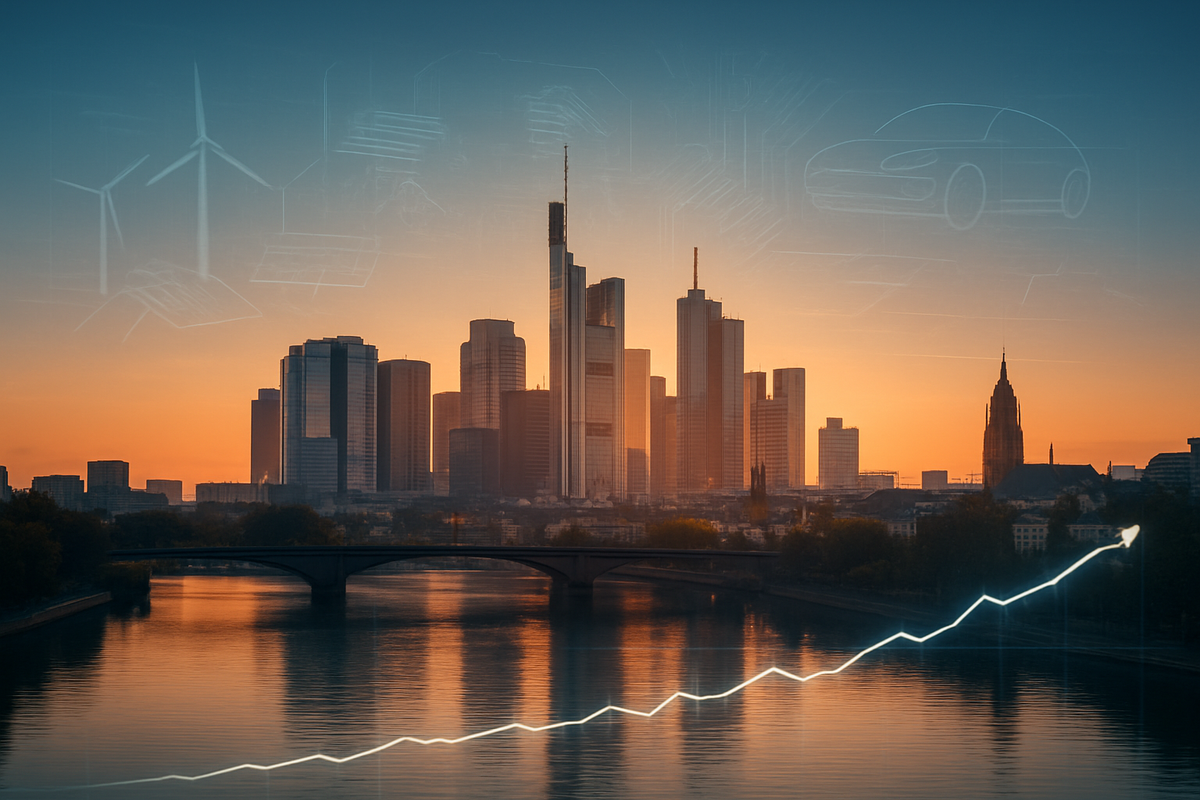
As the final weeks of 2025 unfold, the German equity market finds itself at a critical crossroads. While current industrial production figures remain sluggish, a wave of forward-looking optimism is sweeping through the financial district in Frankfurt. Leading the charge is European brokerage powerhouse Kepler Cheuvreux, which has just released its definitive "Top 10 German Stocks for 2026" strategy note. The report suggests that while 2025 was a year of consolidation and structural adjustment, 2026 is poised to be the year where "self-help" stories and infrastructure-led growth finally bear fruit for patient investors.
The immediate implications of this report are already being felt across the DAX and MDAX indices. Analysts at Kepler Cheuvreux argue that the German market is currently bifurcated: companies tethered to old industrial models continue to struggle, while those pivoting toward defense, green energy, and semiconductor cycles are preparing for a multi-year upswing. With the ZEW Indicator of Economic Sentiment surging to 45.8 this December, the market is beginning to price in a 2026 recovery that could see German GDP growth rebound toward the 2.0% mark, supported by a significant easing of fiscal "debt brake" restrictions.
The 2026 Selection: A Strategy of Resilience and Recovery
The release of Kepler Cheuvreux’s 2026 outlook on December 19, 2025, follows a turbulent eighteen months for German industry. High energy costs and a cooling Chinese market forced many of Germany’s largest players to undergo radical restructuring. The "Top 10" list represents a curated selection of firms that the brokerage believes have successfully navigated these headwinds. Key players in this selection include Aumovio (XETRA:AUV)—the newly spun-off automotive division of Continental—which is being hailed as the premier "self-help" play of the decade. With a net cash position exceeding €1 billion, Aumovio is expected to lead the charge in high-margin automotive software and safety systems.
The timeline leading to this announcement has been marked by a shift in investor sentiment from fear to calculated risk-taking. Throughout 2025, the German government’s pivot toward infrastructure stimulus and defense modernization provided a backdrop for companies like Rheinmetall AG (XETRA:RHM) and Siemens Energy AG (XETRA:ENR) to build record-breaking order backlogs. Kepler Cheuvreux’s endorsement has acted as a catalyst, with institutional investors rotating out of pure-play consumer stocks and into these "structural winners" that offer high visibility into 2026 and 2027 earnings.
Initial market reactions to the list have been largely positive, though cautious. While the Ifo Business Climate Index remains at a seven-month low of 87.6, reflecting current pain in the manufacturing sector, the stock prices of the "Top 10" have shown remarkable divergence. Traders are increasingly ignoring the "here and now" of the 2025 winter slump and are instead focusing on the projected 14% Return on Tangible Equity (ROTE) targets set by financial picks like Commerzbank AG (XETRA:CBK), which Kepler Cheuvreux identifies as a top capital-return play for the 2026–2028 period.
Winners, Losers, and the "Self-Help" Alpha
The companies identified in the Kepler Cheuvreux report are expected to be the primary beneficiaries of a stabilizing interest rate environment and a global recovery in capital expenditures. Infineon Technologies AG (XETRA:IFX) stands out as a major winner, positioned to ride a multi-year semiconductor upcycle driven by the electrification of everything. Similarly, Bayer AG (XETRA:BAYN) is viewed as a "deep value" recovery play. After years of being weighed down by glyphosate litigation, Kepler Cheuvreux analysts believe 2026 will mark a legal and operational inflection point for the life sciences giant, as its seeds franchise recovers and litigation risks finally begin to recede into the rearview mirror.
Conversely, the "losers" in this shifting landscape are likely to be companies that failed to adapt to the high-cost energy environment or those overly dependent on traditional internal combustion engine (ICE) supply chains. While Mercedes-Benz Group AG (XETRA:MBG) and BMW AG (XETRA:BMW) continue to trade at low multiples, they were notably absent from the top picks, reflecting a broader market skepticism regarding the speed of their transition to electric platforms. The brokerage's focus on GEA Group AG (XETRA:G1A) and E.ON SE (XETRA:EOAN) further highlights a preference for "picks and shovels" companies that provide the essential infrastructure and equipment for the green transition, rather than the end-market manufacturers themselves.
The financial sector also sees a clear winner in Commerzbank AG (XETRA:CBK). As the bank completes its multi-year restructuring, it is transitioning from a "turnaround story" to a "yield machine." Kepler Cheuvreux forecasts a total shareholder yield of up to 10% over the next three years. This puts pressure on smaller, less efficient regional banks that may struggle to match the scale and digital efficiency that Commerzbank has achieved through its aggressive cost-cutting and technology investments.
Broader Significance: Germany’s Industrial Renaissance
The Kepler Cheuvreux report is more than just a list of stocks; it is a roadmap for what many are calling Germany’s "Industrial Renaissance." For the past three years, the narrative surrounding Europe’s largest economy has been one of "deindustrialization." However, the 2026 outlook suggests a pivot. By focusing on firms like Siemens Energy AG (XETRA:ENR) and its €138 billion order backlog, the brokerage is signaling that Germany is successfully repositioning itself as the "engine room" of the European Green Deal and the continent's new defense architecture.
This shift fits into a broader global trend where national security and energy independence are becoming the primary drivers of industrial policy. The inclusion of Rheinmetall AG (XETRA:RHM) reflects a permanent shift in German fiscal policy, where defense spending is no longer a political taboo but a structural necessity. This has ripple effects across the entire European defense supply chain, benefiting partners and putting immense pressure on competitors to scale up or be left behind. The historical precedent here is the post-war reconstruction era, where massive infrastructure spending laid the foundation for decades of growth—a scenario that some analysts believe is being mirrored in today's "green and secure" modernization efforts.
Regulatory and policy implications are also at the forefront. The German government’s decision to partially ease the "debt brake" to allow for infrastructure investment is a game-changer for companies like Fraport AG (XETRA:FRA) and E.ON SE (XETRA:EOAN). By providing the capital necessary to modernize the power grid and transport hubs, the state is effectively de-risking the long-term growth profiles of these utility and infrastructure players. This "State-Led Growth" model marks a significant departure from the purely market-driven approach of the previous decade.
The Road to 2026: Scenarios and Strategic Pivots
Looking ahead, the short-term challenge for these "Top 10" picks will be navigating the final hurdles of the 2025 economic slowdown. While the ZEW sentiment is high, the reality on the ground—as evidenced by the Ifo index—remains difficult. Companies will need to maintain strict cost discipline while simultaneously investing in the capacity needed for the 2026 surge. Strategic pivots, such as Merck KGaA (XETRA:MRK) doubling down on its specialty chemicals for the semiconductor industry, will be essential to capture the emerging market opportunities.
In the long term, the primary risk remains geopolitical. Should global trade tensions escalate, particularly between the West and China, Germany’s export-heavy model could face renewed pressure. However, Kepler Cheuvreux’s selection favors companies with diversified global footprints or those tied to domestic European demand, such as DHL Group (XETRA:DHL) and Fraport AG (XETRA:FRA). These firms are better insulated from trans-Atlantic trade spats than traditional heavy manufacturing exporters.
Market participants should also watch for potential M&A activity. With many German mid-caps still trading at a significant discount to their historical averages and their US peers, the "Top 10" list could serve as a shopping list for private equity firms or larger international conglomerates. The "self-help" initiatives mentioned by Kepler Cheuvreux make these companies particularly attractive targets, as much of the hard work of restructuring has already been completed.
Summary: A New Chapter for the DAX
The Kepler Cheuvreux "Top 10" list for 2026 serves as a powerful reminder that even in an economy facing structural challenges, there are always pockets of immense value and growth. The key takeaways for investors are clear: look for "self-help" stories where management is taking proactive steps to unlock value, focus on structural themes like defense and the green transition, and don't ignore the massive capital return potential in the banking sector.
As we move into 2026, the market will likely reward those who can distinguish between cyclical noise and structural change. The divergence between sentiment and current conditions suggests that the best time to position for the recovery is while the headlines still look grim. The lasting impact of this period will be a leaner, more focused German industrial base that is less dependent on cheap Russian gas and more integrated into the high-tech supply chains of the future.
Investors should keep a close eye on quarterly earnings reports throughout the first half of 2026 to ensure that the "order backlog" narrative is translating into actual revenue growth. The performance of Infineon Technologies AG (XETRA:IFX) and Siemens Energy AG (XETRA:ENR) will be the primary bellwethers for this transition. If these leaders can deliver on their promises, the German market may well be on the cusp of its most significant bull run in a generation.
This content is intended for informational purposes only and is not financial advice.