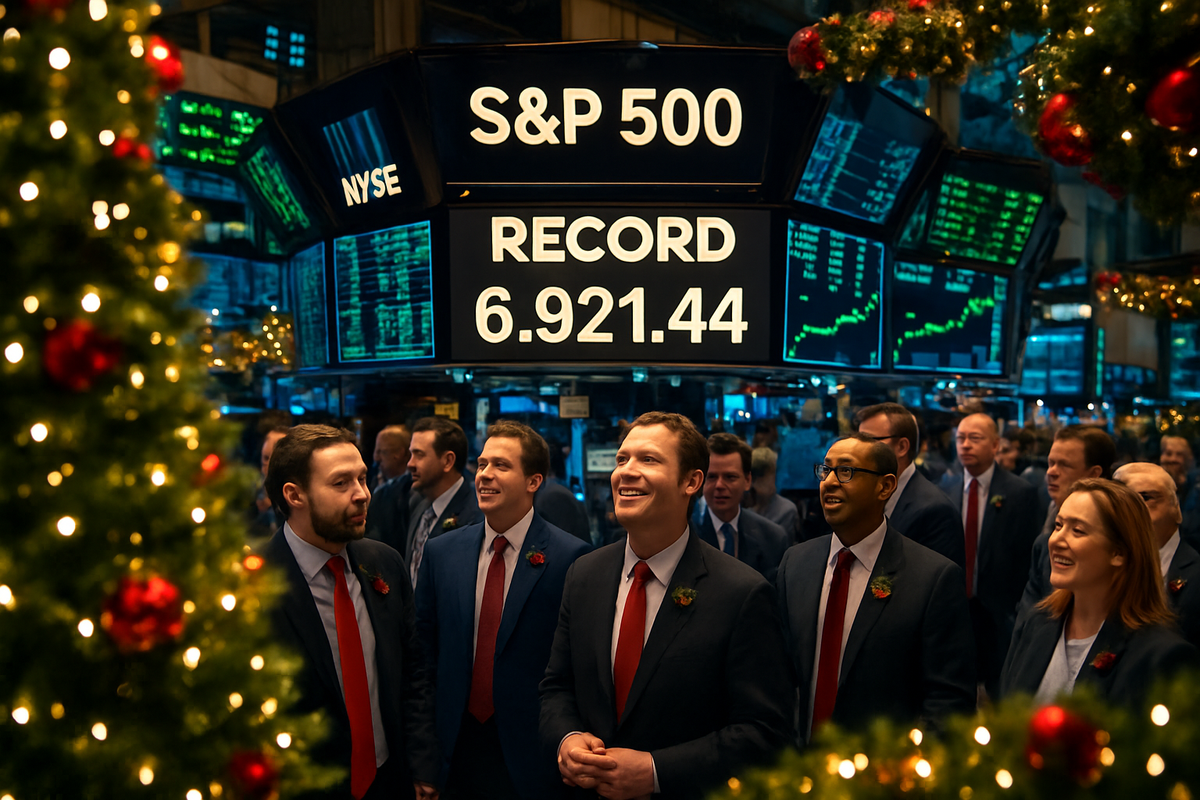
In a final burst of holiday cheer, the S&P 500 (INDEXSP:.INX) climbed to a fresh intraday record on Wednesday, December 24, 2025, as investors celebrated a year defined by economic resilience and the transformative power of artificial intelligence. During the shortened Christmas Eve session, which concluded at 1:00 PM ET, the benchmark index touched an all-time high of 6,921.44, narrowly eclipsing the previous record set just one day prior. The festive atmosphere on the floor of the New York Stock Exchange reflected a broader sense of relief across global markets, as the long-feared recession of the mid-2020s failed to materialize, replaced instead by a robust "soft landing."
The intraday milestone caps off a remarkable 2025 campaign that has seen the S&P 500 gain more than 17% year-to-date. This performance marks the third consecutive year of double-digit gains for the index, a rare feat that underscores the enduring strength of the U.S. consumer and the massive capital expenditures flowing into next-generation technology. As the closing bell rang through the half-day session, the market’s trajectory suggested that the legendary "Santa Claus Rally" is in full effect, providing a bullish tailwind that many analysts believe will carry over into the new year.
A Milestone Reached Amidst Festive Quiet
The ascent to 6,921.44 occurred during a period of characteristically thin trading volume, a common feature of the Christmas Eve session. However, the lack of liquidity did little to dampen the upward momentum. The rally was catalyzed by a series of positive economic data points released earlier in the week, including a revised Q3 GDP growth rate of 4.3% and cooling labor cost figures. These indicators reinforced the narrative that the Federal Reserve has successfully navigated the inflationary challenges of the post-pandemic era without stifling growth.
The timeline leading to this record-breaking moment was paved by the Federal Reserve’s strategic pivot in late 2025. After maintaining a restrictive stance for much of the year, the central bank executed three consecutive 25-basis-point interest rate cuts in September, October, and finally at the December meeting. This brought the federal funds rate down to a range of 3.50%–3.75%, providing the necessary liquidity to justify the high valuations of growth-oriented stocks. Key stakeholders, from institutional asset managers to retail investors using automated AI-advisors, have spent the final weeks of the year rebalancing portfolios to capture this late-season surge.
Market reactions to the intraday record were overwhelmingly positive, though tempered by the early close. Traders noted that the psychological breakthrough of the 6,900 level earlier in the week had cleared the way for this final push. While some technical analysts cautioned that the Relative Strength Index (RSI) is entering overbought territory, the prevailing sentiment heading into the holiday weekend is one of "FOMO" (fear of missing out), as investors scramble to ensure they are positioned for a potential 7,000-point milestone in early 2026.
Winners and Losers in the 2025 Victory Lap
The primary beneficiaries of the 2025 rally have undoubtedly been the titans of the semiconductor and software industries. NVIDIA (NASDAQ: NVDA) continued its reign as the market’s north star, ending the shortened session with a year-to-date gain of over 36%. The company’s dominance in AI data center hardware remains unchallenged, bolstered by a fresh wave of enterprise spending. Similarly, Micron Technology (NASDAQ: MU) and Advanced Micro Devices (NASDAQ: AMD) saw significant gains as the "AI broadening" trade took hold, moving beyond large-language models into edge computing and industrial applications.
Beyond the tech sector, the "AI infrastructure" play has created unexpected winners in the Utilities and Industrials sectors. GE Vernova (NYSE: GEV) and Caterpillar (NYSE: CAT) have both outperformed the broader market this year, as the demand for power-hungry data centers and precision manufacturing facilities reached new heights. These companies have transitioned from "old economy" staples to essential components of the digital infrastructure boom, benefiting from both federal subsidies and private sector investment.
However, the rally has not been universal. The "Magnificent Seven" showed signs of divergence this year; while Apple (NASDAQ: AAPL) and Microsoft (NASDAQ: MSFT) maintained steady growth, some consumer-facing giants like Amazon (NASDAQ: AMZN) faced headwinds from "sticky" core inflation that pressured middle-income discretionary spending. Additionally, the traditional energy sector lagged behind as the global transition toward renewables accelerated, and oil prices stabilized at lower levels due to increased non-OPEC production. These laggards serve as a reminder that even in a record-breaking year, sector rotation remains a critical factor for portfolio performance.
The Broader Significance of the 6,900 Threshold
Reaching a fresh record at the end of 2025 is more than just a numerical achievement; it represents the validation of the "Goldilocks" economic theory. For the past 18 months, the primary concern for the S&P 500 was whether the Federal Reserve could lower inflation to its 2% target without triggering a spike in unemployment. The current market levels suggest that the "soft landing" has been achieved. This historical precedent draws comparisons to the mid-1990s, where a similar period of tech-driven productivity growth allowed the economy to expand even as interest rates remained relatively high by historical standards.
The event also highlights a significant shift in market composition. The S&P 500 is increasingly dominated by companies that are not just "using" AI, but are fundamentally rebuilt around it. This has led to a structural increase in corporate margins, which has helped justify a forward price-to-earnings (P/E) ratio of roughly 24x. While critics argue this valuation is stretched, proponents point to the massive $5 trillion to $8 trillion in projected AI capital expenditures through 2030 as a justification for these premium multiples.
Furthermore, the late-2025 rally has occurred despite significant geopolitical and policy uncertainty. The resilience of the market in the face of shifting trade policies and "tariff shocks" suggests that corporate earnings have become the primary driver of stock prices, superseding macro-political noise. This decoupling is a significant development for global markets, as it indicates that the U.S. equity market remains the preferred "safe haven" for global capital seeking both growth and stability.
Looking Ahead: The Road to 7,500
As we move into 2026, the central question for investors is whether this momentum is sustainable. Short-term possibilities include a continuation of the Santa Claus Rally into the first week of January, followed by a period of consolidation as the Q4 earnings season begins. Analysts at major financial institutions have already begun raising their 2026 year-end targets, with a median forecast of 7,500 and some bullish outliers suggesting the S&P 500 could hit 8,000 by the end of the next year.
However, the path forward is not without challenges. The primary risk remains the potential for a "valuation reset" if earnings growth fails to meet the lofty expectations baked into current prices. Strategic pivots may be required for investors who have been overly concentrated in the "Magnificent Seven," as the market breadth is expected to widen further. We may see a "catch-up" trade in small-cap stocks and mid-cap industrials that have yet to fully participate in the AI-driven valuation expansion.
Market opportunities are likely to emerge in sectors that facilitate the "second wave" of AI—specifically cybersecurity, grid modernization, and biotechnology. As AI models move from training to inference, the companies that provide the security and the physical power to run these systems will become the next frontier for growth. Investors should also keep a close eye on the Federal Reserve; while three cuts were delivered in 2025, any sign of a "pause" in 2026 due to rebounding inflation could spark a period of volatility.
Closing Thoughts on a Historic Year
The S&P 500’s record-breaking performance on this Christmas Eve is a testament to the enduring dynamism of the American economy. From the depths of inflation fears to the heights of an AI-fueled bull market, 2025 has been a year of transformation. The key takeaway for investors is that the "soft landing" is no longer a theoretical hope but a market reality, providing a stable foundation for the next leg of the economic cycle.
Moving forward, the market will likely be characterized by a shift from "multiple expansion" (where stocks get more expensive) to "earnings-driven growth" (where stocks rise because profits are increasing). This is a healthier stage of a bull market but one that requires more disciplined stock selection. Investors should watch for the January "barometer"—the idea that as the first month of the year goes, so goes the rest of the year—to see if the festive optimism of December 2025 translates into a sustained rally for 2026.
As the markets remain closed for the Christmas holiday, the record-high close serves as a reminder of the power of staying invested through cycles of uncertainty. For now, Wall Street can head into the long weekend with the satisfaction of a year well-traded and a portfolio that, for many, is looking greener than a Christmas tree.
This content is intended for informational purposes only and is not financial advice.