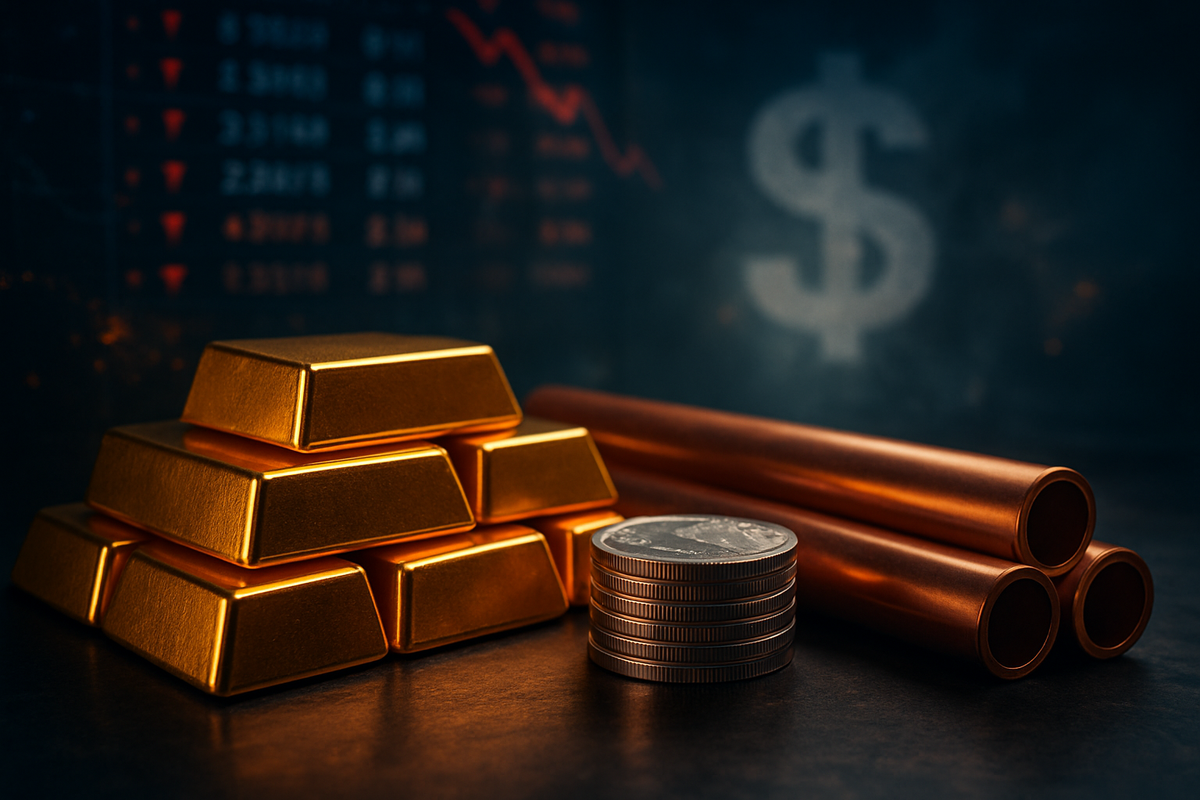
As of December 24, 2025, the global financial landscape is witnessing a historic "Triple Crown" rally in the metals market. Gold, silver, and copper have all surged to unprecedented all-time highs, capping off a year that has redefined the role of hard assets in a modern portfolio. This massive influx of capital into the commodities sector comes as investors seek refuge from a weakening US dollar and a geopolitical environment that many analysts describe as the most volatile in decades.
The immediate implications of this rally are profound. For central banks and institutional investors, the "debasement trade" is no longer a fringe theory but a primary strategy. As spot gold prices hover near $4,520 per ounce—a staggering 70% increase since the beginning of the year—the shift away from sovereign debt and toward tangible stores of value has accelerated. This movement is reshaping global trade dynamics, forcing a re-evaluation of inflationary hedges and challenging the long-standing dominance of the greenback as the world’s undisputed reserve currency.
A Year of Records: The Path to $4,500 Gold
The trajectory of the 2025 metals rally began in earnest during the second quarter, triggered by a decisive shift in Federal Reserve policy. After a prolonged period of maintaining high interest rates, the Fed initiated a series of aggressive cuts, bringing the Fed Funds rate down to approximately 3.75% by December. This "monetary pivot" significantly reduced the opportunity cost of holding non-yielding assets like gold and silver, sparking a massive wave of buying from both retail and institutional players.
The timeline of events leading to this Christmas Eve peak was further accelerated by the "Venezuela Crisis" in late autumn. The US government’s decision to seize and blockade Venezuelan oil tankers introduced fresh friction into global energy markets, sending the US Dollar Index (DXY) into a tailspin. By late December, the DXY had fallen to 97.80, its lowest level in over two decades. Because metals are priced in dollars, this currency weakness acted as a high-octane fuel for the rally, making bullion significantly cheaper for international buyers in Europe and Asia.
Key players in this drama include central banks from the BRICS+ nations—most notably China, India, and Turkey—which have been on a record-breaking gold-buying spree to diversify their reserves. Initial market reactions were skeptical in early 2025, but as silver broke past $70 per ounce and copper topped $12,000 per metric ton, the skepticism turned into a "Fear Of Missing Out" (FOMO) rally that has sustained itself through the final weeks of the year.
Winners and Losers in the Commodities Supercycle
The primary beneficiaries of this price surge are the major mining and streaming companies. Newmont (NYSE: NEM) has seen its stock price climb over 160% year-to-date, reporting a record-breaking free cash flow of $1.6 billion in the third quarter alone. Similarly, Barrick Mining (NYSE: GOLD)—which famously dropped "Gold" from its primary branding this year to reflect its expansion into copper—has seen its shares surge by 182%, bolstered by the resolution of mining disputes in Africa and the expansion of its Nevada operations.
Streaming and royalty companies have also emerged as massive winners. Wheaton Precious Metals (NYSE: WPM) reached an all-time high of $122.81 this month. Because its business model relies on fixed-cost contracts, Wheaton has been able to capture the full upside of silver’s 140% rally without being hindered by the rising labor and fuel costs that plague traditional miners. Freeport-McMoRan (NYSE: FCX) has also outperformed the broader market, as its heavy exposure to copper allows it to capitalize on the "red metal" shortage driven by the global AI data center boom.
Conversely, the rally has created significant headwinds for downstream manufacturers and technology giants. Tesla (NASDAQ: TSLA) has felt the squeeze, as electric vehicles require substantially more copper and silver than internal combustion engines. High input costs, combined with the expiration of federal EV tax credits, have pressured Tesla’s margins, causing the stock to retreat from its mid-December highs. Apple (NASDAQ: AAPL) has also lagged behind its peers in the "Magnificent Seven," as the soaring cost of gold and silver used in semiconductor circuitry forced the company to accelerate its "urban mining" recycling initiatives to mitigate spot market volatility. Meanwhile, Boeing (NYSE: BA) reported negative margins in its commercial aircraft unit, citing the "downstream demand destruction" caused by the skyrocketing price of specialized aerospace metals.
Macro Significance and the De-Dollarization Trend
The 2025 metals rally is more than just a price spike; it is a symptom of a broader structural shift in the global economy. This event fits into a multi-year trend of "de-dollarization," where sovereign nations are increasingly wary of the US dollar's role as a geopolitical tool. The aggressive use of tariffs and sanctions by the current administration has only accelerated this trend, prompting central banks to seek safety in gold—an asset with no counterparty risk.
Historical precedents for this movement can be found in the late 1970s, but the current era is complicated by the dual-role of metals like silver and copper. Unlike the 1970s, the 2025 rally is being sustained by the "Green Transition" and the "AI Revolution." The demand for silver in solar panels and copper in high-performance computing has created a structural deficit that financial hedging alone cannot explain. This convergence of safe-haven demand and industrial necessity has created a "perfect storm" that traditional economic models are struggling to contain.
Furthermore, the ripple effects are being felt in the regulatory sphere. Governments in South America and Africa are increasingly moving toward "resource nationalism," seeking a larger share of the windfall profits generated by foreign mining companies. This policy shift could lead to further supply constraints in 2026, potentially creating a floor for prices even if the current geopolitical tensions subside.
The 2026 Outlook: Consolidation or Continued Ascent?
As we look toward 2026, the market faces a critical juncture. Short-term indicators, such as the Relative Strength Index (RSI), suggest that gold and silver are in "overbought" territory, leading some analysts to predict a technical correction in January. However, the long-term fundamentals remain overwhelmingly bullish. If the Federal Reserve continues its path of rate cuts as expected, the downward pressure on the US dollar will likely persist, providing a supportive backdrop for further gains.
Strategic pivots will be required for companies on both sides of the trade. Manufacturers like Ford (NYSE: F) may need to implement significant price hikes or seek alternative materials to maintain profitability. Meanwhile, mining companies will face pressure to reinvest their record profits into new exploration and development to address the looming supply shortages in copper and silver. The primary challenge for the market will be navigating the "volatility of victory"—managing the risks associated with such rapid price appreciation while ensuring that supply can eventually meet the insatiable global demand.
Final Takeaways for the 12/24/2025 Market
The 2025 metals rally is a landmark event that has vindicated the "hard money" advocates and forced a reckoning for traditional currency-based portfolios. The key takeaway for investors is that the relationship between the US dollar and commodities has entered a new, more volatile phase. The decoupling of gold from traditional interest rate expectations suggests that the market is pricing in systemic risks that go beyond simple inflation.
Moving forward, the market will remain highly sensitive to geopolitical headlines and Federal Reserve rhetoric. While the current prices may seem dizzying, the structural deficits in industrial metals and the ongoing diversification by central banks suggest that the "Golden Pivot" is far from over. Investors should keep a close eye on the US Dollar Index and the upcoming January jobs report, as these will be the primary catalysts for the next leg of this historic bull run.
This content is intended for informational purposes only and is not financial advice.