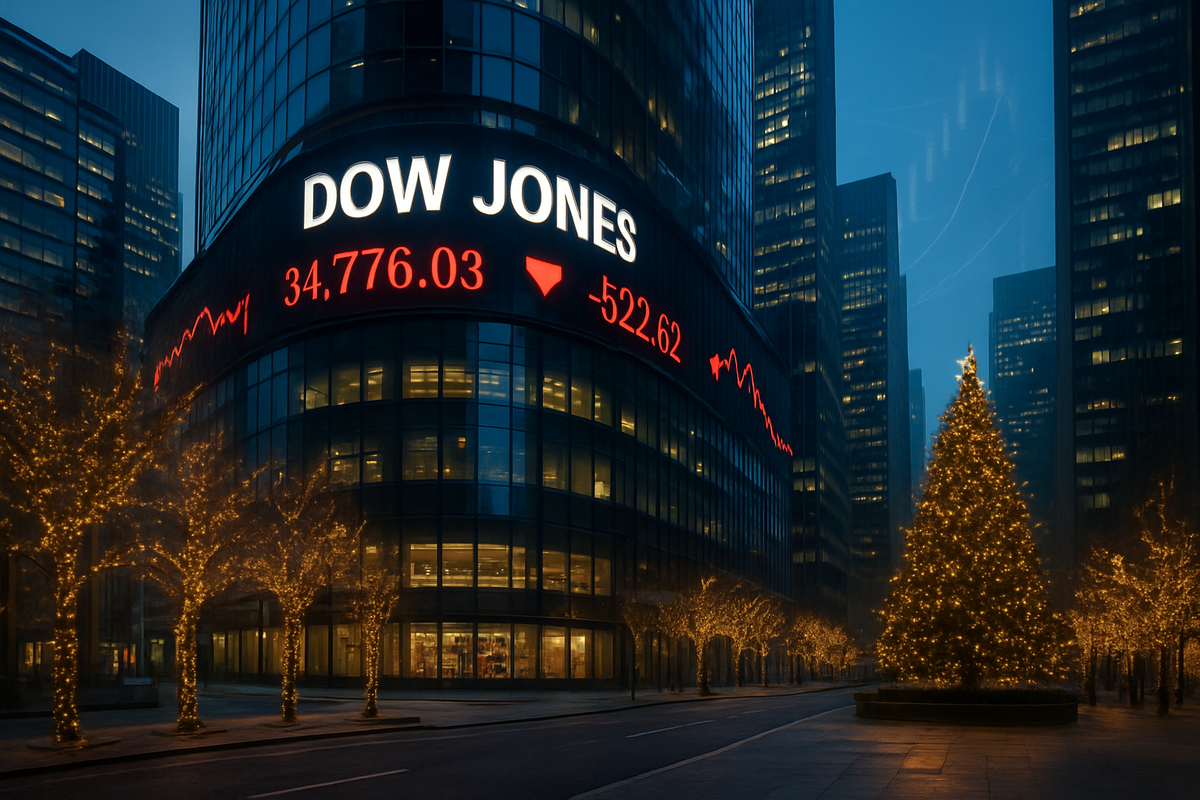
The Dow Jones Industrial Average (NYSE: DJI) retreated from its historic peaks on Monday, December 29, 2025, as investors began the holiday-shortened final week of the year with a bout of profit-taking. After a blistering rally that saw the blue-chip index climb approximately 15% year-to-date, the market’s momentum cooled in early Monday trading, reflecting a cautious shift in sentiment despite a favorable interest rate environment and a cooling inflationary backdrop.
This pullback marks a notable departure from the "Santa Claus rally" that had characterized much of December. While the index remains within striking distance of its all-time high of approximately 48,711, the day's decline highlights the fragility of thin holiday trading volumes. As the 2025 calendar winds down, the market is grappling with the dual forces of institutional year-end rebalancing and lingering concerns over trade-related volatility scheduled for early 2026.
A Year of Resilience and Volatility
The Dow’s performance on this final Monday of 2025 is the culmination of a tumultuous but ultimately rewarding year for equities. The index navigated a significant "April swoon" and the economic fallout from the longest government shutdown in U.S. history, which paralyzed federal agencies throughout October 2025. Despite these headwinds, the Dow surged in the fourth quarter, propelled by the Federal Reserve’s decisive pivot toward "cautious normalization."
On December 10, 2025, the Federal Open Market Committee (FOMC) delivered its third consecutive interest rate cut, a 25-basis-point reduction that brought the federal funds rate to a range of 3.50%–3.75%. This move provided a massive tailwind for the Dow’s industrial and financial components, which had struggled under the "higher for longer" regime of the previous year. However, the initial euphoria of the rate cut appears to have reached a saturation point, leading to the current consolidation phase.
The timeline leading to today’s drop was also influenced by the expiration of several key derivatives contracts and the implementation of China’s strict rare-earth export controls on December 1. These geopolitical tensions have introduced a layer of uncertainty that has prompted some of the market’s largest stakeholders—including major hedge funds and pension funds—to lock in gains before the new year begins.
The Winners and Losers of the Year-End Shift
The tech-heavy giants that led the 2025 charge are among the most notable "losers" in today’s session. Companies like Nvidia (Nasdaq: NVDA) and Tesla (Nasdaq: TSLA), which benefited immensely from the sustained Artificial Intelligence boom, saw significant selling pressure on Monday. Investors appear to be rotating out of high-growth tech and into more defensive or value-oriented sectors as they prepare for a potentially more volatile 2026.
Conversely, some of the Dow’s traditional heavyweights have shown relative strength. Goldman Sachs (NYSE: GS) and UnitedHealth Group (NYSE: UNH) have remained resilient, buoyed by the prospect of a "soft landing" and the anticipated benefits of the "One Big Beautiful Bill Act" (OBBBA). This legislation, which is set for full implementation in early 2026, is expected to provide substantial corporate tax credits and refunds, offering a safety net for blue-chip earnings in the coming quarters.
In the industrial sector, Caterpillar (NYSE: CAT) and Boeing (NYSE: BA) have faced a mixed bag. While lower interest rates favor capital-intensive businesses, the ongoing trade tensions and tariff-induced "goods inflation" remain a cloud over the sector. Boeing, in particular, continues to navigate the complexities of global supply chains that have been further strained by the Caspian Sea escalations and the resulting volatility in energy prices, with WTI crude hovering near $58 per barrel.
Analyzing the Wider Significance
The current pullback in the Dow is more than just a seasonal dip; it reflects a broader transition in the global economic order. The 2025 market has been defined by "Liberation Day"—the announcement of sweeping U.S. tariffs—and the subsequent retaliatory measures from major trading partners. This environment has forced a decoupling of key industries, particularly in the semiconductor and renewable energy sectors, making the Dow’s 15% YTD gain even more remarkable.
Historically, the final week of the year is characterized by the "Santa Claus" window, where indexes typically trend upward through the first two trading days of January. However, the 2025 version of this rally is being tested by the structural risks of the 4.6% unemployment rate—a four-year high—and the delayed economic data resulting from the October shutdown. The market is currently in a state of "price discovery" for the post-normalization era, trying to determine if the Fed’s neutral rate of 3.25%–3.50% is sustainable.
Furthermore, the Dow’s retreat mirrors a global trend where investors are increasingly wary of "geopolitical exhaustion." From the power vacuums in the Middle East following the Syrian regime's collapse to the renewed maritime conflicts in the Caspian, the geopolitical risk premium is being recalibrated. This suggests that the market’s reliance on domestic policy, such as the OBBBA, will be a critical theme for the first half of 2026.
The Path Forward into 2026
In the short term, market participants should expect continued volatility through the remainder of this holiday-shortened week. With many traders away from their desks, small trades can cause outsized moves in the major averages. The primary challenge for the Dow will be maintaining its support levels above the 48,000 mark. A failure to hold this level could signal a deeper correction as the market enters the first quarter of 2026.
Long-term, the strategic pivot for many companies will involve navigating the "goods inflation" expected to emerge from the 2025 trade policies. Investors will be watching closely for the first-quarter earnings season to see how the OBBBA tax credits offset rising input costs. There is a potential for a "January Effect" where small-cap stocks outperform, but the Dow’s blue chips will remain the primary barometer for the health of the broader U.S. economy.
Summary and Investor Outlook
As we wrap up 2025, the key takeaway is that the market has entered a phase of cautious optimism. The Dow’s retreat from its record highs is a healthy consolidation after a year of significant gains and systemic shocks. The Federal Reserve has successfully steered the economy toward a soft landing, but the "last mile" of inflation control remains a hurdle, especially with the 2.7% CPI reading still slightly above the 2% target.
Moving forward, the market will be dominated by the implementation of new fiscal policies and the evolution of global trade relations. Investors should keep a close eye on the labor market and the potential for further "normalization" cuts from the Fed in 2026. While the record highs of December 2025 may have temporarily slipped away, the underlying fundamentals of the Dow Jones Industrial Average suggest that the bull market, though maturing, still has room to run.
This content is intended for informational purposes only and is not financial advice.