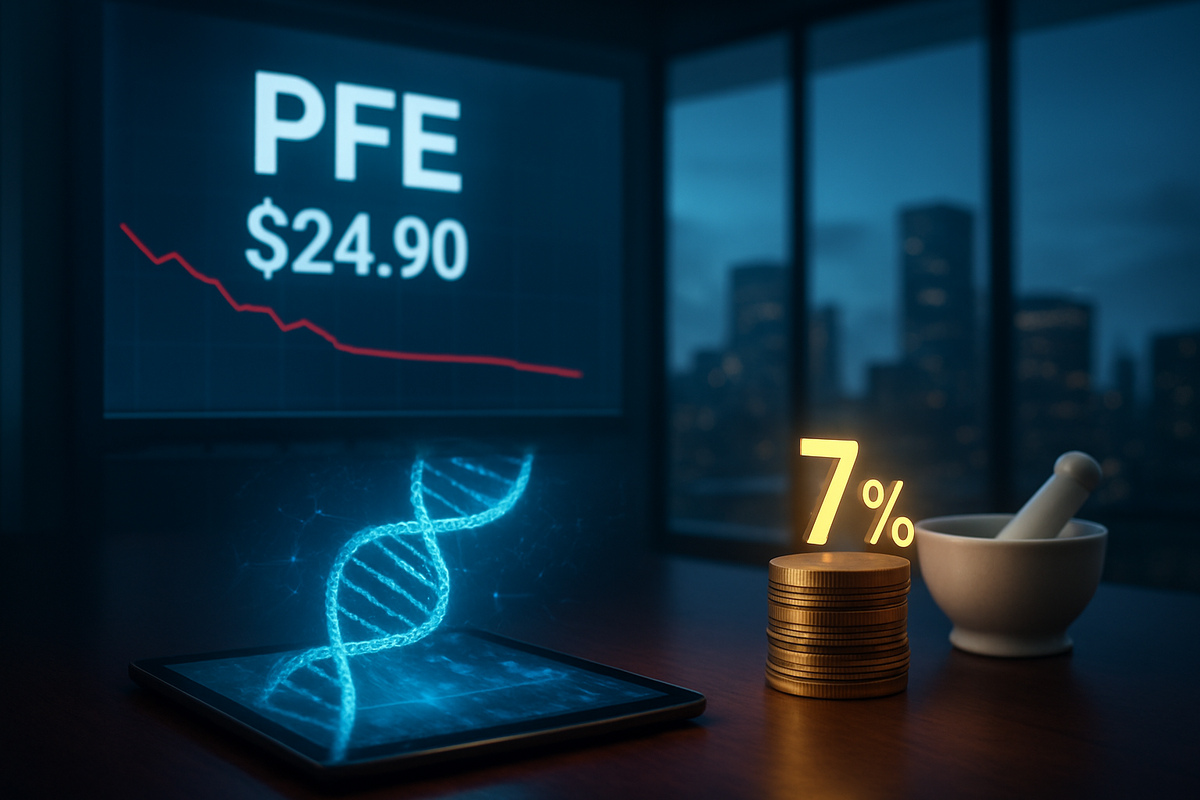
As the calendar turns to January 1, 2026, Pfizer Inc. (NYSE: PFE) finds itself in a position that would have been unthinkable during the height of the pandemic. Once the darling of the pharmaceutical world, the company’s stock ended 2025 at approximately $24.90, marking another year of trading well below the psychological $30 threshold. Despite a massive dividend yield approaching 7% and a series of aggressive multibillion-dollar acquisitions, the market remains skeptical of Pfizer’s ability to replace its dwindling COVID-19 revenue and navigate a looming "patent cliff."
The immediate implications for investors are stark: Pfizer has become a classic "battleground" stock. Value hunters point to a rock-bottom forward price-to-earnings (P/E) ratio of 8.6x and a sustainable dividend as signs of a generational buying opportunity. Conversely, skeptics argue that the company is a value trap, burdened by high debt from its $43 billion acquisition of Seagen and a pipeline that has seen as many high-profile failures as it has successes over the last 24 months.
A Year of "Resets" and Strategic Pivots
The road to Pfizer’s current sub-$30 valuation was paved with significant volatility throughout 2025. Following a disastrous 2024, management spent much of the past year attempting to "reset" investor expectations. In December 2025, Pfizer issued 2026 revenue guidance of $59.5 billion to $62.5 billion, a range that reflects a $1.5 billion headwind from patent expirations and the continued erosion of Comirnaty and Paxlovid sales. While the non-COVID portfolio grew by a respectable 4% operationally in late 2025, it has not yet been enough to offset the vacuum left by the pandemic products.
A key subplot of the past year was the intervention of activist investor Starboard Value LP. The hedge fund took a $1 billion stake in late 2024, pressuring CEO Albert Bourla to accelerate cost-cutting measures and improve R&D productivity. While Starboard failed to secure board seats and eventually exited its position in November 2025, its influence was felt. Pfizer successfully implemented a massive cost-realization program, targeting $7.2 billion in net savings by 2027. This austerity, combined with a narrowed earnings guidance of $3.00 to $3.15 per share for the end of 2025, has helped stabilize the bottom line even as the stock price remains depressed.
The most dramatic shift occurred in Pfizer’s obesity strategy. After the high-profile failure of its once-daily oral drug danuglipron in April 2025 due to safety concerns, Pfizer pivoted aggressively. In November 2025, the company spent approximately $7 billion to acquire Metsera, a move that brought a new suite of GLP-1 candidates into the fold. This acquisition was seen as a "Hail Mary" to remain relevant in a weight-loss market currently dominated by rivals.
The Winners and Losers of the New Pharma Landscape
In the current market environment, the clear winners have been Eli Lilly and Company (NYSE: LLY) and Novo Nordisk A/S (NYSE: NVO). These two titans have effectively cornered the obesity and diabetes market with their respective blockbusters, Zepbound and Wegovy. Pfizer’s struggle to break into this space has resulted in a massive valuation gap; while Lilly trades at premium multiples, Pfizer has been relegated to the bargain bin. However, if Pfizer’s new Metsera-derived candidates, such as the injectable MET-097i, show strong Phase 3 data in 2026, Pfizer could emerge as a "comeback kid" winner, offering a cheaper entry point into the obesity gold rush.
On the losing side of this transition are the legacy COVID-19 manufacturers, including Moderna, Inc. (NASDAQ: MRNA), which has faced similar struggles in diversifying its revenue stream beyond mRNA vaccines. Within Pfizer’s own portfolio, the "losers" are the shareholders who bought in at the 2021 highs. The stock’s technical setup at the start of 2026 is decidedly bearish, with shares trading below their 50-day and 200-day moving averages. Technical analysts point to a "floor" at $23.88, but warn that without a breakout above $27.00, the stock remains in a persistent downtrend.
Shifting Focus: Oncology and the Patent Cliff
Pfizer’s current predicament fits into a broader industry trend known as the "Patent Cliff." Like its peers Merck & Co., Inc. (NYSE: MRK) and Bristol Myers Squibb (NYSE: BMY), Pfizer is facing the loss of exclusivity for several multi-billion dollar drugs, including Eliquis and Ibrance, over the next few years. To combat this, Pfizer has staked its future on oncology. The integration of Seagen has been a bright spot, with the bladder cancer drug Padcev exceeding sales expectations in 2025. Pfizer expects its oncology division to contribute $10 billion in incremental revenue by 2030, a goal that is essential for the company to return to growth.
Historically, pharmaceutical giants have used "M&A binges" to bridge the gap between patent expirations. Pfizer’s recent $43 billion spend on Seagen and $7 billion on Metsera follows this precedent, but it has left the company with a significant debt load. This has forced management to pause share buybacks to prioritize debt reduction and dividend payments. The market is currently punishing Pfizer for this leverage, comparing it unfavorably to more "capital-light" biotech firms that are seeing higher R&D efficiency.
What Lies Ahead: The 2026 Outlook
Looking forward, the short-term trajectory for Pfizer will be dictated by its February 2026 earnings report and the initial clinical readouts from the Metsera pipeline. If the company can prove that its new obesity candidates are competitive in terms of efficacy and side-effect profiles, it could trigger a massive short-covering rally. Conversely, any further delays in the oncology pipeline or a dividend cut—though management insists the payout is safe—would likely send the stock tumbling toward the $20 mark.
The long-term scenario depends on Pfizer’s ability to transform from a "vaccine company" back into a diversified "specialty medicine" powerhouse. Investors should watch for potential strategic pivots, such as the divestiture of non-core consumer health assets or a further narrowing of the R&D focus. The company needs to demonstrate that it can grow its non-COVID revenue at a double-digit clip to regain the market's trust.
Final Assessment: Value or Trap?
As of January 2026, Pfizer is the ultimate test of a value investor's patience. The 7% dividend yield provides a significant "margin of safety" for those willing to wait for a turnaround, and the current payout ratio of 56-58% of adjusted earnings suggests the dividend is more sustainable than the headline GAAP numbers imply. However, the lack of immediate growth catalysts and the technical weakness of the stock suggest that the "trap" remains set for those expecting a quick recovery.
Moving forward, the market will be laser-focused on three things: the debt-to-equity ratio as Pfizer pays down its M&A loans, the Phase 3 progress of the Metsera obesity assets, and the continued commercial success of the Seagen oncology portfolio. For now, Pfizer remains a high-yield utility-like play in a high-growth sector—a paradox that will only be resolved when the company proves it can innovate its way out of the COVID shadow.
This content is intended for informational purposes only and is not financial advice.