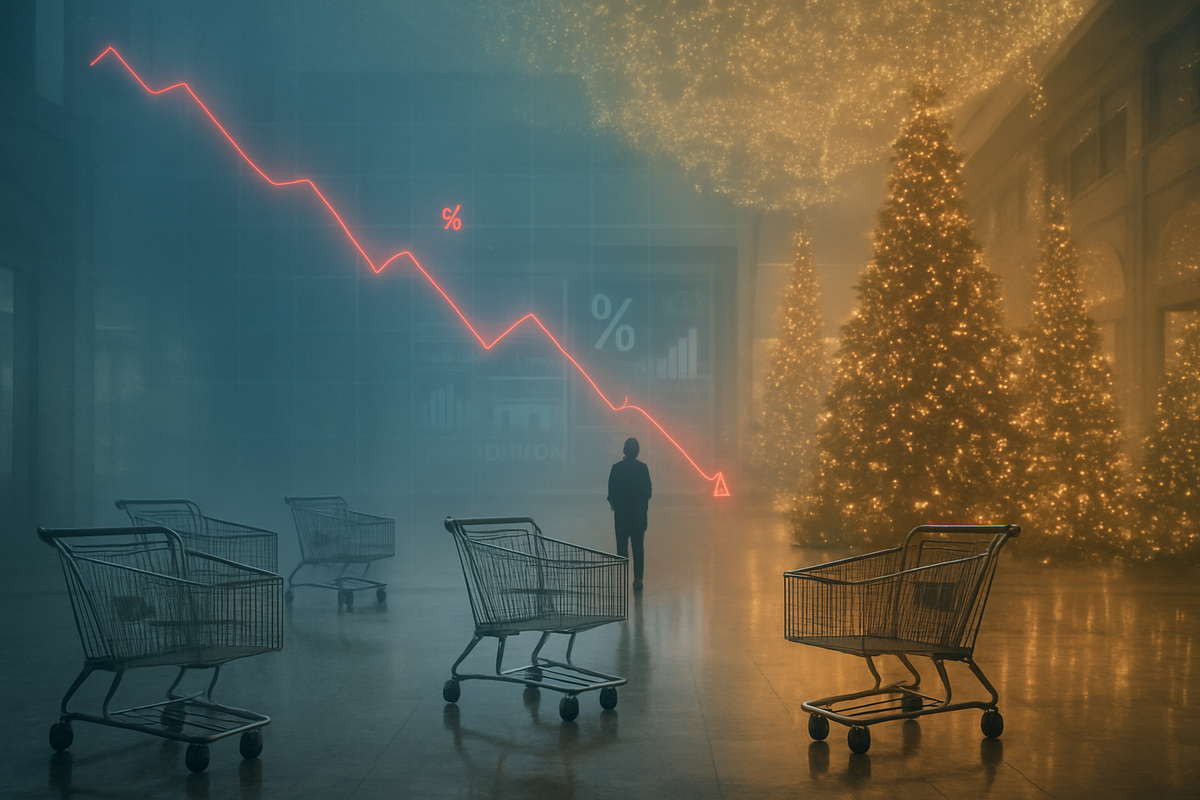
As the calendar turns to January 2, 2026, the euphoria of a record-breaking $1 trillion holiday season has been replaced by a sobering reality. Recent economic reports, delayed by a late-2025 government shutdown, reveal that the headline growth in US consumer spending was largely a product of "sticker shock" inflation rather than genuine demand. While nominal sales hit historic highs, the underlying unit volume tells a different story: a "spending hangover" that suggests the American consumer is finally reaching a breaking point under the weight of persistent inflation and new trade tariffs.
The immediate implications are stark for the retail sector. As households grapple with record-breaking debt and high "Buy Now, Pay Later" (BNPL) balances, the "selective resilience" that defined 2025 is evolving into a broad-based retreat. Market analysts are now bracing for a volatile first quarter as the Federal Reserve’s "sticky" inflation targets and the looming impact of the 2026 tariff schedule force a massive recalibration of growth expectations across the S&P 500.
The Data Blackout and the October Front-Loading
The surprising reduction in spending was masked for months by a 43-day federal government shutdown that lasted from October 1 to November 12, 2025. This "data blackout" left investors and retailers flying blind during the critical lead-up to the holidays. When the Bureau of Economic Analysis (BEA) finally resumed reporting in mid-December, the revised figures showed a significant downward trend. While nominal retail sales grew by 4.2% year-over-year, real inflation-adjusted growth was a meager 2.2%.
The timeline of this slowdown reveals a strategic shift by consumers. In October 2025, there was a massive "front-loading" of purchases as households rushed to buy electronics and durable goods before anticipated tariff-driven price hikes took effect in early 2026. This artificial surge in the fall led to a "Cyber Week Slump," where dollar sales declined by 1.3% and unit volume plummeted by 4.4% compared to the previous year. Key stakeholders, including the National Retail Federation and major logistics providers, have noted that the "spending breather" currently being observed in January is the result of a consumer base that is both tapped out and stocked up.
Retail Winners and Losers: The Great Trade-Down
The spending contraction has created a sharp divide between retail giants capable of capturing value-conscious shoppers and those reliant on discretionary "wants." Walmart Inc. (NYSE: WMT) has emerged as the clear victor of this cycle. By leveraging its "Bettergoods" private-label line and an automated delivery network, Walmart successfully attracted affluent shoppers—those earning over $100,000—who began "trading down" to save on essentials. Walmart’s US online sales surged 28% in the latter half of 2025, cementing its position as the primary beneficiary of the squeeze.
Conversely, Target Corporation (NYSE: TGT) has faced a turbulent period. With a product mix heavily weighted toward discretionary categories like home decor and apparel, Target saw a 1.5% sales dip in the third quarter of 2025. To combat the slowdown, the retailer was forced to slash prices on over 8,000 items, a move that may protect market share but will likely compress margins in the upcoming earnings reports. Similarly, Amazon.com, Inc. (NASDAQ: AMZN) has managed to maintain a 9.1% share of total US retail spending, but its growth is increasingly driven by its high-margin advertising segment rather than direct retail sales, which provided a necessary financial cushion as consumers cut back on non-essential electronics.
A K-Shaped Economy and the Tariff Shadow
This spending reduction fits into a broader trend of "K-shaped" economic performance that has characterized the post-pandemic era. While high-income households remain employed, their shift toward value brands signals a deep-seated anxiety about the future. The Conference Board’s "Expectations Index" remained below the critical recession-warning threshold of 80 for 11 consecutive months ending in December 2025. This is the longest streak of consumer pessimism since the 2008 financial crisis, highlighting a disconnect between low unemployment and high cost-of-living frustrations.
The ripple effects are extending to partners and competitors alike. Logistics firms and manufacturers are seeing a slowdown in replenishment orders as retailers sit on inventory that moved slower than expected in December. Furthermore, the persistent "sticky" inflation—with the Personal Consumption Expenditures (PCE) index remaining at 2.9%—means the Federal Reserve may be hesitant to cut interest rates in early 2026. This "higher-for-longer" environment, combined with the 2026 tariff schedule, creates a double-whammy for retail stocks that rely on global supply chains and low-cost consumer credit.
Looking Ahead: The OBBBA Factor and Q1 Pivots
The short-term outlook for the market depends heavily on the implementation of the "One Big Beautiful Act" (OBBBA), a legislative package passed in late 2025. Expected to inject fresh liquidity into the pockets of middle-class families and seniors starting in February 2026, the OBBBA could provide a much-needed buffer against the current slowdown. However, the immediate challenge for retailers will be the Q4 2025 earnings season, where many are expected to issue conservative guidance for the year ahead.
Market opportunities may emerge in the discount and "off-price" sectors. Companies like Dollar General Corporation (NYSE: DG) and The TJX Companies, Inc. (NYSE: TJX) are positioned to gain as the "spending breather" of January extends into a permanent lifestyle shift for many families. The strategic pivot for 2026 will be "value at scale"—retailers that cannot prove their price-to-utility ratio will likely see continued divestment from institutional investors.
Summary and Investor Outlook
The "surprising" reduction in US consumer spending is a wake-up call for a market that had grown accustomed to resilient demand. The key takeaways are clear: the $1 trillion holiday milestone was an inflationary mirage, and the real economy is cooling faster than nominal data suggests. The combination of high household debt, a 4.2% personal saving rate, and the looming impact of tariffs creates a challenging backdrop for the first half of 2026.
Moving forward, investors should keep a close eye on the January and February CPI prints and the initial rollout of OBBBA benefits. The retail sector is no longer a "rising tide lifts all boats" environment; it is a battle for the "trade-down" dollar. Success will be found in companies with strong balance sheets and the ability to offer value without sacrificing margin, while those tied to the "aspirational" middle-class consumer may face a difficult road to recovery.
This content is intended for informational purposes only and is not financial advice.