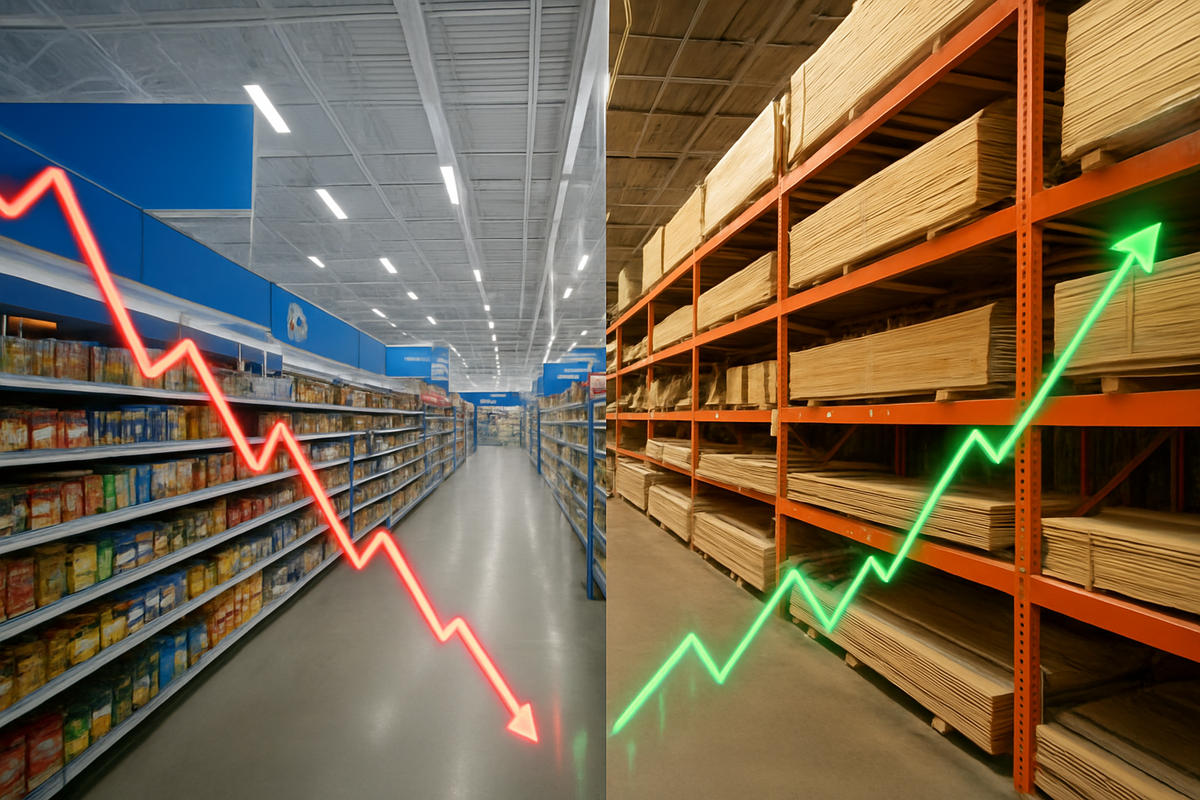
As the financial world braces for the upcoming 2026 fiscal year-end reports, the shadow of last year’s mid-cycle performance continues to loom large over the retail sector. On January 20, 2026, market analysts are still dissecting the "Great Retail Divergence" of early 2025—a pivotal moment when the two largest retailers in the United States, Walmart Inc. (NYSE: WMT) and The Home Depot, Inc. (NYSE: HD), reported surprisingly strong quarterly results that were met with diametrically opposed market reactions.
The divergence highlighted a shifting psychology among investors who have moved past the "inflation-at-all-costs" era into a more nuanced assessment of long-term sustainability. While Walmart delivered a decisive beat on both top and bottom lines for its fourth quarter, its stock plummeted as a result of a cautious forward-looking sales guidance that signaled a potential ceiling for the "trade-down" effect. Conversely, Home Depot, which had been mired in a multi-quarter slump, saw its stock rally on the back of a stabilization narrative, proving that in the eyes of the market, a light at the end of the tunnel is often more valuable than a record-breaking present with an uncertain future.
A Tale of Two Tapes: The February 2025 Reporting Cycle
The events unfolded over a critical five-day window in February 2025. On February 20, Walmart Inc. (NYSE: WMT) released its fourth-quarter fiscal 2025 results, reporting a massive $180.55 billion in revenue—beating analyst estimates of $180.31 billion. The retail behemoth also delivered an adjusted earnings per share (EPS) of $0.66, surpassing the $0.64 consensus. However, the celebration was short-lived. In the accompanying guidance, Walmart projected net sales growth of just 3% to 4% for the upcoming year, a figure that fell short of the 4.2% Wall Street had modeled. Management’s commentary was riddled with caution, citing an "uncertain economic outlook" and potential volatility in consumer spending. The result was a sharp sell-off, with shares dropping nearly 8% in a single session.
Just five days later, on February 25, 2025, The Home Depot, Inc. (NYSE: HD) reported its own Q4 results. The numbers were technically impressive—EPS of $3.13 against a $3.04 estimate—but the real story was in the comparable sales. For the first time in eight quarters, Home Depot reported positive comparable store sales of 0.8%. While the company’s guidance for the next year was also conservative, projecting a 2% dip in annual EPS, investors focused on the "clearing of the decks." The market viewed the conservative outlook as a realistic floor rather than a warning of a new ceiling. Home Depot’s stock jumped 3.6% following the report, as investors bet that the worst of the housing-market-driven contraction was finally in the rearview mirror.
The Ripple Effect: Who Stood to Gain and Who Faced Headwinds
The market’s reaction to these reports sent shockwaves through the broader retail landscape. Target Corporation (NYSE: TGT) found itself in a precarious position, initially falling in sympathy with Walmart. As Walmart signaled that even the king of "low prices" was seeing a slowdown in the "trade-down" demographic—higher-income shoppers seeking value—investors worried that Target’s more discretionary-heavy inventory would suffer even more. However, as the year progressed, Target was forced to pivot its strategy toward essentials, a move that would define its 2025 recovery.
In the home improvement sector, Lowe's Companies, Inc. (NYSE: LOW) was the primary beneficiary of the positive sentiment surrounding Home Depot. If the "home improvement slump" was indeed bottoming out, Lowe’s stood to gain significantly from a renewed DIY interest. The positive reaction to Home Depot’s stabilization provided a "halo effect" for the sector, allowing home-related stocks to decouple from the gloomier projections seen in the general merchandise space. Meanwhile, smaller discount retailers like Dollar General Corporation (NYSE: DG) struggled, as Walmart’s cautious guidance suggested that the extreme budget-conscious consumer was already tapped out, leaving little room for growth in the deep-discount tier.
A New Chapter in Consumer Psychology
The divergent reactions of 2025 fit into a broader trend of "expectation management" that has come to dominate the post-inflationary market. For years, Walmart benefitted from being the primary beneficiary of inflation, as middle- and upper-class consumers migrated toward its value proposition. By February 2025, the market reached a consensus that this "trade-down" tailwind had been fully priced in. When Walmart failed to promise continued explosive growth from this trend, the market punished the stock for its perceived lack of a "next act."
This event mirrors historical precedents such as the retail shifts of 2011, where "big-box" fatigue first began to show in earnings guidance despite strong historical numbers. The 2025 reports also highlighted a critical policy implication: the sensitivity of retail stocks to interest rate projections. Home Depot’s positive reaction was largely driven by a stabilization in the housing market, which was itself a response to the Federal Reserve’s signaling of a more predictable rate environment. This suggests that for capital-intensive sectors like home improvement, the "macro" narrative often outweighs the "micro" quarterly beat.
Looking Ahead: The 2026 Horizon
As we stand in January 2026, the retail sector is awaiting the next round of annual reports with bated breath. The primary question for Walmart is whether its 2025 caution was an act of "under-promising and over-delivering" or a genuine warning of a plateau. Analysts expect Walmart to potentially unveil more aggressive moves into the healthcare and advertising sectors to diversify away from the slowing growth of its core retail business. The acquisition of Vizio, which was integrated throughout 2025, will be a key metric to watch in the upcoming February 2026 report to see if "Walmart Connect" can provide the high-margin growth the market craves.
For Home Depot, the challenge for 2026 is maintaining the momentum of its "turnaround." With the housing market showing signs of a more robust recovery in late 2025, the pressure is on for Home Depot to convert "stabilization" into "growth." Investors will be looking for a return to mid-single-digit comparable sales growth. The risk remains that if interest rates remain "higher for longer" than the market anticipated, the positive sentiment from early 2025 could quickly evaporate, proving that the stock's rally was perhaps premature.
Conclusion: Lessons from the Divergence
The stark contrast between the 2025 earnings of Walmart and Home Depot serves as a masterclass in market sentiment. It demonstrated that a "beat" is only as good as the guidance that follows it. Walmart’s Q4 beat, while technically sound, failed to provide a compelling narrative for the future, leading to a massive capital outflow. Home Depot, conversely, won the day by providing clarity and a sense of "bottoming out," which offered a safer entry point for investors looking for long-term recovery.
Heading into the final stretch of the 2026 fiscal cycle, the key takeaway for investors is the importance of the "guidance-to-valuation" ratio. In a market that has become increasingly skeptical of short-term wins, the ability of a company to map out a clear, resilient path forward is the ultimate driver of stock price. For the months ahead, all eyes will be on whether Walmart can recapture its growth narrative and if Home Depot can sustain its hard-won stability in an ever-shifting economic climate.
This content is intended for informational purposes only and is not financial advice.