VICTOR NYE
Financial Correspondent
February 17, 2026
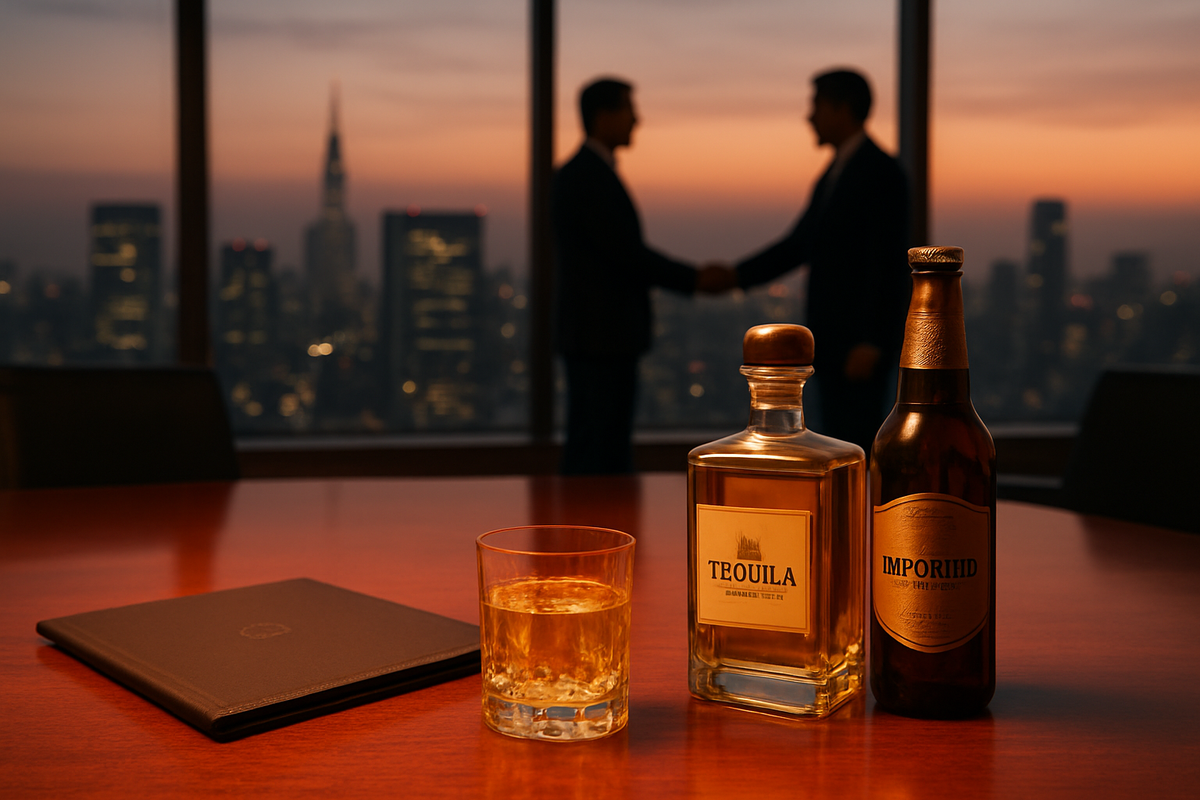
The world of high-end spirits and premium imports is bracing for a tectonic shift as Constellation Brands (NYSE: STZ) enters a critical period of transformation. Just days ago, on February 12, 2026, the beverage powerhouse announced a meticulously planned but sudden leadership succession that will see long-time CEO Bill Newlands step down in favor of incoming chief Nicholas "Nick" Fink. The news sent an immediate tremor through the markets, with Constellation shares tumbling approximately 8% in the 24 hours following the announcement as investors grappled with the departure of the architect behind Modelo Especial's historic rise to the top of the U.S. beer market.
This transition comes at a delicate juncture for the Victor, New York-based company. While the organization has successfully "premiumized" its portfolio—jettisoning lower-margin wine and spirit brands like Svedka and Woodbridge—it now faces a "perfect storm" of macroeconomic headwinds. From newly implemented 25% general tariffs on Mexican imports to a cooling demand among its core Hispanic consumer base, the incoming leadership inherits a crown jewel that is under significant external pressure. The move signals a pivot from the high-growth "Modelo era" to a more disciplined, efficiency-focused strategy designed to navigate a hyper-competitive and volatile global trade environment.
The announced transition, effective April 13, 2026, marks the end of an era for Bill Newlands. Since taking the helm in 2019, Newlands oversaw a period of unprecedented success for Constellation's beer business. Under his watch, Modelo Especial transitioned from a popular import to the #1 selling beer in the United States by dollar sales, capitalizing on the fragmentation of traditional domestic giants. Newlands will remain as a strategic advisor through late 2026 to ensure continuity, but the reins are being handed to a leader with a distinctively different profile.
Nicholas "Nick" Fink, a member of the Constellation Board since 2021 and the former CEO of Fortune Brands Innovations (NYSE: FBIN), is seen by the board as the ideal candidate to navigate the "selective premiumization" trend now dominating the industry. Fink brings a deep pedigree in premium brand building and digital transformation, having spent nearly a decade at Suntory Global Spirits. His appointment was characterized by Board Chair Christopher J. Baldwin as the culmination of a "multi-year, thoughtful planning process" intended to modernize the company's operational footprint.
The leadership shuffle extends beyond the C-suite's top office. In October 2025, the company announced that Jeff LaBarge would take over as Executive VP and Chief Legal Officer on March 1, 2026, following the retirement of Jim Bourdeau. This comprehensive refresh of the inner circle suggests that Constellation is preparing for a legal and strategic landscape that looks very different from the last decade—one dominated by trade disputes, shifting regulatory environments for alternative products, and a aggressive push into high-margin spirits like High West Whiskey and The Prisoner Wine Company.
As Constellation Brands (NYSE: STZ) navigates this internal change, the external environment is creating clear winners and losers across the consumer staples sector. The most immediate threat to Constellation’s dominance is the newly implemented 25% tariff on all Mexican imports, coupled with a 50% tariff on aluminum that took effect in mid-2025. With approximately 41% of its Mexican beer packaging consisting of aluminum cans, analysts estimate an annual hit to operating profits of between $20 million and $90 million. This has created a "valuation gap" that has seen the stock trade significantly lower than its historical multiples.
In contrast, rivals like Anheuser-Busch InBev (NYSE: BUD) are emerging as relative "winners" in the current climate. BUD recently reported a strong fourth quarter for 2025, beating expectations with an EPS of $0.95 and seeing its stock rise 25% year-to-date. By focusing on "mega platforms" like the upcoming 2026 FIFA World Cup and leaning into the recovery of Michelob Ultra, Anheuser-Busch has managed to recapture momentum that it lost during the early 2020s. Similarly, Molson Coors Beverage Company (NYSE: TAP) is positioning its core brands like Coors Light as "premium value" alternatives for consumers who are beginning to baulk at the $18-per-six-pack price point of imported lagers.
The "losers" in this shift appear to be the mainstream, "value-tier" wine and spirit brands that Constellation has spent the last year divesting. The Wine Group, which acquired brands like Woodbridge and SIMI from Constellation in 2025, is now tasked with managing low-margin assets in a market where consumers are increasingly either "trading up" to premium labels or "trading out" to non-alcoholic alternatives. Meanwhile, Sazerac, which purchased Svedka Vodka in late 2024, is facing a saturated vodka market where brand loyalty is at an all-time low.
The leadership change at Constellation is a microcosm of a broader shift within the alcoholic beverage industry: the evolution of "premiumization." For years, the industry mantra was that consumers would always pay more for better quality. However, by early 2026, the market has entered a phase of "selective premiumization." Consumers are still willing to spend, but they are increasingly demanding "tangible justification"—such as specific age statements or artisanal authenticity—for high price tags.
This has led to the "Modelo Paradox." While brands like Pacifico are seeing 15% growth, flagship imports like Corona Extra have seen depletion rates drop as much as 9% in some regions. This reflects a "bifurcated economy" where high-income resilience is offset by a pronounced pullback from middle- and low-income demographics. Constellation has noted a significant decline in "trip frequency" among Hispanic consumers, a core pillar of their business, driven by both socioeconomic pressures and a changing social climate that has reduced large-scale gatherings.
Furthermore, the rise of the "sober-curious" movement has forced a major pivot. Non-alcoholic (NA) beer sales grew by over 22% in 2025, and every major brewer has been forced to launch "0.0" versions of their flagships. Constellation’s focus on high-ABV spirits and premium imports leaves them somewhat exposed to this trend, though their involvement in the Ready-to-Drink (RTD) category—which now accounts for 12.5% of total U.S. alcohol dollar sales—provides a vital hedge.
In the short term, Nick Fink’s primary challenge will be stabilizing investor sentiment and mitigating the impact of the "Mexico-U.S. trade friction." The market will be watching closely for any signals that Constellation might seek to diversify its production footprint away from Mexico, although the massive $1 billion capital expenditure commitment for the Veracruz brewery suggests the company is doubling down on its current model.
The long-term outlook, however, remains cautiously optimistic. The 2026 FIFA World Cup, hosted across North America, is expected to provide a massive "on-premise" consumption boost during the summer months. This global event represents a critical opportunity for Fink to re-assert Modelo and Pacifico's dominance in stadiums and bars across the country. Additionally, analysts from TD Cowen and Deutsche Bank note that despite the recent stock dip, the consensus price targets for STZ remain around $183–$185, suggesting that the "value gap" created by the recent sell-off may represent a buying opportunity for those who believe in the company’s long-term "premiumization" thesis.
Strategic pivots may also include a deeper dive into the "Functional Alcohol" space—low-carb, low-calorie, and botanical-infused options—to counter the decline in traditional craft categories. Fink’s background in digital transformation at Fortune Brands Innovations (NYSE: FBIN) will likely lead to a more aggressive direct-to-consumer and e-commerce strategy, areas where the alcohol industry has traditionally lagged behind other consumer staple sectors.
The leadership transition at Constellation Brands (NYSE: STZ) marks a definitive end to the high-growth "Newlands era" and the beginning of a more complex, disciplined chapter under Nick Fink. While the immediate market reaction was negative, the move reflects a proactive attempt by the board to prepare for a "reset year" in the consumer staples sector.
Key takeaways for investors include:
- Succession Clarity: The transition is structured and planned, with Bill Newlands remaining as a consultant through 2026.
- Macro Sensitivity: Constellation is more exposed to Mexican trade policy and aluminum tariffs than its domestic-heavy competitors.
- Portfolio Purity: The company is now a "pure play" on premium beverage brands, having successfully shed its low-margin assets.
- Market Watching: Investors should keep a close eye on Q2 2026 earnings for signs of "depletion rate" stabilization and any updates on the Veracruz brewery's operational timeline.
As the "Year of Celebration" kicks off with the 250th anniversary of the U.S. and the World Cup, the coming months will test whether Constellation’s "premium-only" bet can withstand the pressures of a changing global economy. For now, the "Alcohol Giant" remains a dominant, if currently embattled, force in the market.
This content is intended for informational purposes only and is not financial advice.