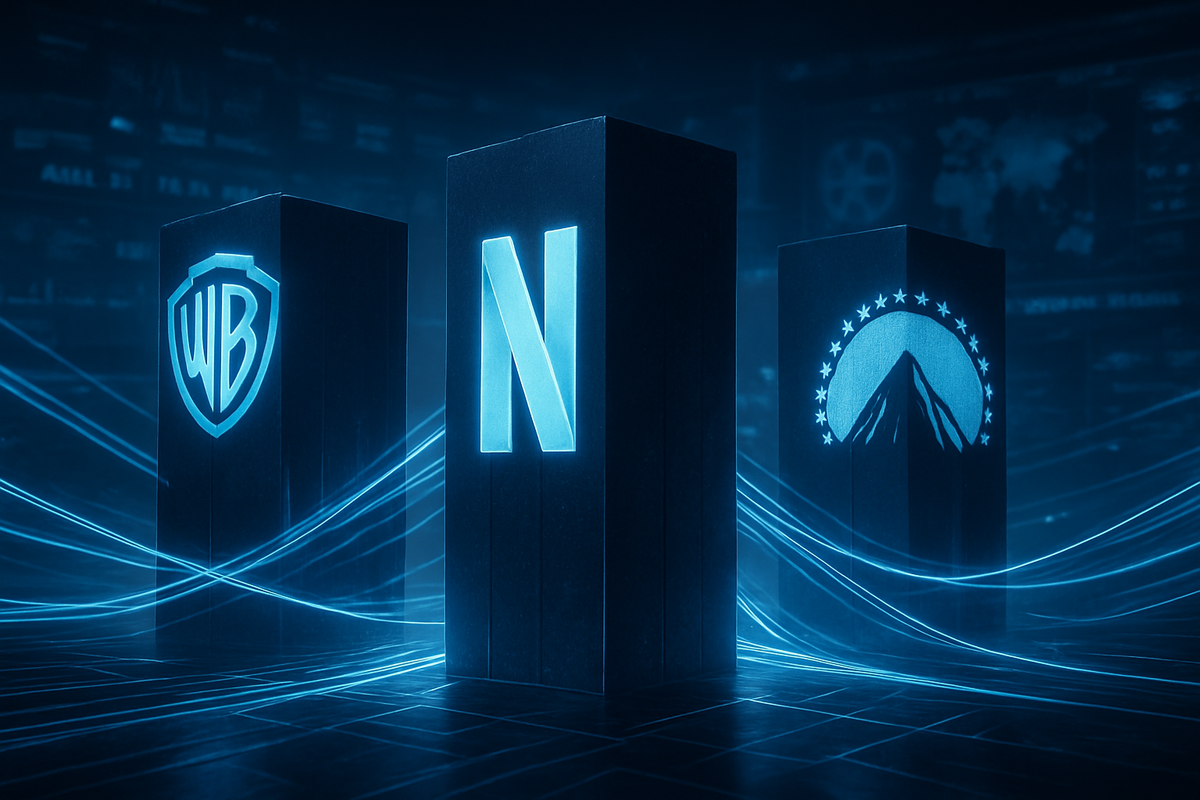
In a move that has sent shockwaves through the global media landscape, Warner Bros. Discovery (NASDAQ: WBD) confirmed late yesterday, February 16, 2026, that it has officially reopened its doors to competing acquisition offers. The decision follows weeks of mounting pressure from shareholders and a lucrative, yet controversial, hostile takeover bid from the newly merged Paramount Global (NASDAQ: PARA) and Skydance Media. This pivot marks a dramatic shift for WBD, which had previously signaled its commitment to a split-asset merger with streaming giant Netflix (NASDAQ: NFLX).
The immediate implications for the market are profound. As of early trading on February 17, WBD shares have seen a significant uptick, reflecting investor optimism over a potential bidding war that could drive the company’s valuation to heights not seen since the original 2022 merger. For the broader media sector, this reopening of negotiations signals that the era of aggressive consolidation is far from over, as traditional content powerhouses struggle to reach the necessary scale to survive in an increasingly tech-dominated entertainment ecosystem.
High-Stakes Negotiations and the Seven-Day Window
The current fervor follows a pivotal board meeting held on February 16, 2026, where WBD leadership decided to grant Paramount Global CEO David Ellison a strictly defined 7-day "window of opportunity" to present a "best and final" offer for the entire company. This move effectively pauses the momentum of the $82.7 billion deal previously struck with Netflix in late 2025. That initial agreement would have seen Netflix acquire WBD’s "growth" pillars—Warner Bros. Film and TV Studios, DC Studios, and the Max streaming platform—while spinning off the company's legacy cable networks, including CNN and Discovery, into a standalone entity tentatively titled "Discovery Global."
The timeline leading to this moment has been defined by WBD’s aggressive financial recovery. Under the leadership of CEO David Zaslav, the company transformed itself into what analysts called a "deleveraging machine," successfully hacking its mountain of debt down from over $55 billion in 2022 to approximately $33.5 billion by the third quarter of 2025. This improved balance sheet made WBD the industry’s most attractive "belle of the ball" by early 2026. However, the proposed Netflix deal faced internal and external criticism for "abandoning" the linear networks, prompting Paramount to jump in with a $108.4 billion hostile bid for the whole enterprise, offering $31 per share and promising to keep the company’s storied assets unified.
The industry reaction has been a mix of exhilaration and uncertainty. While WBD’s board continues to officially recommend the Netflix deal for its strategic focus on digital growth, the opening of talks with Paramount suggests a "value realization" phase where Zaslav and his board are obligated to explore the highest possible return for shareholders. This 7-day window, expiring on February 23, 2026, has effectively put the entire media world on high alert, with many wondering if a third party might yet emerge to disrupt the proceedings.
Winners, Losers, and the Future of Content Libraries
In this high-stakes game of corporate chess, the potential winners and losers are starkly defined. Warner Bros. Discovery shareholders appear to be the most immediate victors; the competitive tension between Netflix and Paramount is likely to extract a premium price that seemed unlikely just a year ago. If Paramount succeeds, David Ellison emerges as a dominant force in Hollywood, controlling a combined library that spans from "Star Trek" and "Mission: Impossible" to "Harry Potter" and "The Dark Knight." This would solidify Paramount as a true peer to The Walt Disney Company (NYSE: DIS) in terms of intellectual property (IP) breadth.
Conversely, Netflix faces a significant strategic setback if its deal collapses. For Netflix, acquiring the Warner Bros. library was seen as the ultimate "moat" against the growing sports and live-event dominance of other platforms. Losing this deal would force Netflix to return to its expensive strategy of internal content production or seek out other, arguably less prestigious, studio partners. Meanwhile, the employees and stakeholders of the legacy cable assets find themselves in a state of limbo. Under the Netflix plan, they would be relegated to "Discovery Global," a company many fear would be managed for cash flow decline rather than growth. A Paramount win might save the unified structure but would likely lead to massive "synergy" layoffs as the two companies' back-office operations and news divisions are integrated.
Other potential losers include smaller, independent streaming services that lack the capital to compete in this new tier of "mega-giants." Companies like Comcast (NASDAQ: CMCSA), which had previously floated its own merger proposals for its NBCUniversal division, may find themselves shut out of the top tier of content owners if the WBD-Paramount or WBD-Netflix deals finalize. Comcast now faces the pressure to either significantly overbid or find a new way to scale its Peacock service in a world where its primary rivals have suddenly doubled in size.
A Fundamental Shift in the Media Landscape
The significance of these negotiations extends far beyond the boardrooms of New York and Los Angeles; it represents a fundamental restructuring of the global media economy. This event fits perfectly into the "SpinCo/RemainCo" trend of 2025-2026, where legacy media companies are desperate to separate their declining but cash-heavy linear television businesses from their high-growth digital futures. WBD's dilemma—whether to split the company for a tech giant (Netflix) or stay whole for a media rival (Paramount)—is a microcosm of the entire industry's struggle to find a sustainable business model in the post-cable era.
The regulatory implications are equally massive. A Netflix-WBD merger would be a landmark case for the Department of Justice, testing whether a dominant distribution platform (Netflix) can also own one of the world's most storied content engines without violating antitrust principles. Paramount’s bid is strategically framed as the "safer" choice for regulators because it maintains the traditional "Content-to-Consumer" studio model. However, any deal of this magnitude will face intense scrutiny regarding its impact on the theatrical exhibition market and the diversity of news voices, particularly with the potential consolidation of CNN and CBS News assets.
Furthermore, this bidding war highlights the role of "sharks in the water" like Apple (NASDAQ: AAPL) and Amazon (NASDAQ: AMZN). While they have not made formal bids, their presence as potential "white knights" or cherry-pickers of specific IP has forced the primary bidders to move faster and offer more. The historical precedent here is the 2019 Disney-Fox merger, but on a much more complex scale, involving the integration of AI-driven content discovery and the global dominance of tech-heavy ecosystems.
Strategic Pivots and the Road to 2027
Looking ahead, the next seven days will be the most critical in Warner Bros. Discovery’s short history. If Paramount delivers a "superior offer" by February 23, the WBD board will be legally and fiduciary-bound to pivot away from Netflix. This would likely lead to a formal merger agreement by March 2026, followed by a grueling 12-to-18-month regulatory review. In the short term, WBD must maintain its operational momentum while managing the internal anxieties of its global workforce, who are effectively waiting to find out who their next boss will be.
Alternatively, if Paramount fails to sweeten the pot, WBD will likely proceed with the Netflix deal and the "Discovery Global" spinoff. This scenario would require a massive strategic pivot, as the company would essentially be reinventing itself as a pure-play content and streaming service while offloading its traditional cash-cow networks. Market participants should also keep a close watch on Alphabet (NASDAQ: GOOGL), which has remained surprisingly quiet. Some analysts speculate that Google could enter the fray at the eleventh hour, not to buy the company, but to secure exclusive licensing or AI-training rights for WBD’s massive library of human-generated scripts and footage.
Final Assessment: A Winner-Takes-All Market
To summarize, the reopening of takeover discussions at Warner Bros. Discovery is the climax of a multi-year effort to stabilize the company and realize its true market value. Whether WBD chooses the path of disaggregation with Netflix or total consolidation with Paramount, the outcome will permanently alter the competitive landscape. For investors, the takeaway is clear: the media sector has moved from a period of "surviving the transition" to a "winner-takes-all" consolidation phase. Scale is no longer just an advantage; it is a requirement for survival.
Moving forward, the market will be watching the February 23 deadline with bated breath. Beyond the price tag, the specifics of the deal—particularly the fate of the linear networks and the strategy for the Max streaming service—will determine the long-term viability of the surviving entity. Investors should remain cautious of the regulatory hurdles that could stall any final agreement well into 2027. Ultimately, the battle for Warner Bros. Discovery is a battle for the soul of Hollywood in the digital age, and the winner will hold the keys to some of the most influential cultural assets in history.
This content is intended for informational purposes only and is not financial advice.