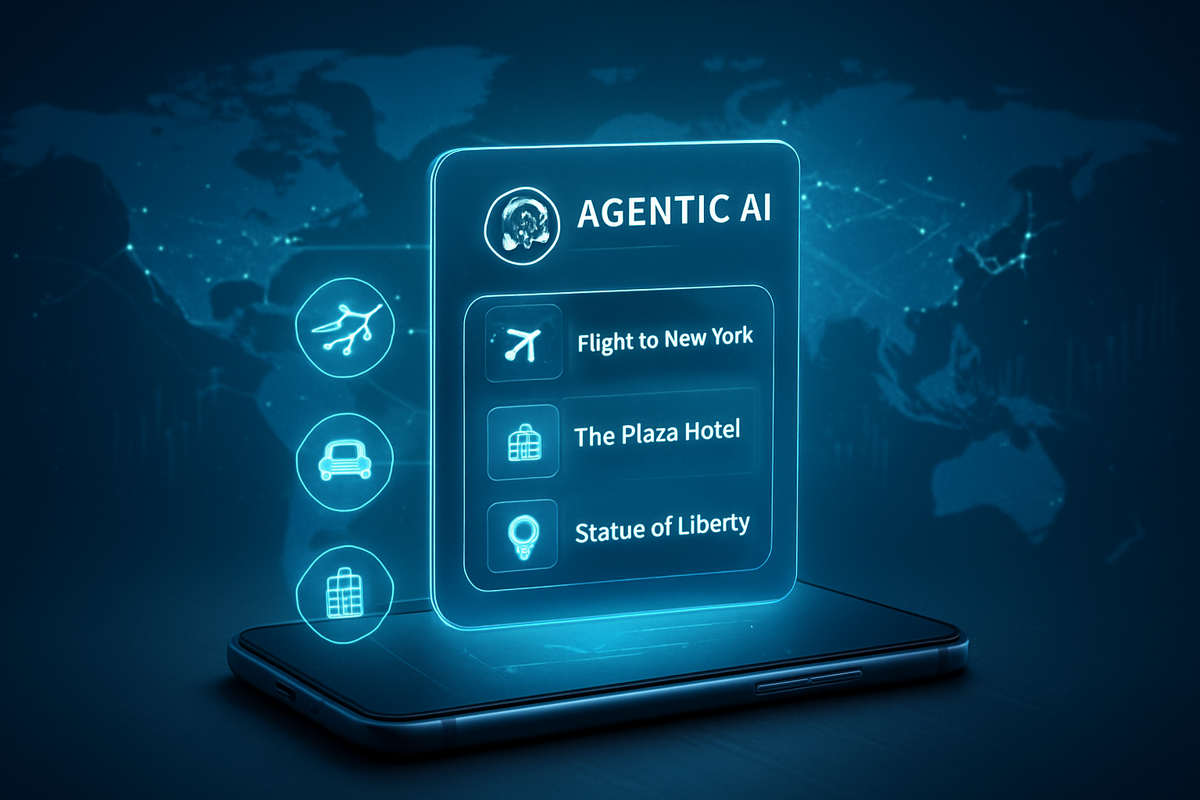
NORWALK, CT — February 18, 2026 — Booking Holdings Inc. (NASDAQ: BKNG) reported its fourth-quarter and full-year 2025 financial results today, delivering a performance that underscores the widening gap between global travel giants and their regional competitors. As the travel industry grapples with a "normalization" of demand following the post-pandemic boom, Booking Holdings is betting its future on a pivot from simple search-and-book functionality to "Agentic AI"—autonomous systems capable of managing entire trips without human intervention.
The report comes at a volatile moment for travel equities. Just last week, a "technical correction" swept through the sector, fueled by fears that AI agents from big tech firms like Google and OpenAI might bypass traditional online travel agencies (OTAs) altogether. However, Booking’s Q4 numbers suggest that the company’s massive scale and its "Connected Trip" strategy are providing a defensive moat, even as U.S. domestic demand shows signs of cooling.
Efficiency and the 'Connected Trip' Drive Q4 Results
For the quarter ending December 31, 2025, Booking Holdings reported revenue of $6.12 billion, an 11.5% increase year-over-year, narrowly beating analyst expectations of $6.11 billion. Non-GAAP earnings per share (EPS) came in at $48.55, comfortably within the anticipated range of $48.23 to $48.69. Gross bookings reached a staggering $41.9 billion, driven largely by strong performance in the Asia-Pacific region and Europe, which helped offset a sluggish U.S. market.
The company is currently in the middle of a massive $400 million efficiency program, first announced in late 2024. Management confirmed today that roughly $150 million in savings was realized in 2025 through workforce optimizations and the consolidation of back-end technologies across its brands, including Booking.com, Priceline, and Agoda. These savings are being aggressively reinvested into the "Connected Trip" vision—a seamless ecosystem where flights, car rentals, and accommodations are bundled and managed by a single AI interface. Notably, flight bookings saw a 38% year-over-year surge, signaling that Booking is successfully evolving beyond its hotel-only roots.
Winners and Losers in the 2026 Travel Landscape
The early 2026 earnings season has created a clear divide between the "haves" and "have-nots" of the travel world. Airbnb, Inc. (NASDAQ: ABNB) has emerged as a significant winner, with its stock rising 8% this month after reporting robust demand for its "premium" unique listings, which appear more insulated from the AI-driven search disruption affecting generic hotel platforms. Similarly, Marriott International, Inc. (NASDAQ: MAR) and Hilton Worldwide Holdings Inc. (NYSE: HLT) have seen their shares climb to record highs as they successfully drive more "direct-to-brand" bookings, bypassing OTA commissions.
On the other side of the ledger, Expedia Group, Inc. (NASDAQ: EXPE) has struggled, with its stock tumbling nearly 10% following its February 12 report. Expedia’s heavy reliance on the U.S. domestic market—which is currently facing a "K-shaped" recovery where budget travelers are pulling back—has made it more vulnerable than the internationally diversified Booking Holdings. Analysts note that while Booking is successfully pivoting to the "Merchant Model" (taking payments directly), Expedia is still navigating the headwinds of a stagnant U.S. lodging market and rising customer acquisition costs.
The Shift to Agentic AI and Geopolitical Headwinds
The wider significance of this earnings report lies in the industry's rapid transition from "Generative AI"—which simply helps plan trips—to "Agentic AI." Booking Holdings CEO Glenn Fogel highlighted the new "Autonomous Rebooking" feature, which can proactively move a traveler to a new flight or hotel during a disruption without the user ever opening the app. This shift is seen as a direct response to the threat of disintermediation by AI-native platforms. By becoming the "agent" themselves, OTAs hope to remain the primary gatekeeper of the traveler’s wallet.
However, the industry is also contending with significant geopolitical shifts. The "Trump Slump" in U.S. inbound tourism—a term coined by analysts to describe the 6% decline in foreign visits to the U.S. following 2025 policy changes—has created a drag on domestic performance. Canadian travel to the U.S. has particularly plummeted, down nearly 30% due to trade-related currency swings. For companies like Booking Holdings, their strength in the Asia-Pacific region, led by the Agoda brand, has become a critical hedge against these North American headwinds.
What Lies Ahead: The 2026 World Cup and Beyond
Looking forward, the travel industry is banking on the June 2026 FIFA World Cup to provide a significant boost to North American RevPAR (Revenue Per Available Room). Booking Holdings has already noted a "material uptick" in advanced bookings for host cities. However, the company gave a cautious outlook for the first half of 2026, citing "value-conscious" consumer behavior. Travelers are increasingly opting for shorter stays and "trading down" in accommodation classes, which may pressure margins if the $400 million cost-saving measures do not hit their targets.
Strategically, the market will be watching to see if Booking's pivot to a payment-based merchant model—expected to account for 68% of bookings in 2026—will continue to improve customer loyalty. The goal is to lock users into the "Booking.com ecosystem" before Google or OpenAI can offer a more integrated alternative. The next six months will be a test of whether AI is a tool that enhances the OTA moat or a force that eventually dries it up.
The Bottom Line for Investors
In summary, Booking Holdings' Q4 2025 results show a company that is successfully navigating a complex and cooling global market. Key takeaways include the resilience of international demand, the success of the "Connected Trip" cross-selling strategy, and the critical importance of AI-driven operational efficiencies. While the "AI Scare Trade" has introduced new volatility, Booking's scale and data advantages remain its strongest defense.
For investors, the coming months will require a close eye on U.S. consumer confidence and the progress of "Agentic AI" rollouts. As the travel sector moves toward a more automated future, the companies that own the relationship with the traveler—and the data that fuels it—will be the ones to watch. Booking Holdings appears to be leading that charge, but the competition from both traditional hotel chains and new AI gatekeepers has never been more intense.
This content is intended for informational purposes only and is not financial advice.