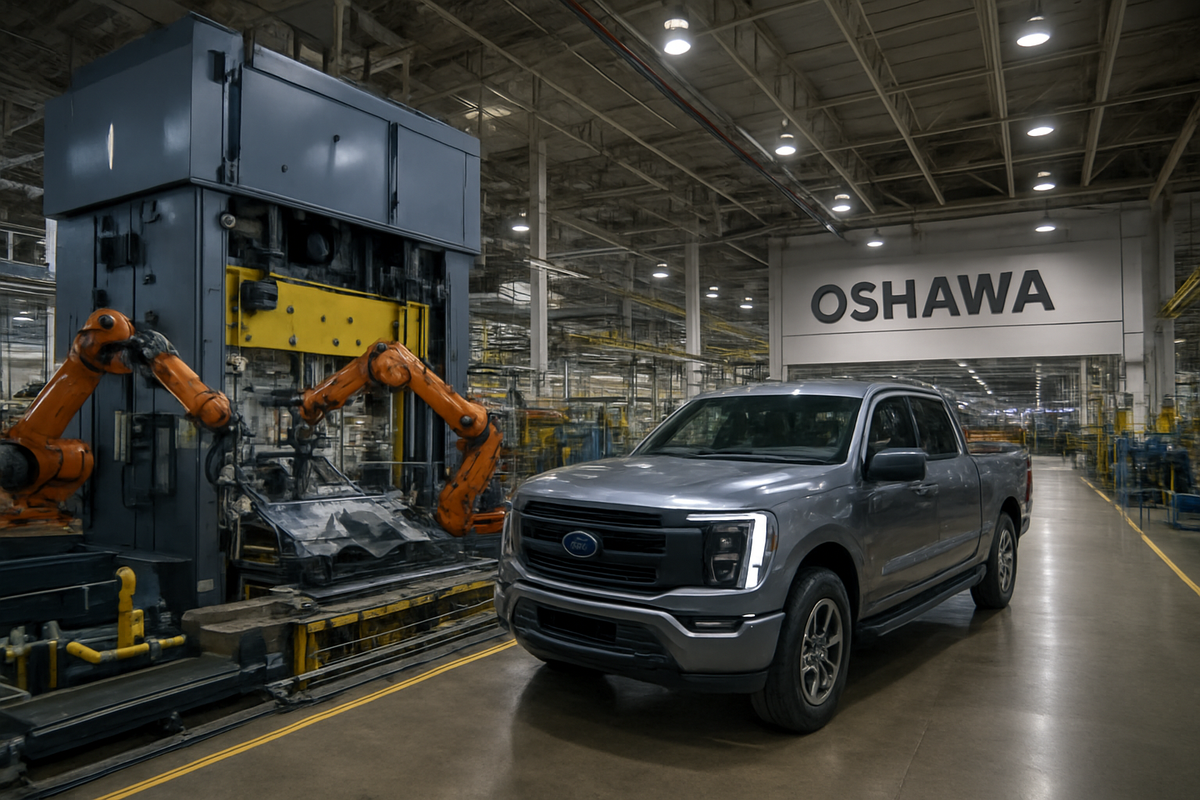
OSHAWA, ONTARIO – In a move that signals a strategic "doubling down" on its most profitable vehicle segments, General Motors (NYSE: GM) officially announced a $63 million (CAD) investment in its Oshawa Assembly plant today, February 18, 2026. The capital injection is earmarked for upgrading the facility’s stamping operations, specifically to prepare for the production of the next generation of gas-powered full-size pickups. This announcement comes at a critical juncture for the automaker as it navigates a cooling electric vehicle (EV) market and increasing trade friction across the North American border.
The investment serves as a major vote of confidence for the Canadian manufacturing sector, which has faced a tumultuous start to 2026. By modernizing the Oshawa plant's ability to produce complex body components and service parts, GM is ensuring that its "truck hub" remains the centerpiece of its North American production strategy. For the local economy and the thousands of workers represented by the Unifor union, the news provides a necessary boost following recent concerns over shift reductions and the long-term viability of internal combustion engine (ICE) manufacturing.
A Legacy of Resilience: Inside the $63 Million Blueprint
The $63 million investment announced today is not an isolated event but the latest chapter in one of the most remarkable turnarounds in automotive history. Just seven years ago, the Oshawa plant was silenced, ending over a century of vehicle assembly and leaving thousands unemployed. However, after a hard-fought battle by Unifor and significant incentives from the Canadian and Ontario governments, the plant was resurrected in late 2021. Today’s funding brings GM’s total capital commitment to the Oshawa facility to approximately $1.5 billion since its reopening, solidifying its status as the only GM plant capable of producing both heavy-duty and light-duty Chevrolet Silverados on a single line.
The timing of this announcement is particularly poignant. In late January 2026, GM was forced to eliminate the third shift at the Oshawa plant, a decision the company attributed to shifting North American trade dynamics and newly imposed U.S. tariffs on Canadian-made automotive components. Today’s investment suggests that while production volume may fluctuate due to macro-economic headwinds, the underlying infrastructure is being primed for the next decade of ICE dominance. Key stakeholders, including GM Canada President and Unifor National President Lana Payne, emphasized that the new stamping equipment will allow for greater vertical integration and faster turnaround times for the highly profitable Silverado and Sierra lines.
Winners and Losers in the ICE Resurgence
The primary beneficiary of today’s announcement is undoubtedly General Motors (NYSE: GM) itself. By investing in the "next generation" of gas-powered trucks, GM is acknowledging a market reality that many analysts ignored two years ago: demand for high-towing, long-range internal combustion trucks remains insatiable, even as EV growth plateaus. This "follow the money" strategy allows GM to use the massive margins generated by Oshawa-built trucks to fund its eventual transition to a zero-emission future, which has proven more capital-intensive and slower to scale than originally projected.
Regional suppliers are also poised for a significant win. Magna International (NYSE: MGA), which provides frames, seating, and advanced electronics for the Silverado, stands to benefit from the plant's upgraded stamping capabilities. Similarly, Ontario-based Linamar Corporation (TSX: LNR) and Martinrea International (TSX: MRE) are expected to see sustained demand for powertrain and structural components as GM prepares for its new engine programs. Conversely, the "losers" in this scenario may be the pure-play EV startups and competitors who over-leveraged themselves into an all-electric future. Companies that neglected their ICE portfolios are now finding themselves at a disadvantage as consumers retreat toward the reliability and infrastructure of traditional gasoline and hybrid platforms.
A Strategic Pivot Amidst Global Uncertainty
This $63 million move fits into a broader industry trend of "EV retrenchment." Over the last six months leading into early 2026, GM has taken nearly $9 billion in financial charges related to scaling back its EV capacity and delaying several battery-electric launches. The investment in Oshawa confirms that GM, like several of its peers including Ford (NYSE: F) and Stellantis (NYSE: STLA), is shifting its focus toward a "balanced" portfolio. The resurgence of the V8 engine and the integration of hybrid technology into the truck lineup are now seen as necessary bridges to keep the company profitable through the late 2020s.
Furthermore, the investment highlights the ongoing complexity of the USMCA (United States-Mexico-Canada Agreement) framework. As trade protectionism rises, GM’s decision to keep its high-margin truck production in Canada—despite tariffs—suggests that the integrated supply chain of the Great Lakes region remains too valuable to abandon. The Canadian government’s continued support of these "traditional" manufacturing hubs also signals a pragmatic policy shift, recognizing that while green energy is the goal, the tax revenue and jobs provided by ICE manufacturing are currently irreplaceable.
The Road Ahead: What to Watch Next
In the short term, investors should monitor how quickly the new stamping equipment can be integrated without disrupting current production schedules. The "next-gen" truck platform is expected to debut in late 2027 or early 2028, meaning the work starting today is foundational for GM's competitiveness for the next ten years. A major question remains whether GM will eventually restore the third shift in Oshawa, or if the $63 million investment is aimed more at automation and efficiency than at increasing the total headcount.
Long-term, the Oshawa facility is a bellwether for the entire North American auto industry. If GM can successfully navigate the current "trade war" environment and maintain the profitability of its ICE trucks, Oshawa will remain a crown jewel in its manufacturing crown. However, if U.S. protectionism intensifies, GM may be forced to make a difficult choice between its Canadian legacy and its largest market south of the border. Market observers will also be watching for any signs of a hybrid Silverado variant, which would represent a middle-ground strategy between the current gas-powered models and the Silverado EV.
Closing Thoughts for Investors
General Motors’ $63 million investment in Oshawa is a calculated bet on the enduring power of the American pickup truck. By focusing on stamping operations and next-gen ICE platforms, GM is shoring up its cash reserves during a period of intense technological and geopolitical volatility. The move underscores a fundamental shift in the industry: the "EV-or-bust" era has transitioned into an "EV-and-ICE" era, where flexibility and profitability are the new benchmarks of success.
For investors, the key takeaways are GM’s commitment to its most profitable products and its willingness to invest in "traditional" hubs despite trade headwinds. While the $63 million figure is small compared to the billions spent on battery plants, its strategic value is outsized. Moving forward, the market should keep a close eye on GM's quarterly earnings to see if the margins from these Oshawa-built trucks continue to provide the "shield" necessary for the company to survive the ongoing transformation of the global automotive landscape.
This content is intended for informational purposes only and is not financial advice.