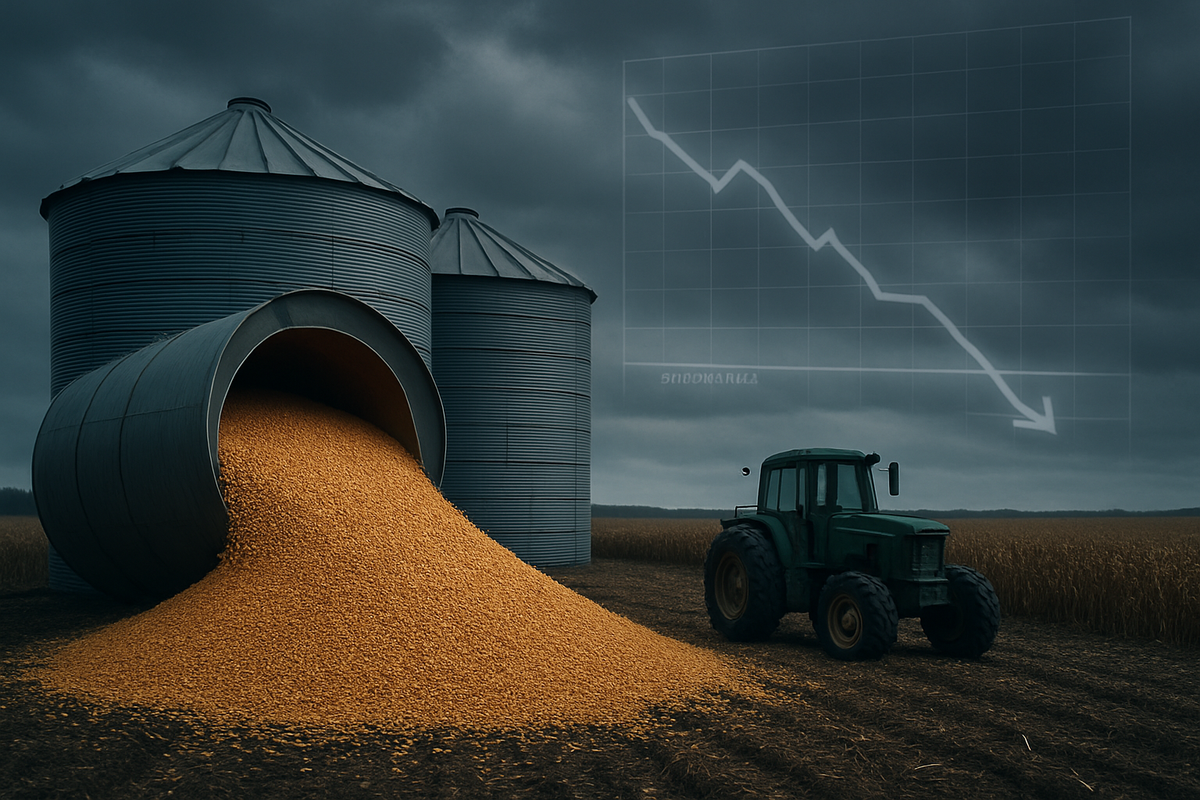
The global agricultural landscape has shifted into a definitive bear market as of early 2026, following a record-shattering 2025 harvest that has left elevators and silos overflowing across the American Heartland. A series of "jaw-dropping" reports from the U.S. Department of Agriculture (USDA) have effectively dismantled any remaining bullish sentiment, confirming that the "supply avalanche" from last year is now weighing heavily on future price projections. As of February 18, 2026, the market is grappling with a reality where grain prices are trending dangerously close to, or even below, the cost of production for many family farms.
The immediate implications are a stark reversal of the high-commodity-price era seen earlier in the decade. With corn and wheat ending stocks reaching nine-year highs, the leverage has shifted entirely from producers to end-users and processors. Farmers are entering the 2026 planting season with a sense of trepidation, as futures markets signal that profitability will remain elusive unless there is a significant weather-driven supply disruption or a major shift in global trade policy.
A "Monster Harvest" and the Collapse of the Bull Narrative
The current market malaise traces back to the 2025 growing season, which analysts have dubbed the "Monster Harvest." According to the January 2026 WASDE (World Agricultural Supply and Demand Estimates) report, U.S. corn production hit a record 17.02 billion bushels, fueled by a national average yield of nearly 188.8 bushels per acre. These figures, described by industry veterans as "jaw-dropping," caught the market off-guard, as many had expected late-season heat to curb productivity. Instead, the final tallies revealed a supply overhang that has fundamentally reset the price floor.
The USDA Agricultural Outlook Forum, held just days ago on February 15–16, 2026, solidified this bearish outlook. The agency projected December 2026 corn futures to settle around $4.64 per bushel, while wheat is expected to hover near $5.48 per bushel. These prices represent a significant decline from the peaks of the previous three years and, more importantly, are hovering near or below the breakeven costs for most Midwestern producers. In high-productivity regions like Central Illinois, total costs—including land rent—are estimated to exceed $1,100 per acre for corn, meaning a farmer would need a yield of 240 bushels per acre just to break even at $4.64.
The timeline of this collapse accelerated in the fourth quarter of 2025, as it became clear that global competitors were also contributing to the glut. Argentina reported a record 27.8 million metric ton wheat crop, while Brazilian soybean production continued to expand despite early-season weather concerns. This convergence of global supply has left the U.S. with an estimated corn carryover of 2.26 billion bushels for the 2025/26 marketing year, the highest since 2017.
Winners and Losers in the Grain Glut
The current pricing environment is creating a sharp divide between those who sell grains and those who buy them. Major agricultural equipment manufacturers like John Deere (NYSE: DE) and CNH Industrial (NYSE: CNH) are among the most visible casualties. John Deere recently lowered its 2026 net income forecast to a range of $4.0 billion to $4.75 billion, a significant drop from previous analyst expectations, as farmers defer large capital investments to preserve cash. CEO John May noted that 2026 likely represents the "bottom of the large ag cycle," reflecting a steep decline in tractor and combine sales.
Conversely, meat and food processors are finding a silver lining in the lower input costs. Tyson Foods (NYSE: TSN) is seeing a significant boost in its chicken segment, which benefits directly from the lower cost of corn and soybean meal used for feed. While Tyson's beef segment continues to struggle with tight cattle supplies, the poultry division is expected to lead the company's profitability in 2026. Similarly, food giants like Mondelez International (NASDAQ: MDLZ) and General Mills (NYSE: GIS) are benefiting from lower ingredient costs, allowing them to potentially expand margins or stabilize consumer prices after years of inflation.
For the major grain merchants and crushers, the outlook is more nuanced. Archer Daniels Midland (NYSE: ADM) and Bunge Global (NYSE: BG) are handling record volumes of grain, which keeps their logistics networks busy. However, both companies have issued 2026 guidance below Wall Street estimates, as the glut has squeezed processing margins and reduced the volatility they typically profit from. Furthermore, fertilizer giants such as Nutrien (NYSE: NTR) and The Mosaic Company (NYSE: MOS) are facing a demand slump; as farmer margins turn negative, the first items cut from the budget are often premium fertilizers and soil amendments.
Broader Industry Trends and Regulatory Headwinds
The current situation is not happening in a vacuum; it marks the end of the post-pandemic commodity boom and a return to a "stocks-to-use" ratio that favors buyers. This shift is also attracting regulatory attention. The USDA has recently taken a more aggressive stance toward input providers, with public accusations directed at Nutrien and Mosaic regarding what the agency termed a "duopoly" that has kept fertilizer prices artificially high even as crop prices plummeted. This suggests that the 2026 market may be shaped as much by federal policy and anti-trust investigations as by supply and demand.
Historically, periods of "below-breakeven" pricing have led to significant consolidation in the farming industry. Smaller family operations, lacking the scale to survive thin margins, often sell to larger conglomerates or institutional investors. This trend is likely to accelerate throughout 2026. Additionally, the shift in global trade—where Brazil and Argentina have become increasingly dominant—means that U.S. farmers can no longer rely on being the "supplier of last resort" for the world market. The "jaw-dropping" yields of 2025 have ironically become a burden, highlighting the need for new demand sinks, such as sustainable aviation fuel (SAF) and other industrial uses for corn and soy.
What Comes Next: Pivots and Scenarios
In the short term, the market is watching the March 2026 "Prospective Plantings" report closely. There is a high probability of a significant acreage shift, as farmers move away from corn and toward soybeans or alternative crops like sorghum and sunflowers in an attempt to minimize losses. However, because the supply glut is so broad, there are few "safe havens" in the commodity space. Strategic pivots for 2026 will likely focus on precision agriculture—using data to minimize input costs rather than maximize yields.
The long-term outlook remains dependent on two wildcards: weather and geopolitics. A significant La Niña event could still disrupt the 2026 growing season in the Southern Plains, potentially providing a "weather rally" that would allow producers to lock in higher prices. On the geopolitical front, any escalation in trade tensions or changes in biofuel mandates could either exacerbate the glut or create a sudden vacuum of supply. Investors and producers alike must remain nimble, as the current surplus could evaporate quickly if global production hits a snag.
Market Wrap-Up and Investor Outlook
The grain markets of 2026 are defined by the weight of the 2025 "Monster Harvest." With corn at $4.64 and wheat at $5.48, the agricultural economy is entering a period of contraction that will test the resilience of the entire supply chain. The key takeaway for the coming months is that supply is no longer the problem; demand is. The market has proven it can grow more than enough to feed the world; now, it must find a way to make that production profitable again.
Investors should keep a close eye on the stock levels reported in the next several WASDE reports. Any signs that ending stocks are being worked off faster than expected could signal the beginning of a price recovery. Moving forward, the most successful players will be those who can navigate a low-margin environment—either through the massive scale seen in companies like ADM or the cost-savings offered by the next generation of ag-tech. For now, the "jaw-dropping" reality of the 2025 harvest continues to cast a long, bearish shadow over the fields of 2026.
This content is intended for informational purposes only and is not financial advice.