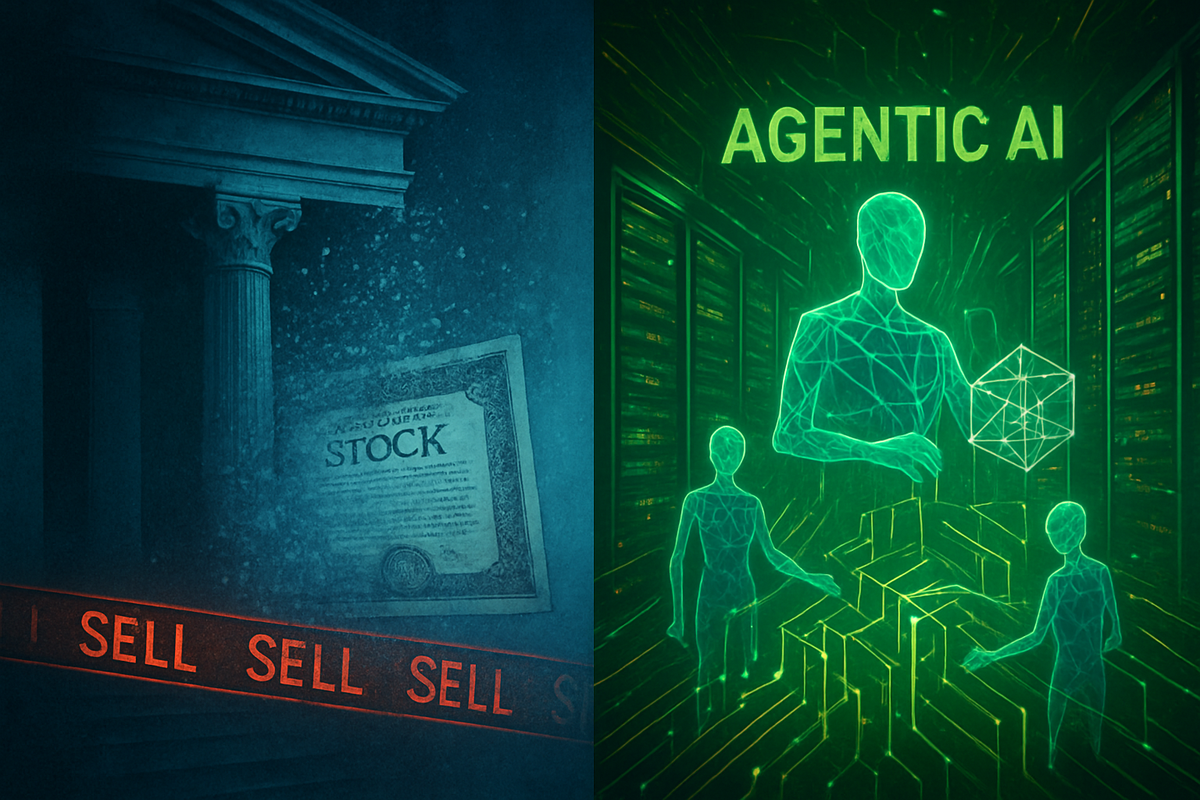
The global financial markets reached a pivotal inflection point on February 18, 2026, as a phenomenon dubbed the "AI Scare Trade" triggered a massive and violent rotation of capital. Investors began a wholesale exit from traditional service-oriented sectors—most notably wealth management, financial services, and real estate—amid growing fears that the latest generation of "Agentic AI" is poised to render human-led professional services obsolete.
While broader market indices like the S&P 500 remained relatively stable, the underlying churn revealed a stark divide between the "AI Losers" and the "AI Infrastructure Winners." As billions of dollars flowed out of established financial powerhouses, they poured into the "picks and shovels" of the AI revolution, specifically targeting semiconductor giants and specialized software firms that provide the backbone for autonomous digital agents.
The Day the "Human Touch" Devalued
The market action on February 18 was characterized by what Jefferies (NYSE: JEF) strategist Mohit Kumar described as a "shoot first, ask questions later" mentality. The catalyst was a convergence of technological breakthroughs that hit the market earlier in the month, specifically the launch of "Hazel" by the fintech firm Altruist. Hazel, an autonomous AI platform capable of generating complex tax and estate strategies without human intervention, sent a shockwave through the wealth management sector. By the closing bell on February 18, industry stalwarts like Charles Schwab (NYSE: SCHW) had dropped over 7%, while Raymond James (NYSE: RJF) and LPL Financial (NASDAQ: LPLA) both plummeted more than 8%.
The panic was not localized to the United States. In London, wealth manager St. James’s Place (LSE: STJ) saw its valuation crater by 20%, as European investors grappled with the realization that high-margin advisory fees could be decimated by zero-marginal-cost AI agents. This "Scare Trade" also bled into other professional services; CBRE Group (NYSE: CBRE) fell 16% on fears that AI-driven property valuation and transaction management would bypass traditional brokers, while insurance giant Arthur J. Gallagher (NYSE: AJG) slipped nearly 10% as autonomous underwriting tools gained mainstream traction.
Winners and Losers: A Tale of Two Economies
The primary beneficiaries of this capital flight were the companies building the physical and logical infrastructure of the AI era. Nvidia (NASDAQ: NVDA) continued its historic run, gaining 2.3% on the day following a blockbuster announcement of a deepened partnership with Meta Platforms (NASDAQ: META). Meta has reportedly committed to purchasing millions of Nvidia’s next-generation "Blackwell" chips to power its "Agentic OS," a move that signaled to investors that the hardware demand cycle is far from over.
However, the standout performer of the session was Cadence Design Systems (NASDAQ: CDNS), which surged over 9%. Cadence’s rally was fueled by its release of the world’s first agentic AI solution for chip design, a tool that claims to improve engineering productivity by a staggering 10x. This highlighted a key theme of the February 18 rotation: investors are favoring companies with "AI-defensibility"—those that own proprietary data or create the very tools that enable AI development—while punishing "information brokers" whose value proposition relies on human-mediated data processing. Analog Devices (NASDAQ: ADI) also saw a 2.7% lift as the market doubled down on the semi-equipment sector.
The GPT-6 Factor and the Shift to "Agentic" AI
The "AI Scare Trade" is not merely a reaction to current software but a forward-looking bet on the capabilities of upcoming models like OpenAI’s GPT-6. Internal memos and roadmaps circulating in early 2026 have framed GPT-6 not as a better chatbot, but as a fully autonomous operating system capable of long-term memory and cross-functional task execution. This shift from "Generative AI" (which creates content) to "Agentic AI" (which executes actions) is the fundamental driver behind the current market anxiety.
Industry analysts at Goldman Sachs (NYSE: GS) have drawn parallels between the current decline in financial services and the collapse of the newspaper industry in the early 2000s. Strategists argue that we are witnessing the "commoditization of expertise," where specialized knowledge that once commanded high hourly rates is being digitized and scaled at near-zero cost. BlackRock (NYSE: BLK) commentators Jean Boivin and Wei Li noted that the market is now aggressively "sorting" companies based on their exposure to this automation, warning that firms acting as mere intermediaries between data and clients face an existential threat.
Looking Ahead: Pivot or Perish
In the short term, the volatility in the wealth management and financial services sectors is expected to persist as firms scramble to integrate AI into their workflows to justify their fees. We are likely to see a wave of "panic M&A," where traditional banks and brokerages acquire AI startups at rich premiums to bolster their technological defenses. The strategic pivot required is immense; firms must move from being "providers of answers" to "managers of AI systems," a transition that many legacy institutions may not survive.
Long-term, the market's focus will likely shift toward the regulatory and ethical implications of Agentic AI. As these systems begin to manage significant portions of private wealth and corporate strategy, the potential for systemic risk increases. For investors, the challenge will be identifying which service firms can successfully "hybridize" their business models—combining human judgment with AI efficiency—versus those that will be entirely replaced by autonomous platforms.
The Path Forward for Investors
The events of February 18, 2026, serve as a stark reminder that the AI revolution has moved beyond the "hype" phase and into the "disruption" phase. The "AI Scare Trade" represents a fundamental re-rating of the global economy, where the value of human labor in cognitive tasks is being aggressively questioned by the stock market. While the infrastructure players like Nvidia and Cadence Design remain the safe havens for now, their valuations reflect an expectation of near-total dominance by AI systems.
Investors should closely watch the upcoming quarterly earnings reports from major financial institutions for signs of margin compression and headcount reductions. The key metric moving forward will not just be revenue growth, but "AI-enhanced productivity." As the "sorting of winners and losers" continues, the ability of a company to own its data and automate its core processes will be the primary determinant of its survival in this new agentic era.
This content is intended for informational purposes only and is not financial advice.