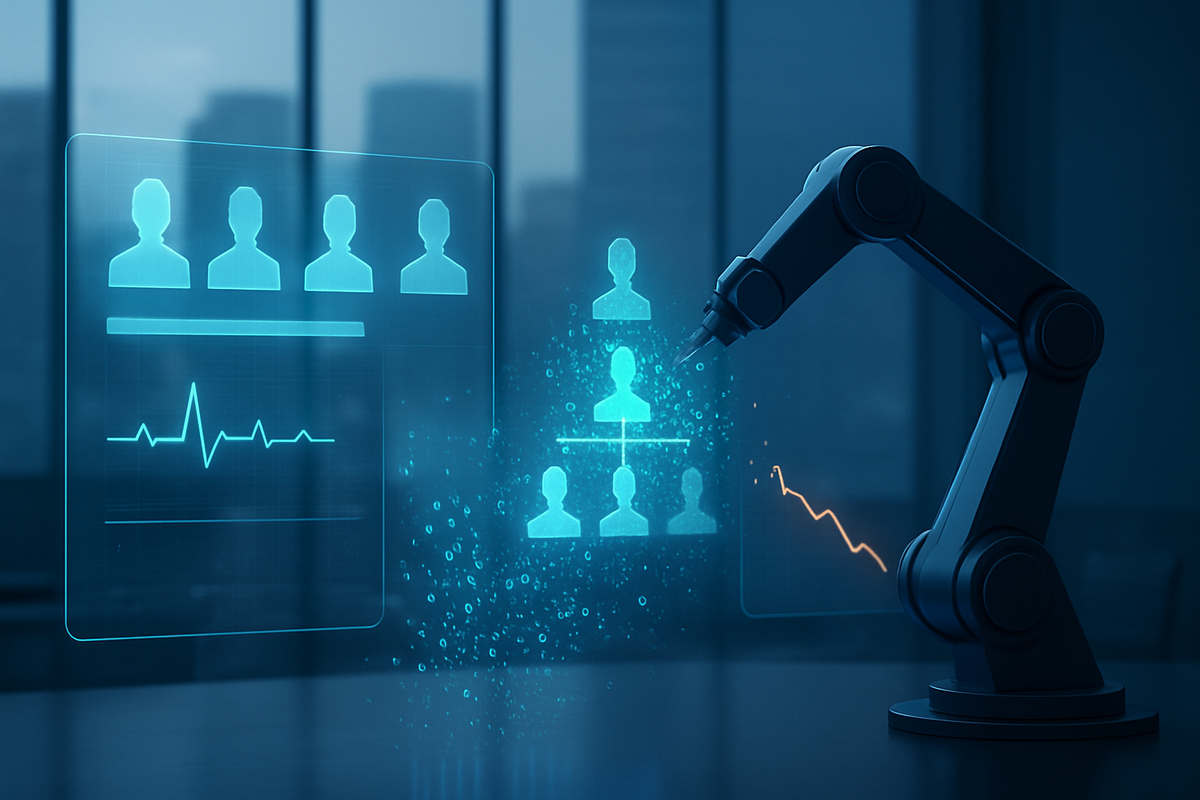
As of February 18, 2026, the Human Capital Management (HCM) software sector is grappling with a profound "Productivity Paradox." For decades, the industry flourished under the Per-Employee-Per-Month (PEPM) revenue model, where growth was inextricably linked to rising corporate headcounts. However, the rapid integration of Generative AI and autonomous agents is now achieving the unthinkable: making HR so efficient that it is actively reducing the number of employees required to manage a workforce, thereby eroding the very seat counts that drive industry profits.
The immediate implications for the market have been stark. Industry bellwethers are reporting stagnating subscriber growth as corporate clients leverage AI to automate administrative, recruiting, and payroll functions. This structural shift has triggered a massive sell-off across the sector in early 2026, as investors realize that the efficiency gains promised by AI may come at the direct expense of the software providers' top lines.
The Great Seat Compression: A Timeline of the HCM Retreat
The current crisis reached a fever pitch in early February 2026, following a series of disappointing earnings reports and guidance revisions. On February 5, Paycom Software, Inc. (NYSE: PAYC) saw its stock tumble 7.9% after issuing 2026 revenue guidance of just 6–7% growth—a significant slowdown from historical double-digit norms. CEO Chad Richison admitted that while their "Beti" automated payroll system is delivering record efficiency for clients, it is simultaneously reducing the "administrative overhead" (and thus, the paid seats) required at many mid-sized firms.
This downward trend followed a volatile 2025, where the industry began to see the first signs of "hiring proof" mandates. According to market data from late 2025, approximately 17% of large enterprises now require managers to prove that an AI agent cannot perform a role before approving a new human hire. This "AI-first" hiring philosophy has put a ceiling on the total addressable market for seat-based software. By the time Workday, Inc. (NASDAQ: WDAY) reported its FY2026 results, even a 15% growth in subscription revenue wasn't enough to prevent a series of analyst downgrades in mid-February, as concerns shifted from "if" AI would monetize to "how fast" it would cannibalize existing seats.
The sector's vulnerability was further underscored when Dayforce Inc. (formerly NYSE: DAY) was taken private by Thoma Bravo in a $12.3 billion deal that closed in early 2026. The move was widely interpreted as a strategic retreat, allowing the company to overhaul its pricing architecture away from public market scrutiny. Meanwhile, industry titan Automatic Data Processing, Inc. (NASDAQ: ADP) reported a cautious outlook in its February 2026 quarterly update, citing a "structural cooling" in white-collar hiring—a direct byproduct of AI-driven corporate restructuring.
Winners and Losers in the Autonomous HR Era
In this shifting landscape, the traditional "winners" are being forced to reinvent themselves or face irrelevance. Paycom (NYSE: PAYC) currently finds itself in the crosshairs; its heavy focus on automating the "user experience" for the employee has been so successful that it is effectively eliminating the need for the human HR managers who originally bought the software. While retention remains high, the expansion potential within existing accounts is hitting a wall of AI-driven efficiency.
Conversely, Paylocity Holding Corp. (NASDAQ: PCTY) is attempting to pivot toward a more diversified "Office of the CFO" strategy. By acquiring spend-management firm Airbase in 2025, Paylocity has moved beyond simple HR seat counts and into transaction-based and credit-based revenue. This move into finance and spend management allows them to increase their Average Revenue Per User (ARPU) even as the total number of employees at their client firms remains flat. Despite this, the stock remains under pressure, trading near 52-week lows as of mid-February 2026.
Workday (NASDAQ: WDAY) appears to be the best-positioned of the "legacy" giants, thanks to the launch of its "Illuminate" platform. By moving toward "Agentic AI"—where autonomous agents perform complex tasks like auditing and recruiting coordination—Workday is attempting to replace lost PEPM revenue with high-margin AI SKU upgrades. However, the market remains skeptical about whether these new revenue streams can scale fast enough to offset the loss of thousands of "standard" user seats at major clients like Salesforce and Shopify, both of which cited AI efficiency for major headcount reductions in late 2025.
The Death of the Seat-Based SaaS Model
The crisis in HCM is a "canary in the coal mine" for the broader SaaS industry. For twenty years, the "seat" was the unit of value in software. AI has shattered that link. If an AI agent can do the work of five payroll clerks, the customer no longer wants to pay for five licenses; they want to pay for the outcome of a processed payroll. This is forcing a transition toward "Outcome-Based Pricing," where companies are charged based on successful hires, completed audits, or resolved tickets rather than the number of people logged into the system.
This shift mirrors historical precedents in the manufacturing sector during the rise of industrial robotics. Just as the value shifted from "man-hours" to "unit throughput," HCM is seeing value shift from "human management" to "process orchestration." Regulatory pressures are also mounting, as labor departments begin to investigate the "AI-first" hiring mandates that are depressing white-collar job growth. For competitors and partners, the message is clear: the era of "growth via headcount" is over. Future market leaders will be defined by their ability to monetize the work performed by AI, not the people overseen by it.
The Road Ahead: Strategic Pivots and Consumption Credits
In the short term, expect more volatility as HCM firms experiment with "AI Credit" tiers. Much like cloud computing (AWS/Azure), software companies are beginning to charge based on the compute power required to run their AI agents. This "Consumption-Based" model is the industry's best hope for survival, but it requires a fundamental change in how sales teams are compensated and how investors model future earnings.
Looking toward 2027, the industry is likely to bifurcate. We will see a group of "Infrastructure HR" firms that provide the backbone for a smaller, highly leveraged human workforce, and a new class of "Autonomous Service" firms that provide AI laborers directly to clients. The strategic challenge for incumbents like ADP (NASDAQ: ADP) will be maintaining their massive data advantage while transitioning away from the stable, predictable PEPM fees that have historically made them a "safe haven" for defensive investors.
Wrapping Up: A Sector in Transition
The events of early 2026 mark a turning point for the Human Capital Management sector. The very technology these companies built to empower the workforce—Artificial Intelligence—has become a powerful force for corporate lean-sizing. The primary takeaway for investors is that volume-based growth is dead; the new metric of success is "Value per Outcome."
Moving forward, the market will closely monitor retention rates and the adoption of "AI-exclusive" modules. If Workday (NASDAQ: WDAY) and Paycom (NYSE: PAYC) can prove that their AI agents can command premium pricing that exceeds the lost seat revenue, a recovery may be on the horizon. However, for those stuck in the traditional PEPM mindset, the road ahead looks increasingly narrow. Investors should watch for further consolidation, as private equity firms like Thoma Bravo look to scoop up undervalued players and aggressively transition them to post-PEPM revenue models.
This content is intended for informational purposes only and is not financial advice.