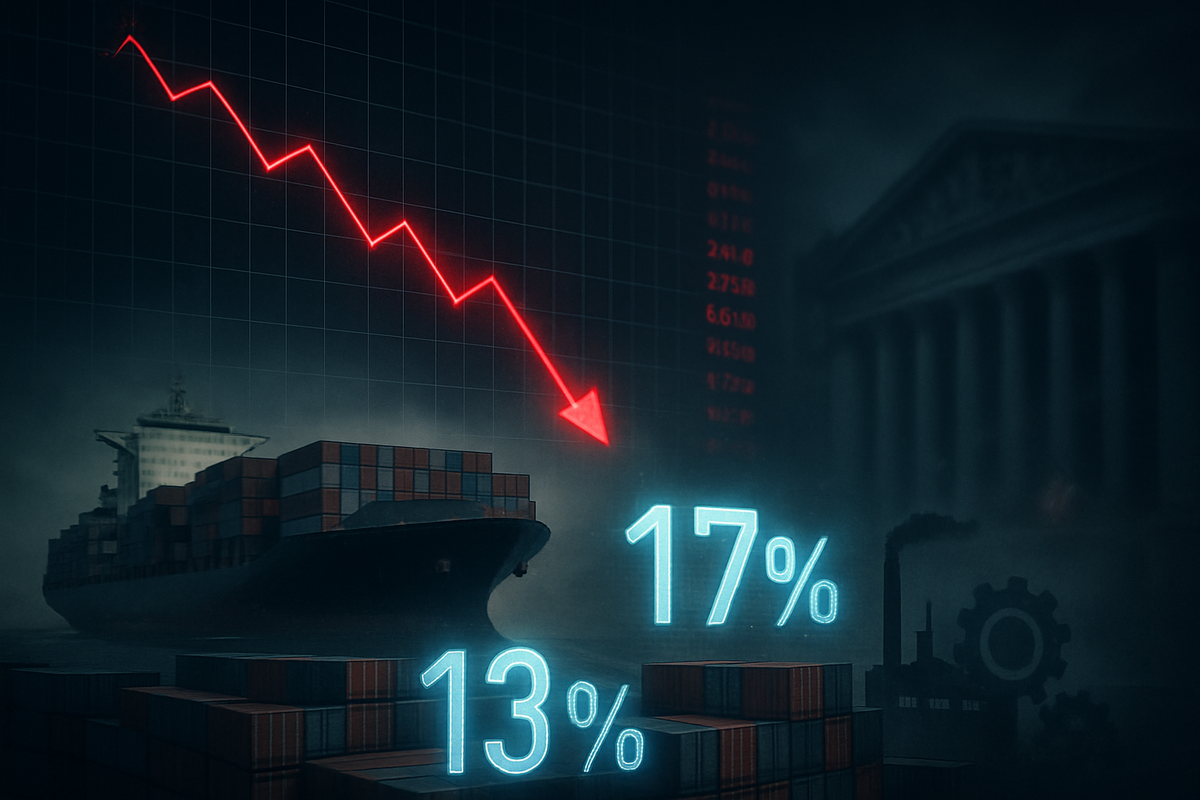
As of February 18, 2026, the United States economy is grappling with the most aggressive shift in trade policy since the Great Depression. The Trump administration’s universal baseline tariff has pushed the average import tax to a staggering 13%, a level not seen in nine decades. While the stock market showed resilience through much of 2025, the "inventory cushion" that protected many multinational corporations has officially evaporated, leaving corporate profit margins vulnerable to direct hits from rising input costs.
The immediate implications are becoming clear in quarterly earnings calls across the S&P 500. Analysts are slashing growth forecasts as the cost of doing business spikes for everything from semiconductor components to basic consumer staples. With Goldman Sachs (NYSE: GS) now warning that effective tariff rates could climb as high as 17% by year-end, investors are reassessing the "fair value" of the broader market in an era of structural protectionism.
The Path to a 90-Year High: How We Got Here
The escalation to a 13% average tariff was not an overnight occurrence, but rather the culmination of a systematic dismantling of decades of free-trade agreements. Following the inauguration in early 2025, the administration moved quickly to implement a 10% universal baseline tariff (UBT) on all imported goods, regardless of origin. By late 2025 and into the first two months of 2026, targeted "Section 301" duties on high-tech sectors and retaliatory measures from trading partners have pushed the weighted average to its current 90-year high.
The primary architect of this policy remains the executive branch, which has utilized national security justifications to bypass traditional legislative hurdles. Key stakeholders, including the Department of Commerce and the Office of the U.S. Trade Representative, have emphasized a "de-risking" strategy aimed at reshoring manufacturing. However, the initial market reaction in early 2026 has been one of mounting concern. David Kostin, chief U.S. equity strategist at Goldman Sachs, has noted that every 5-percentage-point increase in the effective tariff rate historically translates to a 1% to 2% reduction in S&P 500 earnings per share (EPS).
Winners and Losers: Sectoral Carnage and Strategic Resilience
The burden of these trade taxes is not distributed evenly across the market. The automotive sector has emerged as one of the primary casualties. Toyota (NYSE: TM) recently reported a $3 billion quarterly decline in profit directly attributed to U.S. vehicle and parts tariffs. Domestic giants like General Motors (NYSE: GM) and Ford (NYSE: F) are also struggling as the 25% duties on imported steel and aluminum—along with tariffs on Mexican-made components—squeeze margins that were already thin from the transition to electric vehicles.
In the technology space, the impact is felt through complex supply chains. Apple (NASDAQ: AAPL) and Microsoft (NASDAQ: MSFT) are facing significantly higher costs for hardware components, specifically handsets and server parts. While these tech titans possess large cash reserves, the inability to fully pass these costs to consumers without dampening demand has led to a projected 50-to-60 basis point contraction in S&P 500 margins for the first half of 2026. Retailers are also under fire; Walmart (NYSE: WMT) and Nike (NYSE: NKE) are racing to shift sourcing away from China to higher-cost regions, a move that provides long-term stability but creates immediate margin compression.
Historical Precedents and the Macroeconomic Ripple
Economists are increasingly drawing parallels to the Smoot-Hawley Tariff Act of 1930. While that era saw dutiable goods taxed at nearly 40% to 50%, the current 13% average is arguably more disruptive due to the increased integration of the modern global economy. In 1930, imports represented a fraction of the U.S. GDP; today, trade is the lifeblood of American commerce. The Yale Budget Lab projects that these tariffs will slow GDP growth by 0.4 to 0.6 percentage points annually, potentially dragging the U.S. growth rate below 1% by the end of 2026.
Beyond the immediate tax on goods, the wider significance lies in the "boomerang effect" of retaliatory tariffs. The European Union, Canada, and Mexico have already implemented counter-measures, hurting U.S. exporters like Caterpillar (NYSE: CAT) and John Deere (NYSE: DE). This environment marks a departure from the post-WWII era of globalization, signaling a new regime where trade is used more as a geopolitical weapon than a tool for economic efficiency. This "Trade War 2.0" is creating a permanent "uncertainty premium" that is currently reducing the fair value of the S&P 500 by an estimated 5%.
What Lies Ahead: Strategic Pivots and the 17% Threshold
The short-term outlook remains focused on whether the effective tariff rate will indeed reach the 17% threshold predicted by Goldman Sachs. If the administration continues to allow temporary exemptions to expire—particularly in the pharmaceutical and high-tech sectors—the headwind for S&P 500 earnings will only intensify. Companies will be forced to make a strategic pivot: either commit to the high capital expenditure required for domestic reshoring or accept permanently lower margins as they navigate a fragmented global market.
Market opportunities may emerge for domestic-centric firms with minimal exposure to international supply chains, though even these "winners" may suffer if general consumer spending drops. The average U.S. household is projected to lose approximately $1,300 in 2026 due to tariff-induced price hikes. This reduction in discretionary income could trigger a broader slowdown in the consumer staples sector, affecting heavyweights like Procter & Gamble (NYSE: PG), which is already anticipating a $1 billion annual hit to its bottom line.
Conclusion: A New Era of Protectionist Investing
The shift to a 13% average import tariff represents a fundamental changing of the guard in American economic policy. The key takeaway for investors is that the "easy growth" era of frictionless global trade has ended. As we move further into 2026, the market will likely be defined by a massive divergence between companies that can successfully pass on costs and those that are crushed by them.
Moving forward, the market will be watching the Federal Reserve closely to see if they will cut rates to offset the GDP drag or keep them steady to combat the inflationary pressure of the tariffs. For now, the sentiment remains cautious. Investors should keep a close eye on upcoming quarterly earnings reports for mentions of "effective tax rates" and "supply chain relocation costs," as these will be the defining metrics of the 2026 fiscal year.
This content is intended for informational purposes only and is not financial advice