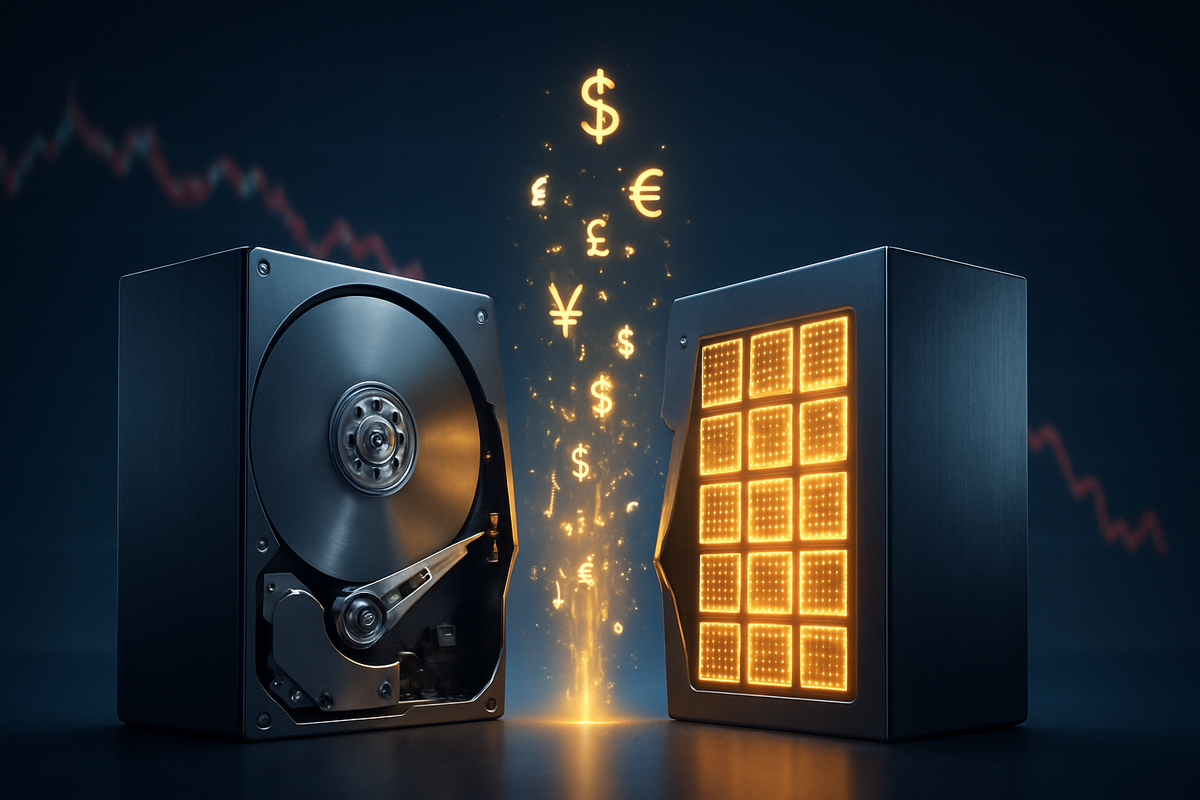
Western Digital Corp. (NASDAQ: WDC) officially completed its long-awaited separation from the flash memory market today, announcing the sale of its remaining 7.5 million share stake in the newly independent SanDisk (NASDAQ: SNDK). The transaction, structured as a secondary public offering to raise approximately $3.1 billion, marks the final chapter of a corporate divorce that began with a strategic pivot in late 2023. The move effectively ends a decade-long saga that saw the two storage giants merged into a single entity, only to be dismantled under pressure from activist investors.
The market reaction to the massive share dump was immediate and sharp. Shares of SanDisk fell 5.74% during Wednesday’s trading session, closing at $590.59. While the drop was significant, analysts noted that the decline was largely technical, driven by the sudden influx of over 7.5 million shares into the secondary market. Despite the single-day tumble, SanDisk remains one of the year’s top performers, having surged more than 140% since its re-listing as a standalone company in early 2025, buoyed by the insatiable global demand for AI-optimized data storage.
The Final Divestment: Breaking Down the $3.1 Billion Exit
The transaction was executed as a sophisticated debt-for-equity exchange involving major financial intermediaries. Western Digital exchanged its remaining 7,513,019 shares of SanDisk common stock for outstanding debt held by affiliates of JPMorgan Chase (NYSE: JPM) and Bank of America (NYSE: BAC). These financial institutions then sold the shares to public investors through a group of underwriters. By utilizing this structure, Western Digital was able to retire a significant portion of its long-term debt without the tax implications of a direct cash sale, effectively streamlining its balance sheet for its future as a pure-play Hard Disk Drive (HDD) manufacturer.
The timeline leading to this final exit was set in motion on October 30, 2023, when Western Digital management, under intense pressure from Elliott Management, announced a plan to split its flash and HDD businesses. The two units had struggled to find synergies since Western Digital’s $19 billion acquisition of SanDisk in 2016. The official separation occurred on February 24, 2025, at which point SanDisk emerged as a standalone NAND flash powerhouse. Western Digital retained a minority equity stake during the one-year transitional period, which has now been fully liquidated as of February 18, 2026.
Under the leadership of CEO Irving Tan, Western Digital is now positioning itself exclusively in the high-capacity HDD market, catering to massive cloud service providers and enterprise data centers. Meanwhile, SanDisk has returned to its roots under CEO David Goeckeler—formerly the CEO of the unified Western Digital—focusing on the volatile but high-growth NAND flash sector. This final sale removes the "overhang" of Western Digital’s ownership, providing SanDisk with total operational and financial autonomy for the first time in nearly ten years.
Winners and Losers in the Storage Shakeup
The primary "winner" in the wake of this divestment appears to be Western Digital itself. By raising $3.1 billion and eliminating a substantial portion of its debt, the company has fortified its position in a competitive HDD landscape dominated by Seagate Technology (NASDAQ: STX). With a leaner capital structure, WDC can now reinvest more aggressively into its proprietary "Energy-Assisted Magnetic Recording" (EAMR) technologies, which are critical for the next generation of massive data storage required by generative AI models.
SanDisk, despite the 6% stock price hit today, also stands to gain from the clarity of its new status. As a pure-play flash company, it is now an attractive partner—or acquisition target—for other industry titans. Its critical joint venture with Kioxia Holdings in Japan remains the crown jewel of its operations, ensuring a steady supply of cutting-edge NAND technology. However, the short-term "losers" include recent retail investors who entered the stock during its 140% run-up, only to see their holdings diluted by the sudden secondary offering.
Competitors like Micron Technology (NASDAQ: MU) and Samsung Electronics (KRX: 005930) are watching the transition closely. A fully independent SanDisk is a more nimble competitor in the SSD (Solid State Drive) market. However, if SanDisk’s stock continues to trade at high multiples, it could increase the valuation benchmarks for the entire memory sector, benefiting all major players. Conversely, any instability during SanDisk’s first year of full independence could allow competitors to snatch market share in the lucrative enterprise SSD segment.
A New Era for Memory and Storage Markets
The dissolution of the Western Digital-SanDisk union reflects a broader trend in the technology sector: the move away from "conglomerate" structures toward specialized, pure-play entities. For years, investors complained that Western Digital’s HDD and Flash businesses were "counter-cyclical," with the losses in one often masking the gains in the other. By splitting the companies, the market can now value each business on its own merits—a strategy that has clearly worked for SanDisk given its explosive growth over the past year.
The role of activist investor Elliott Management cannot be overstated. This event serves as a high-profile validation of their thesis that Western Digital was worth more in pieces than as a whole. This success is likely to embolden other activist firms to target large, diversified tech companies that may be "undervalued" due to complex business structures. It signals to Silicon Valley that the era of massive, multi-sector acquisitions may be giving way to a period of surgical divestitures and focused specialization.
Furthermore, this event highlights the massive influence of the AI revolution on hardware valuations. The reason SanDisk was able to command a $3.1 billion price tag for a mere 7.5 million shares is the global scramble for high-speed NAND flash. As AI models become more complex, the speed at which data can be read and written becomes just as important as how much data can be stored. This shift in market dynamics essentially saved the SanDisk split, providing the valuation tailwinds necessary for a successful exit for Western Digital.
The Road Ahead: Independence and Integration
In the short term, SanDisk will likely focus on stabilizing its stock price and reassuring investors that the "WDC era" is truly over. The company is expected to lean heavily into its partnership with Kioxia, possibly even exploring a formal merger with the Japanese firm now that the Western Digital ownership hurdle has been cleared. Such a move would create a global NAND titan capable of rivaling Samsung for market leadership.
For Western Digital, the challenge lies in proving that a pure-play HDD business can remain relevant in an increasingly flash-dominated world. While HDDs still hold a cost-per-gigabyte advantage for "cold storage," the company must continue to innovate to prevent its products from becoming commoditized. Investors will be looking for significant R&D milestones in the coming quarters to justify WDC’s new, focused trajectory.
The market should also brace for a potential ripple effect in the M&A space. With SanDisk now fully decoupled, the barriers to a major acquisition in the storage sector have been lowered. Whether it is a semiconductor giant looking to vertically integrate or a private equity firm seeking a cash-flow-heavy asset, SanDisk is arguably the most eligible bachelor in the tech hardware space today.
Closing Thoughts for Investors
The $3.1 billion exit by Western Digital marks the end of an ambitious, if ultimately flawed, experiment in storage integration. The 6% drop in SanDisk stock today is a textbook example of market mechanics reacting to supply, but it does little to diminish the company’s underlying strength in the AI-driven memory market. For Western Digital, the move provides a clean break and a reinforced balance sheet to defend its HDD territory.
Investors should view this event as a clearing of the decks. With the ownership overhang removed, the performance of both WDC and SNDK will now be driven entirely by their operational execution and the broader demand for data storage. In the coming months, the focus will shift to SanDisk’s earnings reports as a fully independent entity and Western Digital’s ability to leverage its $3.1 billion windfall into sustainable growth.
This content is intended for informational purposes only and is not financial advice.