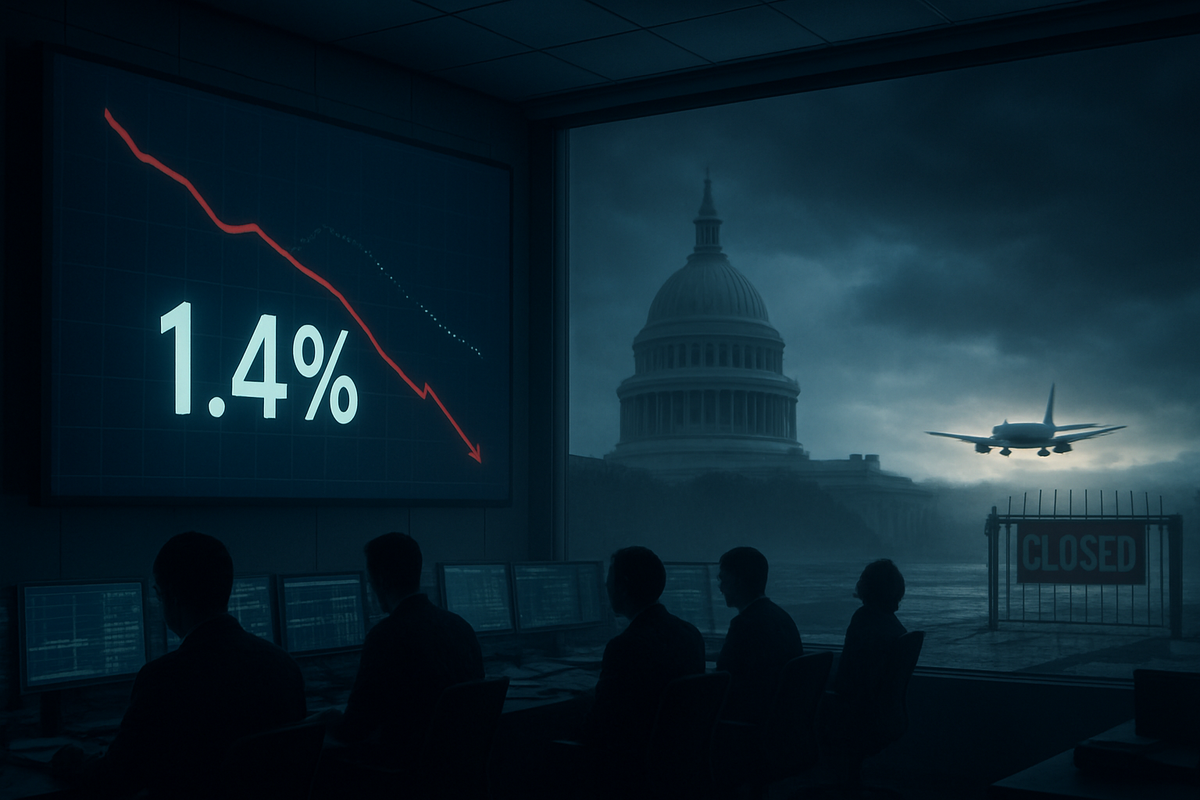
The U.S. economy faced a sobering reality check on Friday as the Bureau of Economic Analysis (BEA) released its preliminary reading for the fourth quarter of 2025. Gross Domestic Product (GDP) grew at an annualized rate of just 1.4%, a sharp deceleration from the 4.4% expansion seen in the third quarter and a significant miss compared to the 2.5% consensus forecast from Wall Street economists. This lackluster performance has cast a long shadow over the Federal Reserve’s long-standing "soft landing" narrative, suggesting that the path to economic stability in 2026 may be far more turbulent than previously anticipated.
The primary culprit for the stalled growth appears to be the historic 43-day government shutdown that paralyzed federal operations from October 1 to November 12, 2025. While the political impasse was eventually resolved, its ripple effects created a "consumption hole" and a massive backlog in private sector contracts that the economy has struggled to fill. With the Core Personal Consumption Expenditures (PCE) price index—the Fed’s preferred inflation gauge—remaining stubbornly high at 2.9%, investors are now grappling with the specter of "Stagflation-Lite," where stagnant growth meets persistent price pressures.
The Shutdown Hangover: A Quarter Lost to Gridlock
The 43-day shutdown, the longest in U.S. history, was triggered by a fierce fiscal standoff over healthcare spending and trade policy. For nearly half of the fourth quarter, non-essential federal operations were halted, resulting in the furlough of approximately 670,000 employees and leaving another 730,000 to work without pay. Although the "One Big Beautiful Bill Act of 2025" eventually provided back pay, the immediate impact on consumer sentiment and spending was profound. The BEA estimated that the shutdown directly subtracted between 1.0 and 1.15 percentage points from the headline GDP figure. Without this drag, growth would have likely tracked closely with the 2.5% target.
The timeline of the quarter was one of disruption followed by a frantic, but ultimately insufficient, attempt at recovery. October saw government outlays plunge at an annualized rate of 16.6%, the sharpest decline in recent memory. By the time the shutdown ended in mid-November, the private sector was already reeling from a halt in Small Business Administration (SBA) loan approvals—totaling nearly $170 million in delayed funding per day—and a freeze on security clearance processing that stalled thousands of defense and technology projects. While the holiday season provided a late-quarter boost, it was not enough to offset the "lost October" that defined the period.
Market Winners and Losers: Resilience Amidst the Rupture
The economic slowdown produced a starkly bifurcated landscape for public companies. In the defense and government services sector, traditional hardware "primes" faced significant headwinds. Lockheed Martin (NYSE: LMT) reported a 7.1% earnings miss for the quarter, citing disruptions in delivery timelines and a massive backlog of unpaid invoices. Similarly, RTX Corporation (NYSE: RTX) and Northrop Grumman (NYSE: NOC) warned that while demand remained high, the administrative freeze on new contract awards would delay cash flows well into the first half of 2026.
Conversely, government services firms proved surprisingly resilient. CACI International (NYSE: CACI) and Booz Allen Hamilton (NYSE: BAH) saw their stocks outperform the broader market as investors recognized their essential roles in intelligence and cybersecurity—sectors that remained "excepted" from the shutdown. These companies benefited from massive backlogs that ensured steady work even as federal agencies were technically closed.
In the consumer space, the impact was equally uneven. Avis Budget Group (NASDAQ: CAR) issued a major guidance miss, as the vanishing of government travel in October coupled with FAA administrative disruptions led to a collapse in demand. Retailers like Chipotle (NYSE: CMG) and Starbucks (NASDAQ: SBUX) also reported cooling demand from lower-income consumers, who tightened their belts amid job security fears. However, "resolution winners" emerged in mid-November. Walmart (NYSE: WMT) and Kroger (NYSE: KR) saw an immediate surge in activity once $8 billion in SNAP (food stamp) benefits were finally unlocked, providing a much-needed lifeline to the retail sector just as the holiday shopping season commenced.
Rethinking the 'Soft Landing' and Macroeconomic Ripple Effects
The 1.4% GDP figure represents more than just a data point; it is a direct challenge to the Federal Reserve's credibility regarding a "soft landing." Throughout 2025, Fed Chair Jerome Powell maintained that inflation could be brought down to the 2% target without triggering a growth collapse. However, the Q4 data suggests the economy may be landing "harder" than expected. The Fed responded with "insurance" rate cuts in both October and December 2025, bringing the federal funds rate to a range of 3.50%–3.75%, but internal dissent is growing. The December FOMC meeting revealed a fractured board, with a 9–3 vote indicating that some officials believe the window for a perfect landing has already slammed shut.
Historically, government shutdowns have been viewed as temporary blips, but the duration and timing of the 2025 event have invited comparisons to the 2008 financial crisis in terms of consumer sentiment impact. The University of Michigan consumer sentiment index plunged to 52.9 in December, reflecting a deep-seated public anxiety that transcends mere fiscal policy. This lack of confidence could have a long-term ripple effect on capital expenditures (CAPEX), as companies like Delta Air Lines (NYSE: DAL) and United Airlines (NASDAQ: UAL) must now navigate a high-cost environment with a more cautious traveler base.
The Road Ahead: Strategic Pivots in a Low-Growth Era
As we move deeper into 2026, the market must adapt to a "lower for longer" growth environment. Short-term, the focus will be on the "catch-up" spending from the $1.5 billion allocated in the recent "minibus" funding bill for infrastructure. Companies like General Dynamics (NYSE: GD) and Huntington Ingalls (NYSE: HII) are expected to see a surge in activity as shipyard modernization projects finally move from the drawing board to the dry dock. Additionally, engineering firms like AECOM (NYSE: ACM) and Jacobs (NYSE: J) are positioned to resume work on long-delayed VA and military housing projects.
However, the long-term outlook remains clouded by the Fed's next move. If inflation remains at 2.9% while growth hovers near 1%, the central bank may be forced to choose between supporting the labor market and fighting price increases. Investors should expect a strategic pivot toward defensive sectors, with a renewed interest in utilities like NextEra Energy (NYSE: NEE) and healthcare giants like Johnson & Johnson (NYSE: JNJ), which offer stability regardless of Washington's political theater.
Navigating the 2026 Economic Landscape
The Q4 2025 GDP report is a stark reminder of how political instability can derail even the most carefully managed economic recoveries. The 1.4% growth rate is a significant blow to the optimistic projections that characterized much of last year. While the resolution of the shutdown has unlocked some pent-up demand, the "stagnation" of the private sector and the cooling of consumer discretionary spending cannot be ignored.
Moving forward, the market's focus will shift from "growth at any cost" to "resilience at a reasonable price." Investors should closely watch the Core PCE readings in the coming months; if inflation does not begin to trend toward 2% despite the growth slowdown, the Fed may find itself with no good options. For now, the "soft landing" remains more of a hope than a reality, and the first half of 2026 will be the ultimate test of the U.S. economy's ability to rebound from a self-inflicted wound.
This content is intended for informational purposes only and is not financial advice.