As the Federal Reserve navigates the complex intersection of cooling inflation and a tech-driven productivity surge, San Francisco Fed President Mary Daly has signaled that the central bank is currently in a "sweet spot." Speaking on February 20, 2026, Daly emphasized that current monetary policy is "well-positioned" to manage a stabilizing labor market and a steady, albeit cautious, descent toward the 2% inflation target.
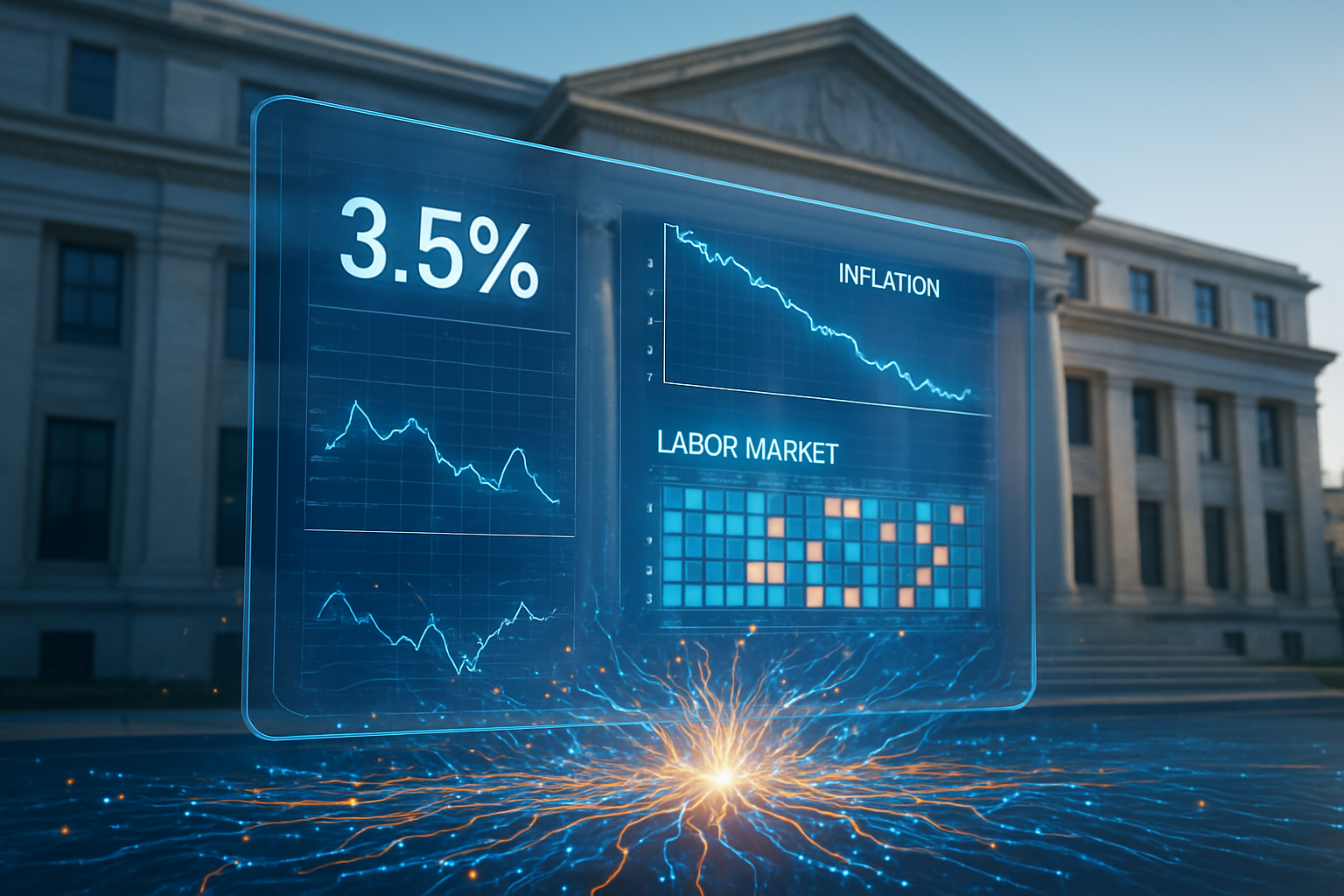
The immediate implication of Daly’s remarks is a "steady-as-she-goes" approach for the Federal Open Market Committee (FOMC). By maintaining the federal funds rate in the current 3.50%–3.75% range, the Fed aims to provide a restrictive enough environment to curb remaining price pressures in the services sector while allowing the burgeoning impact of artificial intelligence to permeate the broader economy without the threat of premature tightening.
A "Well-Positioned" Policy Amidst an AI Awakening
In a landmark address delivered at San Jose State University on February 17, 2026, titled "The AI Moment? Possibilities, Productivity, and Policy," President Mary Daly provided a comprehensive update on the Fed's stance. The speech followed a series of rate cuts in late 2025—totaling 75 basis points—which brought the federal funds rate down from its 2024 peaks. Daly noted that this "deliberate calibration" has allowed the labor market to find a new equilibrium, moving away from the frantic hiring seen earlier in the decade toward a more sustainable pace of job creation.
Daly’s commentary was deeply rooted in the San Francisco Fed’s recent research, which suggests that while the macroeconomic data has yet to show a "transformative" leap in productivity, the micro-level evidence is undeniable. She drew a direct historical parallel to former Fed Chair Alan Greenspan in the mid-1990s. At that time, Greenspan famously argued that official statistics were undercounting the productivity gains of the burgeoning internet era, a hunch that eventually allowed the Fed to keep rates lower for longer during a period of non-inflationary growth.
The timeline leading to this moment has been marked by a shift in Fed rhetoric. Throughout 2025, officials debated whether AI would lead to massive job displacement. However, Daly pointed to a November 2025 San Francisco Fed paper, "Job Transformation, Specialization, and the Labor Market Effects of AI," which argued that the technology is largely augmenting human roles. Initial market reactions to her comments were positive, with Treasury yields remaining stable and equity markets finding support in the prospect of a prolonged "pause" in rate hikes.
The Winners and Losers of the Fed’s AI Assessment
The Fed’s recognition of AI-driven productivity gains creates a favorable backdrop for companies providing the "shovels" for the AI gold rush. NVIDIA Corp (NASDAQ: NVDA) continues to be a primary beneficiary, as the Fed’s willingness to allow the economy to run slightly "hotter" on productivity grounds justifies the massive capital expenditures in data centers and AI infrastructure. Similarly, Microsoft Corp (NASDAQ: MSFT) and Alphabet Inc (NASDAQ: GOOGL) stand to gain as their enterprise AI agents begin to show tangible efficiency returns in the private sector—returns that Daly acknowledges are currently "under the hood" of official GDP figures.
However, the shift toward AI-driven efficiency poses a challenge for traditional business service providers and legacy administrative firms that have been slow to integrate these technologies. Salesforce Inc (NASDAQ: CRM), while a leader in the space, represents a category of companies that must constantly pivot to ensure their software remains the primary interface for this new "augmented" workforce. The "losers" in this environment are likely mid-market firms in the "information processing" sector that face wage stagnation as their tasks are automated, as highlighted in the SF Fed’s December 2025 research on lower-income service roles.
Furthermore, Daly's mention of the "neutral rate" (r*) suggests that the long-term cost of capital may be higher than in the pre-pandemic era. This could create a headwind for highly leveraged, non-tech firms that were hoping for a return to near-zero interest rates. For these companies, the "Daly Doctrine" implies that the days of cheap money are likely over, replaced by a "higher-for-longer" baseline supported by AI-fueled growth.
The Broad Significance: A New "Speed Limit" for the Economy?
The wider significance of Daly’s remarks lies in the potential recalibration of the U.S. economy’s "speed limit"—the rate at which the economy can grow without sparking inflation. If AI is indeed boosting productivity, the Fed can afford to be less aggressive with interest rate hikes even if growth remains robust. This fits into a broader industry trend where "hyper-efficiency" is becoming the standard; recent SF Fed roundtables with venture capitalists revealed that AI agents are now allowing "solo founders" to achieve the output of ten-person teams.
Regulatory and policy implications are also surfacing. Daly’s reliance on "disaggregated data"—looking at individual sectors rather than just headline numbers—suggests a more surgical approach to monetary policy. This approach mirrors the historical precedent of the late 90s but adds a modern twist with the SF Fed’s use of tools like "ChatMacro," a generative AI model used to evaluate inflation forecasts. By integrating AI into their own predictive modeling, the Fed is signaling a policy shift toward tech-augmented governance.
Furthermore, this stance provides a buffer against global economic headwinds. By acknowledging that AI might be keeping domestic inflation in check through lower production costs, the Fed can maintain a stable policy even as other global central banks struggle with volatile energy prices or supply chain disruptions. This "American exceptionalism" in productivity could continue to strengthen the dollar and attract global investment into U.S. tech equity.
What Comes Next: Scenarios and Strategic Pivots
In the short term, market participants should expect the Fed to remain on hold through the first half of 2026. The strategic pivot for investors will be moving away from speculating on "when the next cut is" to "how high is the neutral rate." If Daly’s assessment is correct and AI continues to push the neutral rate upward, we may see a permanent shift in valuation models for long-duration assets.
A potential challenge that may emerge is the "lag" in official data. As Daly noted, aggregate productivity data is notoriously slow to capture technological shifts. There is a risk that the Fed could wait too long to react to a sudden surge in growth, or conversely, stay restrictive for too long if the AI gains fail to move from the "micro" to the "macro" level. Investors should watch for the San Francisco Fed’s upcoming "Business Inflation Expectations" surveys for early signs of AI-driven price cooling.
Long-term, the scenario of "Job Transformation" will require a massive societal shift in education and training. The Fed's research indicates that the most successful workers in 2026 are those who have pivoted to "coordination and customer-facing tasks" where human empathy remains a competitive advantage. Companies that invest in "reskilling" their workforce to work alongside AI agents will likely emerge as the dominant players of the late 2020s.
Summary and Final Thoughts for Investors
Mary Daly’s recent communications represent a pivotal moment in central banking. By declaring policy "well-positioned" and embracing the "Greenspan Parallel," she is effectively signaling that the Federal Reserve is willing to bet on the productivity-enhancing power of AI. The key takeaways are clear: the federal funds rate has likely found its floor for the near term at 3.50%–3.75%, and the Fed’s focus has shifted from fighting "inflation at all costs" to "nurturing growth through technology."
Moving forward, the market should be viewed through the lens of productivity. The "Daly Doctrine" suggests that as long as AI continues to transform the labor market without causing mass unemployment, the Fed will remain a neutral or even supportive force for equity markets. Investors should keep a close eye on service-sector inflation and any revisions to "r*" estimates in the FOMC’s Summary of Economic Projections.
The lasting impact of this event is the formal integration of AI into the Fed’s "reaction function." No longer just a buzzword in Silicon Valley, AI is now a central pillar of U.S. monetary policy strategy. For the coming months, the watchword is "patience"—the Fed is waiting for the hard data to catch up to the technological reality already being seen on the ground in San Francisco and beyond.
This content is intended for informational purposes only and is not financial advice.