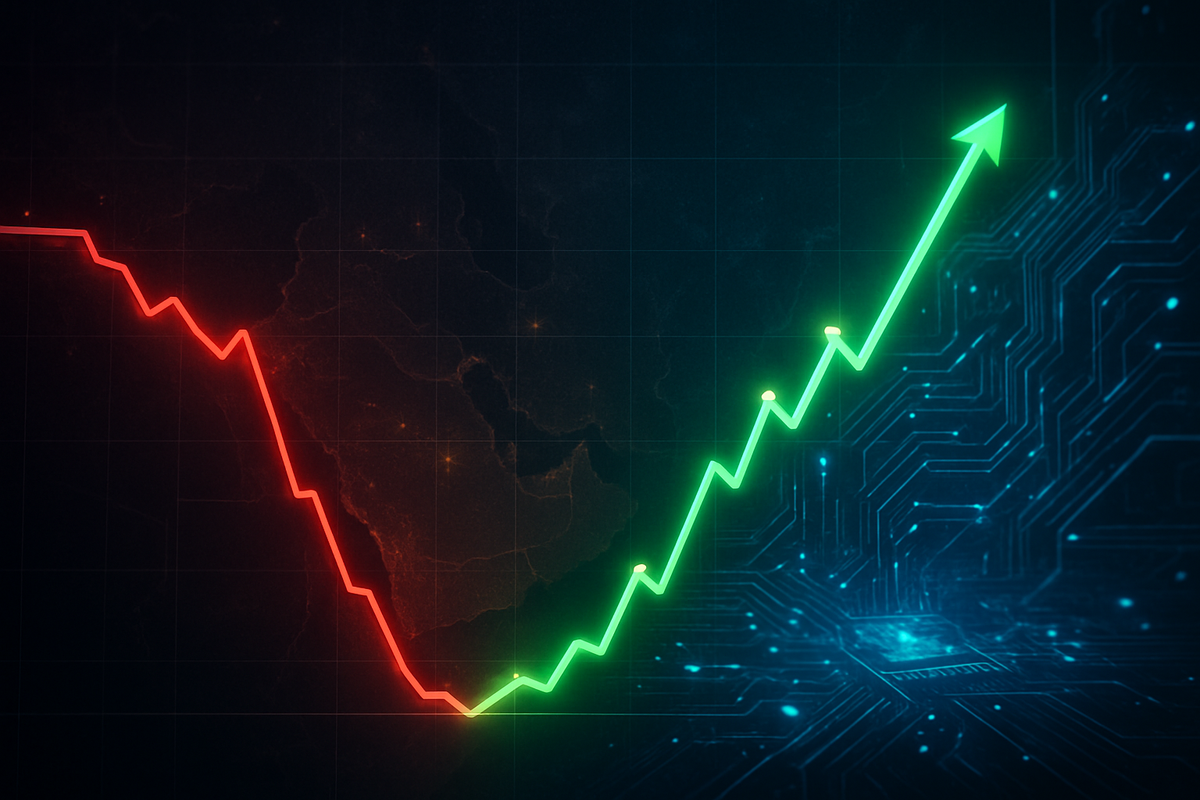
In a session defined by extreme volatility and rapid-fire sector rotation, the Russell 2000 Index staged a historic turnaround on Monday, March 2, 2026. After a terrifying morning that saw the small-cap benchmark plummet nearly 3% at the opening bell due to escalating geopolitical tensions in the Middle East, the index clawed its way back to finish the day up 0.55%. This massive intraday swing of over 3.5% suggests that the "Great Rotation" of 2026—a structural shift of capital from mega-cap giants into broader market participants—remains the dominant psychological force for investors.
The recovery was not merely a technical bounce but a fundamental pivot. While the initial sell-off was fueled by fears of $100-per-barrel oil and disrupted global trade, the afternoon surge was ignited by a multi-billion dollar commitment to artificial intelligence infrastructure. This "V-shaped" recovery reinforces the narrative that market participants are currently conditioned to view any macro-driven dip as a generational entry point for small-cap equities, particularly those tied to the next leg of the technological revolution.
The Fog of War and the Midday Pivot
The day began in a state of high-octane panic. Over the weekend of February 28, news of joint U.S. and Israeli air raids against Iranian military infrastructure sent shockwaves through global markets. By the time the New York Stock Exchange opened on March 2, oil prices had surged by more than 8%, with Brent Crude flirting with the $100 mark. The Islamic Revolutionary Guard Corps’ (IRGC) announcement that it would close the Strait of Hormuz—the world’s most critical oil transit point—was the primary catalyst for the Russell 2000's initial 2.7% drop. Smaller companies are historically more sensitive to energy costs and borrowing rates, making them the first casualties in a "risk-off" environment.
However, the sentiment shifted dramatically around 11:30 AM ET. The spark was an unexpected announcement from Nvidia (NASDAQ: NVDA), which revealed a $2 billion strategic investment in a key small-cap component provider. This move signaled to the market that despite geopolitical instability, the demand for AI hardware and domestic infrastructure remains insatiable. By 1:00 PM, the "buy the dip" algorithms had fully engaged, and the index erased its losses in a matter of hours, closing in positive territory. This marks one of the largest intraday reversals for the Russell 2000 in the last four years, second only to the volatility spikes seen during the early 2022 rate-hike cycle.
Winners and Losers: The AI Infrastructure Surge
The primary beneficiary of the day’s reversal was Lumentum Holdings (NASDAQ: LITE), which skyrocketed 9.97% following the news of Nvidia's $2 billion stake. As a provider of optical components essential for AI data centers, Lumentum became the poster child for the afternoon rally. In its wake, other small-cap optical networking firms saw explosive gains as "sympathy plays." Applied Optoelectronics (NASDAQ: AAOI) surged an astonishing 22.4%, while nLIGHT (NASDAQ: LASR) finished the day up 16.4%. These moves highlighted a clear trend: while the broader market was scared of oil, savvy investors were focused on the hardware backbone of the 2026 AI expansion.
On the other side of the ledger, energy-intensive small caps and those reliant on global shipping struggled to join the rally. While the index turned green, companies in the logistics and regional manufacturing sectors remained under pressure. However, domestic infrastructure plays like Select Water Solutions (NYSE: WTTR) found a middle ground, gaining ground as investors hedged for a potential prolonged energy crisis by betting on U.S.-based production support. Even traditional consumer brands like Wolverine World Wide (NYSE: WWW) and industrial stalwarts like Gorman-Rupp (NYSE: GRC) managed to end the day higher, supported by strong recent earnings reports that had been temporarily overshadowed by the morning's geopolitical headlines.
Analyzing the "Great Rotation" and Historical Precedents
This turnaround is a textbook example of the "Great Rotation" that has defined the first quarter of 2026. For much of 2024 and 2025, the market was carried by a handful of mega-cap "Magnificent" stocks. However, as of early 2026, valuation fatigue in the giants has led to a massive influx of capital into the Russell 2000. Today’s action confirms that this is not a fleeting trend; even a threat of war in the Middle East was not enough to keep investors away from small caps for more than a few hours.
Historically, such wide intraday reversals often signal a "blow-off bottom" in sentiment. Similar action was seen in late January 2022, when the Russell 2000 recovered from a 2.8% deficit to finish positive. In that instance, the recovery preceded a period of intense sector reshuffling. The 2026 version of this event is unique because it is being driven by "dry powder" on the sidelines. With trillions of dollars still sitting in money market funds as of early 2026, any significant dip is being met with a wall of liquidity, effectively putting a "floor" under the market that didn't exist in previous cycles.
What Comes Next: Strategic Pivots for a Volatile Year
In the short term, investors should expect continued "headline risk." If the situation in the Strait of Hormuz escalates further, the initial panic seen today could repeat. However, the lesson from March 2 is that the market's internal plumbing is currently biased toward growth and domestic industrial resurgence. Small-cap companies that can demonstrate a clear link to AI, domestic energy production, or defense technology—such as Palantir Technologies (NYSE: PLTR), which continues to influence the small-to-mid-cap defense sentiment—are likely to remain the preferred vehicles for alpha.
Looking ahead, the long-term challenge will be the "cost of carry." If geopolitical tensions keep oil prices sustained above $95, the inflationary pressure could force the Federal Reserve to pause its expected 2026 rate-cutting cycle. This would be a major headwind for small caps, which typically carry more floating-rate debt than their large-cap counterparts. Investors must watch the 10-year Treasury yield closely; if it climbs alongside oil, the "buy the dip" mentality may eventually be tested by the harsh reality of "higher for longer" interest rates.
Summary: A Market Refusing to Break
The Russell 2000’s massive turnaround on March 2, 2026, is a testament to the current market's resilience and the sheer volume of capital looking for an entry point into small-cap equities. The shift from a 3% loss to a 0.55% gain in a single session is a rare feat that underscores the power of the AI infrastructure trade and the structural "Great Rotation." While geopolitical risks are real and potentially devastating to global supply chains, the market’s current priority is clearly centered on the technological arms race.
For investors, the key takeaway is that the "dip-buying" reflex is as strong as ever, but it is becoming increasingly selective. The winners of today’s reversal were not just "small" companies, but companies with specific roles in the AI and domestic infrastructure narrative. In the coming months, the focus will shift to whether the Russell 2000 can sustain these gains if the macro environment continues to deteriorate. Watch for the $2,400 level on the Russell 2000; a sustained break above this resistance would confirm that the small-cap bull market has truly entered its next aggressive phase.
This content is intended for informational purposes only and is not financial advice