As the first quarter of 2026 draws to a close, the S&P 500 continues to display a striking resilience that masks a deep structural divide within the American economy. According to the latest data from Zacks Investment Research, aggregate earnings for the index are projected to grow by a robust 12.8% year-over-year. While this double-digit expansion suggests a healthy corporate environment, a closer look at the figures reveals a market increasingly reliant on a single engine: the Technology sector.
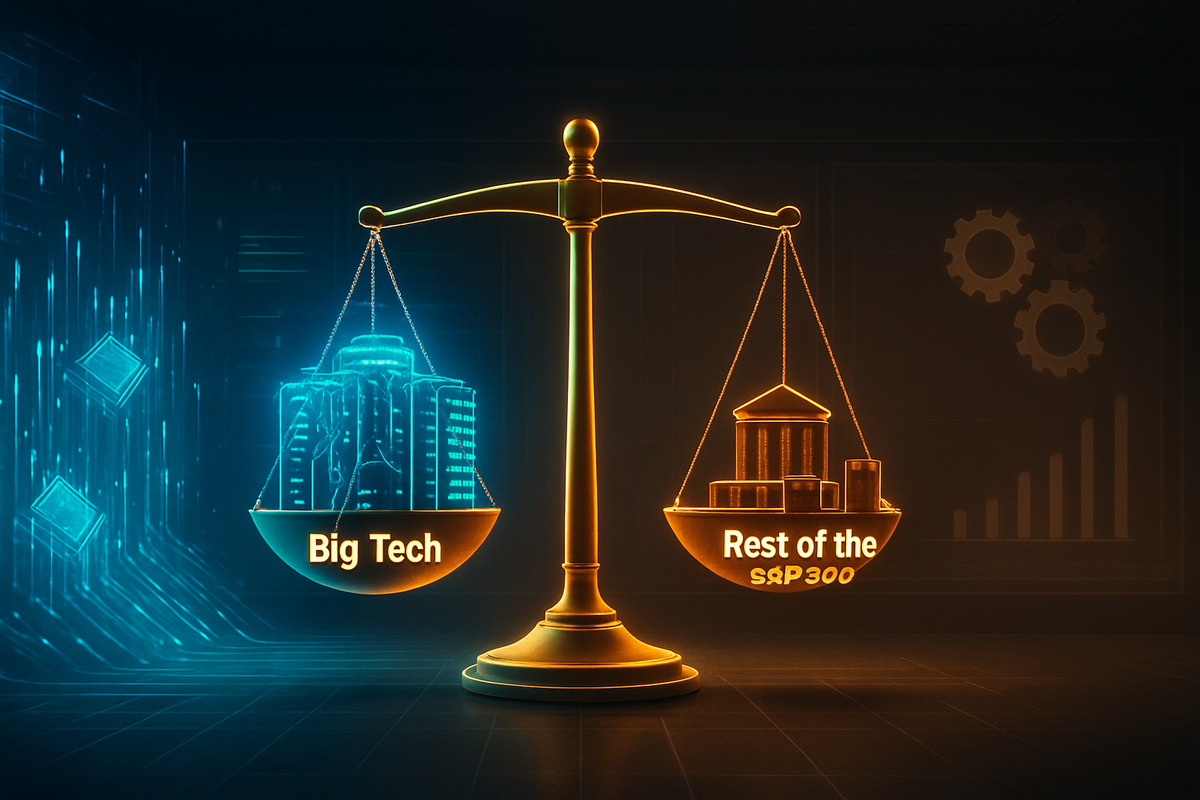
The divergence is staggering. While the Tech sector is expected to see earnings surge by 27.1%, the remaining sectors of the S&P 500 are projected to grow at a much more modest pace of just 5.6%. This nearly five-to-one growth ratio highlights a "two-speed" market where the heavy lifting is being done by a handful of elite firms, raising critical questions about market breadth and the long-term sustainability of the current rally in the face of geopolitical instability and shifting monetary expectations.
The Great Divergence: Tech Engines vs. Industrial Drags
The Q1 2026 earnings season is shaping up to be a definitive moment for the narrative of "AI ubiquity." According to Sheraz Mian, Director of Research at Zacks, the projected 12.8% aggregate earnings growth for the S&P 500 represents a notable upward revision from early March estimates of 11.3%. This optimism persists despite a 70% year-to-date surge in oil prices—fueled by the ongoing conflict involving Iran—which many feared would dampen corporate margins across the board.
The timeline of this divergence traces back to late 2023, when the Technology sector began its ascent as the "critical pillar" of S&P 500 growth. By March 26, 2026, this trend has reached a fever pitch. Tech is not just leading; it is dominating, with revenue growth for the sector expected at 22.5% compared to the index's total revenue growth of 8.8%. This concentration is reflected in the fact that the Tech sector alone is now responsible for roughly 35.9% of all S&P 500 earnings, despite making up over 43% of its total market capitalization.
The Winners and Losers of the Concentration Game
The primary beneficiaries of this lopsided growth remain the "Magnificent 7" stocks. Companies like NVIDIA (NASDAQ: NVDA) and Microsoft (NASDAQ: MSFT) continue to reap the rewards of massive infrastructure spending on artificial intelligence. Microsoft, in particular, has seen its cloud services revenue accelerate as enterprise clients integrate AI tools more deeply into their workflows. Similarly, Meta Platforms (NASDAQ: META) and Alphabet (NASDAQ: GOOGL) have leveraged AI to refine advertising algorithms, offsetting broader concerns about consumer spending.
However, the "Rest of the Index"—the 490+ companies growing at 5.6%—faces a more difficult road. While some sectors like Finance, led by giants such as JPMorgan Chase (NYSE: JPM), are seeing respectable growth of around 19%, others are struggling under the weight of high energy costs and plateauing consumer demand. Tesla (NASDAQ: TSLA) and Amazon (NASDAQ: AMZN), which Zacks often categorizes within the Auto and Retail sectors respectively, are bright spots in their specific niches, but they are outliers. For the average industrial or utility firm, the environment is one of margin compression and slow revenue growth, a stark contrast to the hyper-growth seen in Silicon Valley.
Breadth Concerns and the Shadow of Geopolitics
The wider significance of this earnings gap cannot be overstated. Historically, a healthy bull market is characterized by broad participation across multiple sectors. The current concentration in Tech echoes the "dot-com" era, though analysts point out that today’s leaders are significantly more profitable and cash-flow positive than their predecessors. Still, the reliance on a few names creates a "fragility risk"; if a major player like Apple (NASDAQ: AAPL) or NVIDIA misses expectations, the entire index could see a sharp correction, regardless of how the other 490 companies perform.
Furthermore, the "cognitive dissonance" noted by market observers is becoming harder to ignore. Investors are simultaneously fretting over massive capital expenditure (CapEx) budgets for AI and the potential for a wider Middle Eastern war to disrupt global supply chains. Yet, corporate earnings continue to hit double-digit growth marks. This suggests that the productivity gains from AI may be insulating the largest tech firms from macro shocks that would typically derail a market cycle.
Looking Ahead: Can the Gap Narrow?
As we look toward the second half of 2026, the central question for investors is whether the rest of the market can catch up to Tech. Short-term possibilities include a "catch-up trade" where value stocks become attractive due to their lower valuations, especially if the Federal Reserve begins to signal a more dovish stance on interest rates. However, a strategic pivot may be required for non-tech companies; those that fail to integrate AI into their operational core risk being permanently left behind in a low-growth tier.
Potential scenarios range from a "soft landing" where the 5.6% growth in the broader market slowly accelerates, to a more volatile "sector rotation" where the Mag 7 stocks face a valuation reset. Market opportunities may emerge in the Energy and Basic Materials sectors, which have seen their own estimates move higher recently as commodity prices remain elevated.
A Two-Speed Market in Transition
In summary, the Q1 2026 outlook reveals an S&P 500 that is fundamentally a tale of two markets. The aggregate 12.8% growth is a testament to the sheer power of the American technology sector, yet the 5.6% growth for the rest of the index serves as a sobering reminder of the challenges facing the broader economy. The dominance of the "Mag 7" remains the defining characteristic of this era, providing both the engine for growth and a significant source of concentration risk.
Moving forward, investors should watch for any signs of "earnings fatigue" in the Tech sector and keep a close eye on the secondary sectors like Finance and Energy. While the headline numbers remain impressive, the true health of the market in the coming months will be measured by whether growth can finally begin to broaden out, or if the S&P 500 will remain a house built on a very powerful, but very singular, foundation.
This content is intended for informational purposes only and is not financial advice