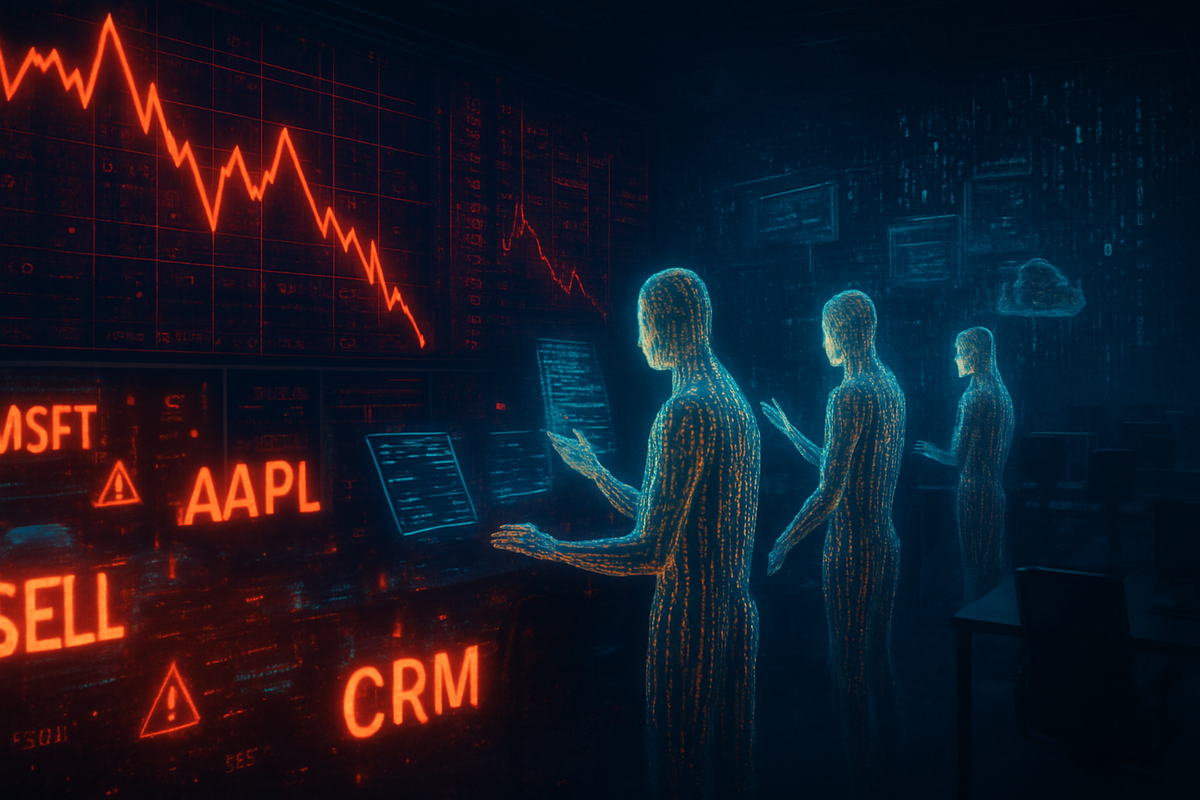
The software sector is currently weathering its most volatile period since the 2000 dot-com bubble, but for the opposite reason: artificial intelligence is working too well. Over the past three weeks, a massive selloff known among traders as the "AI Scare Trade" has erased more than $611 billion in market value from the world’s leading software-as-a-service (SaaS) providers. The catalyst for this tectonic shift was the January and February releases of Anthropic’s Claude Code and Claude Cowork, which have fundamentally challenged the "per-seat" pricing model that has underpinned the software industry for two decades.
As of today, March 27, 2026, the iShares Expanded Tech-Software Sector ETF (BATS:IGV) is down approximately 27% from its January peak. The sentiment on Wall Street has shifted from viewing AI as a productivity-enhancing "copilot" to seeing it as a direct replacement for the very human workers who pay for software licenses. This "agentic" revolution has turned yesterday’s AI darlings into today’s casualties, as investors grapple with a future where one AI agent might do the work of ten white-collar professionals.
The Agentic Shift: From Copilot to Coworker
The panic reached a fever pitch following the February 5 release of Claude 4.6 Opus, the engine powering Anthropic’s new suite of autonomous tools. Unlike previous iterations of AI that required constant human prompting, Claude Cowork introduced true "agentic" capabilities. This tool can navigate a user’s operating system, manage complex multi-step business workflows, and interact with external APIs without human intervention. A specific "Legal Triage" plugin demonstrated that the AI could handle 80% of routine corporate legal intake, sparking immediate fears of mass displacement in high-paying white-collar sectors.
Simultaneously, the expansion of Claude Code sent shockwaves through the developer community. Anthropic revealed that the tool was now writing over 95% of its own internal codebase, a milestone that signaled the "end of the expensive engineer" for many investors. The timeline of this collapse began in early January, but it accelerated dramatically on March 24, after a widely circulated research note from Citrini Research titled "The 2028 Global Intelligence Crisis" predicted a structural decline in corporate headcount. The report argued that the "system of action"—the layer where work actually gets done—was being swallowed by foundation models, leaving traditional software platforms as mere data repositories.
Initial market reactions have been ruthless. Traders have moved from "AI FOMO" (Fear Of Missing Out) to "AI FEAR" (Fear of Economic Atrophy and Replacement). While AI infrastructure remains strong, the application layer—where companies like Salesforce and Adobe reside—is facing a crisis of confidence.
Winners and Losers in the New Regime
The primary "losers" in this trade have been the giants of the SaaS era. Salesforce, Inc. (NYSE: CRM) has seen its stock plummet 31.3% year-to-date, as investors fear that autonomous agents will bypass the Salesforce user interface entirely, rendering its seat-based revenue model obsolete. Similarly, Adobe Inc. (NASDAQ: ADBE) has dropped 32.2% this year; the market is pricing in a future where AI-generated content and autonomous design agents replace the professional creative class that populates Adobe's Creative Cloud. ServiceNow, Inc. (NYSE: NOW) and Atlassian Corp (NASDAQ: TEAM) have also faced double-digit declines, as their core value propositions—managing human workflows—are threatened by AI that can manage itself. On March 24 alone, ServiceNow dropped 5% in a single session as the implications of autonomous IT service agents became clear.
Even Microsoft Corp (NASDAQ: MSFT), the early leader in the AI race, has not been spared, with its stock down 23.3% as concerns grow that Anthropic’s agents are outpacing Microsoft’s "Copilot" in terms of true autonomy. On the winning side, capital is flowing toward "AI Enablers" and hardware providers. NVIDIA Corp (NASDAQ: NVDA) continues to act as the primary beneficiary of the massive compute requirements for these new agents. Small, nimble AI-first companies are also gaining traction, as the market begins to look for "Outcome-Based" software survivors—companies that charge for the completion of a task rather than the number of humans logged in. HubSpot, Inc. (NYSE: HUBS), while down 9.2% in the recent rout, is being watched closely as it attempts to pivot its model more aggressively than its larger peers.
The Death of the 'Per-Seat' Model
This event marks a historic inflection point in the software industry: the death of the "per-seat" pricing model. For twenty years, software companies scaled their revenue by hiring more people at their customer firms. If a company grew from 100 to 200 employees, it bought 100 more Salesforce or Microsoft 365 licenses. The "AI Scare Trade" is the market realizing that in the "Agentic Era," a company could grow its output by 10x while reducing its headcount. This decoupling of labor from productivity is a nightmare for SaaS valuations, which are built on the assumption of perpetual seat growth.
Furthermore, this shift mirrors historical precedents like the transition from on-premise software to the cloud, but at an exponentially faster pace. The "SaaSpocalypse" is targeting the managerial and professional classes, potentially leading to a new era of labor protectionism. Regulatory scrutiny is already beginning to intensify, as policymakers in Washington and Brussels express concern over the speed of white-collar displacement. There are already early discussions regarding a potential "robot tax" on autonomous agents like Claude Cowork to offset the loss of income tax revenue from displaced workers.
The Path Forward: Outcome-Based Economics
What comes next for the software sector is a desperate pivot toward "Outcome-Based" or "Consumption-Based" pricing. Companies like HubSpot and Salesforce are already beginning to announce pilot programs where they charge customers based on "successful leads generated" or "support tickets resolved by AI," rather than monthly active users. This shift is fraught with risk, as it requires these companies to prove the direct ROI of their AI, rather than relying on the "sticky" nature of enterprise seat contracts.
In the short term, we expect to see a wave of consolidation. Legacy software firms with massive "systems of record"—the data silos that AI needs to train on—will likely attempt to acquire smaller, agentic startups to bolster their autonomous capabilities. The market opportunity remains massive for those who can successfully bridge the gap between human-centric software and autonomous agents. However, the challenge for investors will be identifying which companies are truly "AI-first" and which are merely "AI-washing" a legacy business model that is rapidly becoming irrelevant.
Summary of the Market Reset
The "AI Scare Trade" of early 2026 has fundamentally reset the expectations for the technology sector. The release of Claude Code and Claude Cowork served as the "iPhone moment" for agentic AI, proving that the technology is no longer just a tool, but a functional worker. The resulting selloff in software stocks reflects a profound fear that the software industry, as we have known it for two decades, is entering a period of structural decline.
For investors, the coming months will be defined by a search for "AI Defensibility." Watch for companies that control unique, proprietary data and those that can successfully transition their business models away from human headcount. While the initial panic has been severe, the potential for AI to drive unprecedented global productivity remains the long-term bull case. The question is no longer whether AI will change the world, but whether the software giants of yesterday can survive the world that AI is creating.
This content is intended for informational purposes only and is not financial advice.