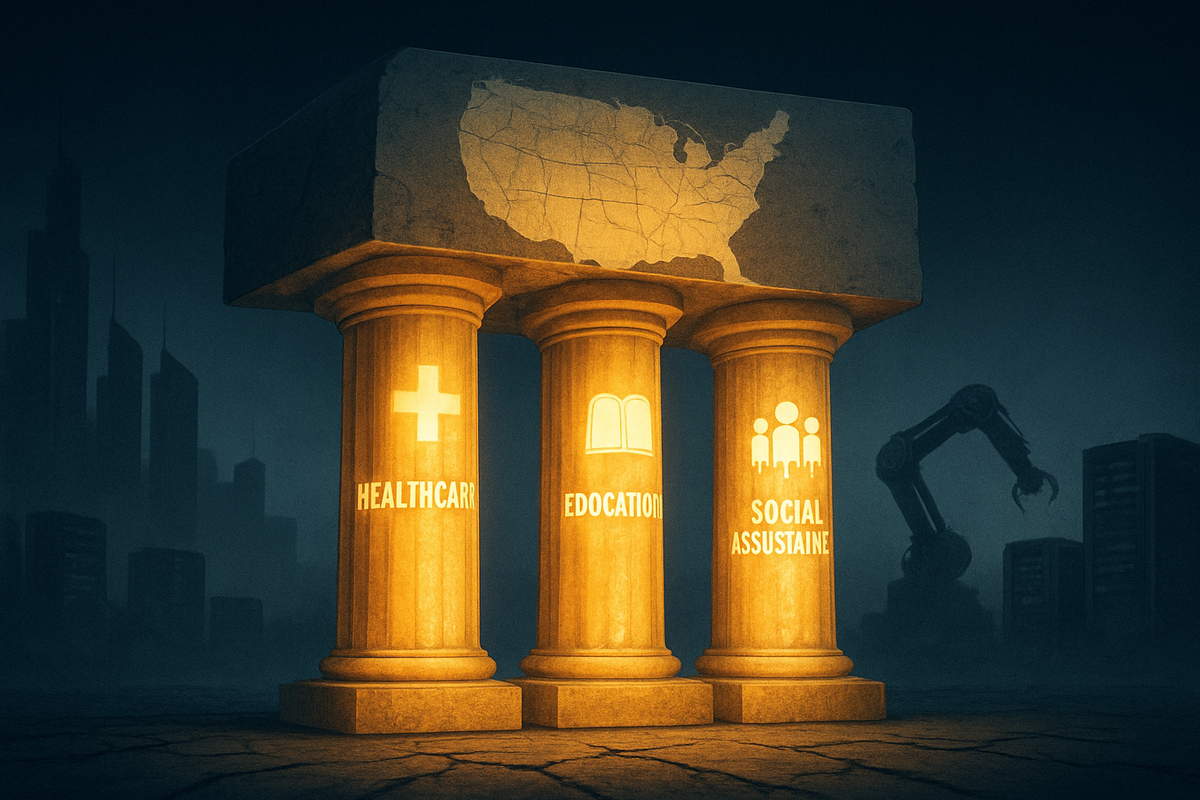
As of March 30, 2026, the United States labor market presents a confusing paradox that has left economists and Wall Street analysts divided. On the surface, the headline employment numbers suggest a resilient economy, with unemployment hovering near 4.5% and monthly job gains consistently topping 150,000. However, a deeper dive into the Department of Labor’s latest data reveals a stark and "narrow" reality: nearly all of America’s job growth is now concentrated in just three "defensive" sectors—Healthcare, Social Assistance, and Private Education.
This concentration, which some analysts are calling the "Three-Pillar Economy," masks significant underlying weakness in the broader private sector. While the healthcare industry continues its post-pandemic expansion to meet the needs of an aging population, traditional engines of growth like Technology, Manufacturing, and Finance are actively shedding workers. This bifurcation is creating a "lopsided" labor market that complicates the Federal Reserve’s mission to manage inflation without triggering a deeper structural recession.
The Anatomy of the Narrow Gain: Data from March 2026
The narrative of "narrow growth" reached a fever pitch this month following the release of the February and March employment reports. According to revised data, Healthcare and Social Assistance alone accounted for a staggering 92% of all net job gains in the first quarter of 2026. Without these sectors, the U.S. economy would have recorded its first period of net job losses since the 2020 lockdowns. The timeline leading to this moment began in late 2024, as the "Great Correction" in tech evolved into a permanent structural shift driven by Generative AI and automation.
The Federal Reserve’s March 2026 Beige Book explicitly warned of this "bifurcated economy." The report noted that while coastal healthcare hubs and regions with large university systems are thriving, industrial and tech-heavy corridors are facing "persistent stagnation." The key stakeholders in this transition—labor unions in the nursing sector and HR executives at major tech firms—are seeing two completely different Americas. While hospitals are offering record signing bonuses to attract staff, software engineers are facing an increasingly crowded and competitive market where "generalist" roles are being automated away by "AI agents."
Winners and Losers in the Bifurcated Market
In this environment, companies within the healthcare and education sectors have become the primary drivers of the labor market's "resilience." HCA Healthcare (NYSE: HCA) and Tenet Healthcare (NYSE: THC) have both announced aggressive hiring plans for the remainder of 2026, focusing on ambulatory care and surgical specialists to meet the demands of a record number of retiring Baby Boomers. Similarly, Welltower Inc. (NYSE: WELL), a leader in senior living infrastructure, has seen a surge in site-level hiring as its properties reach full capacity. In the education space, Adtalem Global Education (NYSE: ATGE) and Grand Canyon Education (NASDAQ: LOPE) are expanding their faculty rosters to accommodate a influx of workers from other sectors seeking "upskilling" in health sciences.
Conversely, the "losers" of this labor shift are concentrated in sectors formerly considered the primary growth drivers of the S&P 500. Intel Corp. (NASDAQ: INTC) and Tesla (NASDAQ: TSLA) have both initiated significant workforce reductions in early 2026—Intel by nearly 15% as it streamlines for its "Foundry" era, and Tesla by over 10% in response to a cooling global EV market and increased automation. Even the "Big Tech" giants are not immune; Microsoft (NASDAQ: MSFT) and Amazon (NASDAQ: AMZN) have continued to trim middle management and non-AI-focused divisions, redirecting capital toward high-end compute resources rather than headcount. Salesforce (NYSE: CRM) has also made headlines this month by replacing a substantial portion of its customer support workforce with specialized AI agents, a move that is being closely watched by the rest of the software-as-a-service (SaaS) industry.
The Federal Reserve’s "Curious Kind of Balance"
For the Federal Reserve, this narrow growth is a double-edged sword. Fed Chair Jerome Powell, in his most recent press conference, described the current situation as a "curious kind of balance." Traditionally, the Fed monitors the labor market for signs of overheating to gauge inflation risks. However, when growth is confined to non-cyclical sectors like healthcare, the traditional relationship between hiring and consumer spending breaks down. Healthcare spending is often mandatory rather than discretionary, meaning that job gains in this sector do not necessarily signal a robust consumer environment that would fuel a new inflationary spiral.
The wider significance of this trend lies in the "break-even" collapse. Research from regional Fed branches indicates that due to aging demographics and a slowdown in immigration through 2025, the U.S. now only needs to add approximately 30,000 to 50,000 jobs per month to keep the unemployment rate stable—a massive drop from the 200,000+ required a decade ago. This lower threshold makes the headline numbers look healthier than they actually are. Historically, such narrow participation in growth has preceded more significant economic downturns, as a single shock to the dominant sector (such as a change in Medicare reimbursement rates or a healthcare staffing crisis) could leave the entire economy without a growth engine.
The Productivity Pivot: What Comes Next?
Looking ahead to the second half of 2026, the primary question for investors is whether the "productivity pivot" in manufacturing and tech will eventually offset the job losses in those sectors. The short-term outlook remains challenging for the white-collar workforce. As Verizon (NYSE: VZ) and other telecom leaders finish their 5G build-outs and transition to automated maintenance systems, we can expect continued headcount pressure in the communications and utility sectors. Companies will likely continue to prioritize "AI-native" workflows, which require far fewer human hours for the same output.
In the long term, a strategic pivot toward "human-centric" services may be required for the entire U.S. labor force. If the narrowness of growth persists, we may see federal policy shifts aimed at subsidizing vocational training for the healthcare and education industries to absorb workers displaced by AI. The emergence of "AI-hybrid" roles in healthcare—where nurses and doctors are supported by sophisticated diagnostic tools—could create a new tier of high-paying, resilient jobs, but the transition period is likely to be marked by continued volatility in the broader private sector.
Summary and Investor Outlook
The "narrow" job growth of early 2026 is a warning sign that the U.S. economy is in the midst of a profound structural realignment. While the headline numbers offer a comforting veneer of stability, the underlying erosion of jobs in tech, manufacturing, and finance suggests that the traditional economic cycle is being rewritten by demographic shifts and technological advancement. For the Federal Reserve, this makes the path to a "soft landing" more treacherous, as the tools used to cool a broad-based boom may be too blunt for a market where only a few sectors are actually growing.
Investors should move away from viewing the labor market as a monolithic entity. Instead, the focus must shift to sector-specific health and productivity metrics. In the coming months, watch for the "break-even" job numbers and any signs of exhaustion in healthcare hiring. If the "three pillars"—Healthcare, Social Assistance, and Private Education—begin to crack, the rest of the economy may find itself without a foundation. The era of the "Generalist" employee is fading, replaced by a bifurcated world where human care and high-level AI oversight are the only certain bets.
This content is intended for informational purposes only and is not financial advice.