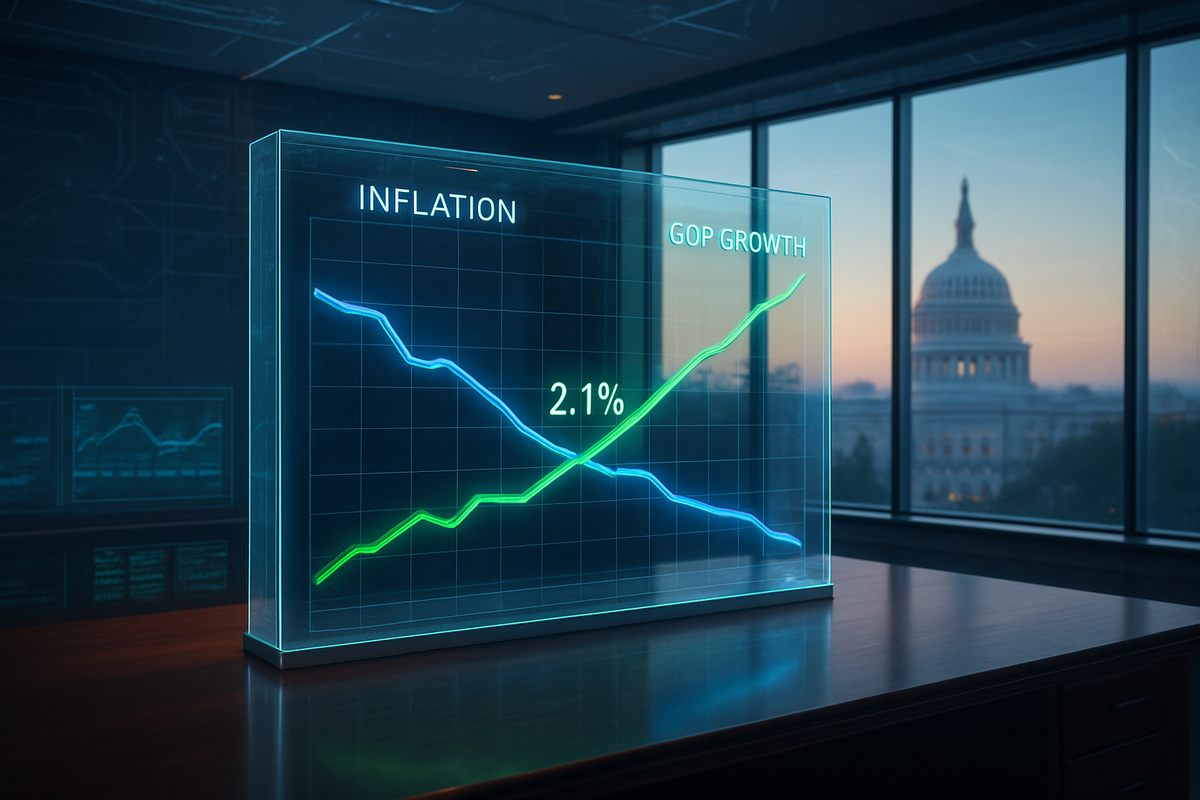
Fresh macroeconomic data released this morning, April 2, 2026, confirms that the long-awaited stabilization of the U.S. economy has finally arrived. Headline inflation cooled to 2.1% in March, a figure that aligns almost perfectly with the Federal Reserve’s long-term targets and provides a much-needed sigh of relief for markets that have been rattled by recent energy price volatility.
This cooling of price pressures comes alongside surprisingly resilient GDP growth projections, which have been revised upward to 2.4% for the 2026 fiscal year. While the data suggests a "Goldilocks" scenario—an economy neither too hot nor too cold—the Federal Reserve has signaled that any significant interest rate cuts are unlikely until late in the year. The central bank remains cautious, navigating a delicate "geopolitical pause" that has momentarily stabilized global supply chains after a turbulent start to the decade.
The 2.1% Threshold: A Milestone in Macroeconomic Stability
The latest Consumer Price Index (CPI) and Personal Consumption Expenditures (PCE) reports indicate that the "last mile" of the inflation fight has been largely won. After a brief but alarming spike in energy costs in February—driven by the "Iran Shock" that saw Brent crude briefly touch $119 per barrel—supply chains have stabilized and housing costs have finally begun to level off. The 2.1% print is the lowest reading since the post-pandemic era began, marking a significant victory for the Fed’s restrictive monetary policy.
The timeline leading to this moment has been one of extreme volatility. Throughout late 2025 and early 2026, many economists feared that a "supply-side shock" from the Middle East would trigger a return to stagflation. However, the announcement of a "geopolitical pause" in military escalations last month allowed oil prices to retreat to the $85–$90 range, providing the deflationary tailwind necessary to hit the 2.1% mark. Key stakeholders, including Treasury Secretary Janet Yellen and Fed Chair Jerome Powell, have credited a "productivity boom" driven by massive investments in Artificial Intelligence (AI) for keeping the economy afloat even as interest rates remained at 15-year highs.
Initial market reactions to the news were mixed but largely optimistic. Treasury yields saw a slight dip, with the 10-year yield settling at 4.15%, while equity futures pointed toward a steady opening. However, the absence of an immediate rate cut signal from the Fed has tempered the enthusiasm of those hoping for a rapid return to cheap capital.
Sector Divergence: Winners and Losers in the New Regime
The stabilization of inflation at 2.1% is creating a distinct divide between the "real economy" and the speculative high-growth sectors. Regional banks are emerging as the primary beneficiaries of this environment. With inflation under control and the yield curve beginning to steepen, institutions like Zions Bancorporation (NASDAQ: ZION) and Regions Financial (NYSE: RF) are seeing expanded net interest margins. Investors are betting that these banks will benefit from a predictable interest rate floor while their cost of deposits begins to stabilize.
Conversely, the "Magnificent Seven" and other mega-cap tech stocks are facing what analysts call "AI Capex Fatigue." While companies like NVIDIA (NASDAQ: NVDA) and Microsoft (NASDAQ: MSFT) continue to report robust revenues, their sky-high valuations are coming under pressure as the market rotates into value sectors. The Fed’s insistence on keeping rates in the 3.50%–3.75% range for the next two quarters acts as a valuation ceiling for growth stocks that rely on low discount rates for their long-term projections. Tesla (NASDAQ: TSLA) has been particularly hard-hit, as higher-for-longer financing costs continue to dampen consumer demand for big-ticket electric vehicles.
The industrial sector is also seeing a renaissance. Companies such as Eaton (NYSE: ETN) and GE Vernova (NYSE: GEV) are riding the wave of infrastructure spending. These firms are winning from a unique combination of lower input cost volatility and sustained demand for power grid modernization and AI data center construction. Meanwhile, ExxonMobil (NYSE: XOM) remains a favored hedge for investors who fear that the current "geopolitical pause" could be short-lived, ensuring that energy remains a pillar of a balanced 2026 portfolio.
The Significance of the Productivity-Driven Soft Landing
The current economic landscape is historically unique. Unlike previous cycles where low inflation was often a harbinger of a recession, the 2.1% inflation rate today is occurring alongside robust GDP growth. This suggests that the U.S. has entered a period of "productivity-driven resilience." The integration of AI into logistics, manufacturing, and services has allowed companies to produce more with less, effectively muting the inflationary impact of a tight labor market.
This event marks a departure from the "inflation-at-all-costs" mindset of 2021-2023. It fits into a broader trend where the U.S. economy has become increasingly decoupled from global shocks due to domestic energy production and a manufacturing "onshoring" boom. However, the regulatory environment remains a wild card. The Federal Trade Commission and other bodies are closely watching how AI productivity gains are distributed, with potential policy shifts on the horizon regarding corporate tax structures and labor protections.
Comparisons are already being drawn to the mid-1990s, where a similar technology-driven productivity boom allowed the Fed to keep rates relatively high without stifling growth. The ripple effect of this stabilization is being felt globally, as the U.S. dollar maintains its strength, forcing other central banks—particularly the European Central Bank and the Bank of Japan—to carefully synchronize their own pivots to avoid excessive currency devaluation.
The Road Ahead: Potential for a Late 2026 Pivot
As we look toward the second half of 2026, the primary question for investors is when the "pivot" will actually occur. Current Fed "dot plots" and market sentiment suggest a 25-basis-point cut in September 2026, followed perhaps by another in December. This slow approach is designed to ensure that inflation does not rebound if the geopolitical situation in the Middle East deteriorates again.
In the short term, companies will likely adopt a "wait-and-see" approach to capital expenditures. While the 2.1% inflation data is encouraging, the cost of borrowing remains high. We may see a wave of strategic pivots where companies move away from aggressive growth-by-acquisition and toward optimizing internal efficiencies and increasing dividends to attract value-oriented investors. The biggest challenge emerging in the coming months will be navigating the potential end of the "geopolitical pause," as any resumption of trade barriers or regional conflicts could quickly reverse the progress made on the inflation front.
A Balanced Outlook for a Maturing Cycle
The stabilization of inflation at 2.1% is a watershed moment for the post-pandemic economy. It validates the Federal Reserve’s aggressive stance over the past four years and provides a stable foundation for the next leg of economic expansion. However, the "higher-for-longer" interest rate environment is far from over, and the market is currently repricing itself for a reality where capital has a persistent cost.
Key takeaways for the market include the continued strength of the U.S. consumer, the pivotal role of AI in maintaining GDP growth, and the shift in investor preference from speculative growth to cash-flow-positive value. Moving forward, the market is expected to remain in a "sideways" trend as it digests these gains, with volatility likely clustered around geopolitical headlines and the Fed's fall meetings.
Investors should watch for any signs of the labor market cooling too rapidly, as well as the quarterly earnings reports of regional banks and industrial giants to confirm that the "soft landing" is truly taking hold. While the 2.1% inflation print is a reason to celebrate, the road to late 2026 will require patience and a focus on fundamental value.
This content is intended for informational purposes only and is not financial advice.
Author: Expert Financial Journalist
Date: April 2, 2026