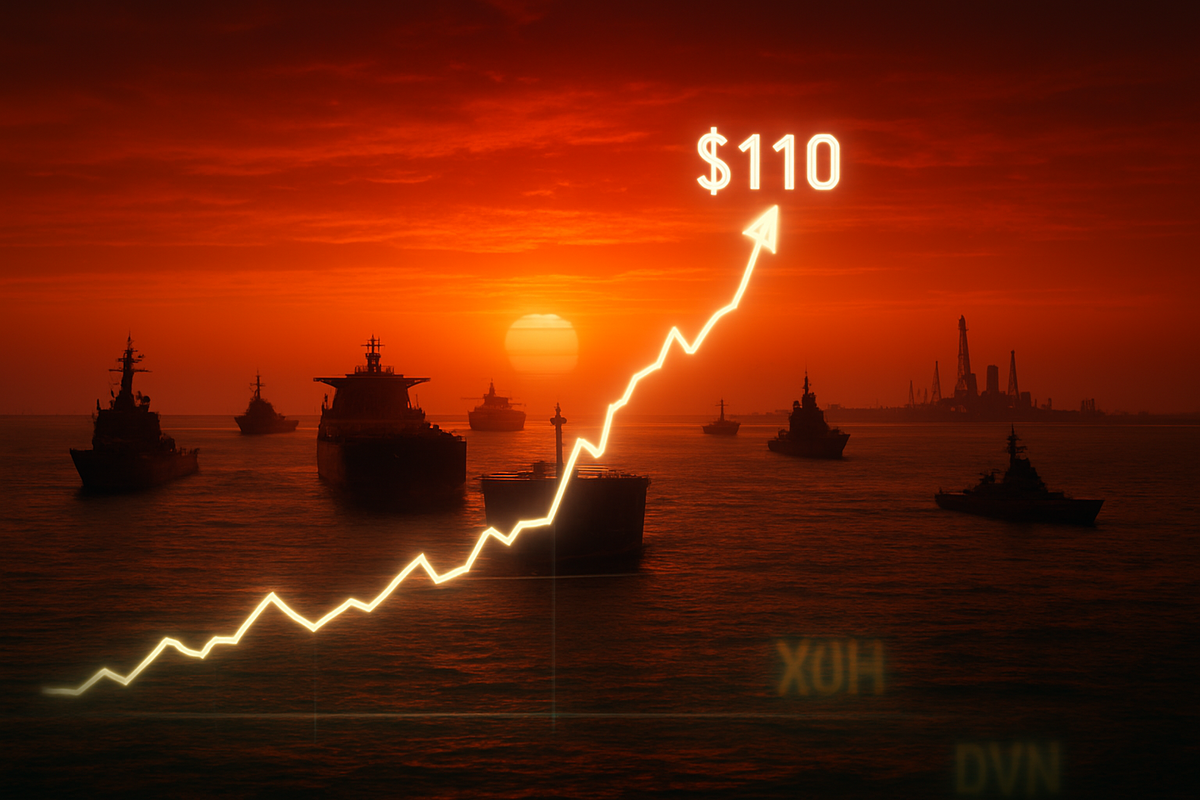
Global energy markets are currently teetering on the edge of a historic precipice as Brent crude oil prices shattered the $110 per barrel ceiling this week, peaking at $112.96. The surge is driven by a total blockade of the Strait of Hormuz, a critical maritime artery that has been effectively shuttered since early March following a dramatic escalation in hostilities between the United States and Iran. With nearly 20% of the world’s daily oil supply and significant quantities of liquefied natural gas (LNG) trapped behind the Iranian-enforced "chokehold," the global economy is bracing for a "warflation" shock not seen in decades.
The immediate implications are dire for global logistics and consumer prices, but the focus of every trading floor in the world is currently fixed on a ticking clock. The second Trump administration has issued a final 48-hour ultimatum—expiring today, April 7, 2026—demanding that Iran immediately reopen the Strait or face "total infrastructure destruction." As the deadline approaches, energy and basic materials stocks are experiencing unprecedented volatility, decoupling from the broader market as investors scramble to price in a potential full-scale military conflict in the Persian Gulf.
Maximum Pressure 2.0: The Path to $110 Oil
The current crisis is the culmination of a months-long "Maximum Pressure 2.0" campaign initiated by President Trump shortly after his return to office in 2025. The timeline of the escalation began in late December 2025, when widespread civil unrest in Iran prompted the U.S. to restore and expand severe sanctions. By January 12, 2026, the administration had imposed a 25% tariff on any nation continuing to trade with Tehran, effectively forcing a global choice between the Iranian and American economies. The situation turned kinetic in late February with "Operation Epic Fury," a joint U.S.-Israeli strike on Iranian nuclear and missile facilities in Isfahan and Natanz.
In retaliation, Iran declared a full blockade of the Strait of Hormuz on March 4, 2026. Since then, the physical disruption of roughly 20 million barrels of oil per day has sent prices on a vertical trajectory. Initial market reactions were panic-driven, with Brent crude piercing $100 within hours of the blockade’s announcement. Despite attempts at mediation, Iran rejected a 45-day ceasefire on March 27, leading to the current 48-hour deadline set by the White House. Stakeholders ranging from OPEC+ leaders to European energy ministers are now sidelined, as the geopolitical contest has shifted from diplomatic negotiations to a direct military standoff.
Market Bifurcation: The Winners and Losers of the Energy Crisis
The energy sector has fractured into two distinct camps: those insulated by geography and those exposed to Middle Eastern risk. Among the primary beneficiaries are U.S. shale "pure-plays" like Devon Energy (NYSE: DVN) and Diamondback Energy (NASDAQ: FANG). These companies are capturing the full upside of the $110+ price environment without the threat of physical supply disruption. Similarly, ExxonMobil (NYSE: XOM) and Chevron (NYSE: CVX) have seen their valuations bolstered by their domestic refining arms and massive 2026 buyback programs, which have provided a sturdy floor for their stock prices.
Conversely, global supermajors with deep ties to the Persian Gulf are under intense pressure. While high prices generally help oil producers, Shell (NYSE: SHEL), BP (NYSE: BP), and TotalEnergies (NYSE: TTE) have significant stakes in Qatari LNG and regional production facilities that are currently stranded. In the natural gas space, Equinor (NYSE: EQNR) has emerged as the "European Hedge," taking over as the continent's primary supplier as Qatari volumes vanish. Cheniere Energy (NYSE: LNG) has also seen massive gains as Asian and European buyers scramble for U.S.-sourced LNG to fill the void left by the blockade.
The impact extends deeply into the Basic Materials sector, where the "energy-to-commodity" transmission mechanism is in full swing. CF Industries (NYSE: CF) has surged over 40% this year, as its U.S.-based nitrogen production uses cheap domestic natural gas while global competitors face feedstock shortages. Other fertilizer giants like Nutrien (NYSE: NTR) and The Mosaic Company (NYSE: MOS) have also seen double-digit gains as the blockade threatens 25% of global urea and phosphate exports during the critical spring planting season. In metals, Alcoa (NYSE: AA) has "ripped" as traders price in the loss of aluminum smelting capacity in the UAE and Bahrain, while Dow Inc. (NYSE: DOW) has captured market share from Middle Eastern ethylene exporters.
Wider Significance: The Stagflationary Pivot
This event represents more than just a temporary price spike; it marks a "Stagflationary Pivot" for the global economy. For years, the Federal Reserve had been signaling potential interest rate cuts, but the $110 oil reality has forced a total reversal of that narrative. With "Warflation" now the dominant economic theme, the Fed is widely expected to "delete" any planned cuts to combat energy-driven inflation. This has placed immense pressure on growth-oriented sectors like Tech and Consumer Discretionary, as the cost of capital remains high while consumer spending power is eroded at the pump.
Historically, this situation echoes the oil shocks of the 1970s, but with the added complexity of modern integrated supply chains and the ongoing energy transition. The current crisis has effectively paused many "Green Energy" initiatives as Western governments prioritize energy security over carbon neutrality. Regulatory policies are shifting rapidly toward incentivizing domestic drilling and fast-tracking LNG export permits, representing a significant strategic pivot from the environmental focus of the early 2020s.
What Comes Next: Escalation or Resolution?
The short-term outlook depends entirely on the events of the next several hours. If the Trump administration’s deadline expires without a reopening of the Strait, military analysts warn of a "Phase 2" of Operation Epic Fury, targeting Iranian port infrastructure. Such an escalation could easily push crude prices toward $150 per barrel, a level that many economists believe would trigger a global recession. Strategic Petroleum Reserves (SPR) are already being tapped, but they cannot replace 20% of global supply indefinitely.
Long-term, the market is likely to see a permanent shift in how energy security is valued. Strategic pivots toward "safe jurisdiction" energy production will likely accelerate, benefiting U.S. and Canadian producers at the expense of Gulf-reliant firms. If a diplomatic cooling occurs, prices may retreat to the $80-$90 range, but the "geopolitical risk premium" is expected to remain baked into the market for the foreseeable future. Investors should prepare for a period of high volatility where "energy independence" is the primary driver of corporate valuation.
Final Wrap-Up: Navigating the 2026 Crisis
The surge of oil to $110 and the blockade of the Strait of Hormuz represent the most significant disruption to global energy markets in recent memory. The key takeaways for investors are clear: the era of cheap, reliable energy has been interrupted by a geopolitical standoff that shows no signs of an easy resolution. While Energy and Basic Materials stocks like DVN, CF, and AA provide a vital hedge against inflation and regional risk, the broader market remains vulnerable to the secondary effects of sustained high prices.
As the April 7 deadline arrives, the market is essentially in a holding pattern. Moving forward, the focus will shift from "if" oil will stay high to "how long" it will stay high. Investors should closely monitor the White House's 8:00 PM ET briefing and any movement of naval assets in the Persian Gulf. In this environment, the most valuable assets are no longer just those with the most reserves, but those with the most secure access to the market.
This content is intended for informational purposes only and is not financial advice.