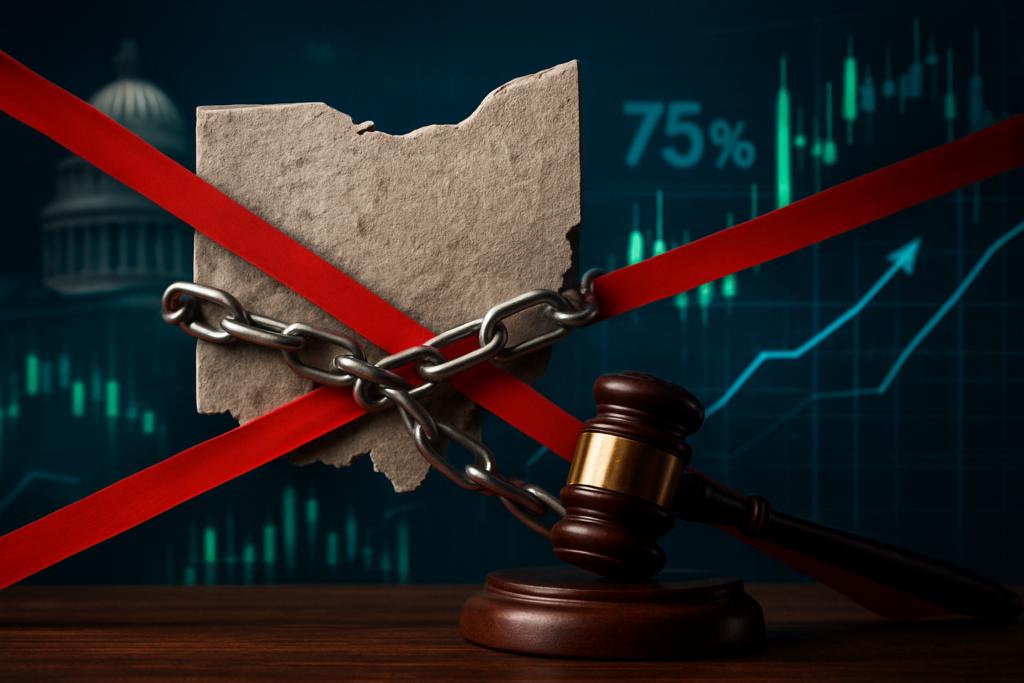
In a legal maneuver that has sent ripples through the prediction market community, the state of Ohio has formally doubled down on its efforts to block federally regulated exchanges from operating within its borders. On January 23, 2026, the Ohio Casino Control Commission (OCCC) filed a notice of supplemental authority in federal court, signaling a significant escalation in the battle between state gambling regulators and the Commodity Futures Trading Commission (CFTC). The move is aimed directly at KalshiEx LLC, the pioneer of regulated event contracts in the U.S., which is currently suing Ohio to protect its right to offer markets to the state’s residents.
Traders and legal analysts are watching this development with intense scrutiny. At the heart of the conflict is a fundamental question: does a federal license from the CFTC provide a "nationwide permission slip," or can individual states use their historic "police powers" to classify prediction markets as illegal gambling? With Ohio now leveraging a fresh legal victory from Massachusetts to bolster its case, the probability of a fragmented, state-by-state regulatory landscape for prediction markets has never been higher.
The Market: What's Being Predicted
While prediction markets are typically used to forecast elections or economic data, the "market" currently under the most intense observation is the legal survival of the industry itself. In the U.S. District Court for the Southern District of Ohio, the case KalshiEx LLC v. Ohio Casino Control Commission et al. has become the primary theater for this conflict. Kalshi seeks to prevent Ohio’s Attorney General, Dave Yost, and the OCCC from enforcing state gaming laws against its CFTC-regulated platform.
The tension has escalated since April 2025, when the OCCC issued cease-and-desist orders not only to Kalshi but also to major fintech players like Robinhood Markets, Inc. (NASDAQ: HOOD) and Crypto.com, alleging they were facilitating unlicensed sports gaming. Trading volume on these platforms in Ohio has effectively frozen as geofencing measures were tightened in response to the state’s aggressive posture. Investors are now pricing in a significant risk that other states will follow Ohio’s lead, potentially creating a "patchwork" regulatory environment similar to the early days of the U.S. sports betting rollout.
Resolution in the Ohio case is expected by mid-2026, but the recent filing of supplemental authority has accelerated the timeline. Ohio is specifically citing a January 20, 2026, ruling from Massachusetts, where a judge granted a preliminary injunction against Kalshi, effectively banning its sports-related event contracts. Ohio argues that this Massachusetts precedent provides the "roadmap" for why state laws should not be preempted by federal commodities law.
Why Traders Are Betting
The primary driver of the current uncertainty is the strategic pivot by state attorneys general. Led by Ohio’s Dave Yost, a coalition of 36 states has argued that prediction markets—particularly those involving elections and sports—pose "life-altering consequences" for citizens if left to the relatively light-touch oversight of the CFTC. This perspective stands in stark contrast to the "Selig Doctrine" currently emerging from Washington.
The new CFTC Chairman, Michael Selig, who was confirmed in December 2025, has championed a "future-proof" regulatory framework that views prediction markets as essential financial hedging tools. Traders who are bullish on the industry had hoped that Selig’s permissive stance would override state-level concerns. However, the Massachusetts ruling has proven that state judges are increasingly sympathetic to the argument that the Commodity Exchange Act (CEA) does not explicitly displace state gaming commissions.
Market participants are also closely watching the behavior of traditional sportsbooks like FanDuel, owned by Flutter Entertainment plc (NYSE: FLUT), and DraftKings Inc. (NASDAQ: DKNG). In a bold move in August 2025, OCCC Executive Director Matthew Schuler warned these licensed operators that their Ohio gaming licenses would be at risk if they even peripherally associated with prediction market exchanges. This has effectively isolated Kalshi and its peers from the broader gaming ecosystem in the Midwest, forcing traders to weigh the risk of total exclusion from the Ohio market.
Broader Context and Implications
The Ohio-Massachusetts alliance represents a significant shift in the narrative of prediction markets. For years, the industry was viewed through a federal lens—a battle between the CFTC and exchanges. Now, the conflict has shifted to a "Federalism vs. Preemption" fight. If Ohio succeeds in using the Massachusetts ruling to defeat Kalshi's motion for a preliminary injunction, it could set a precedent that renders a CFTC license nearly worthless in a dozen or more "restrictive" states.
This reveals a deep public sentiment divide regarding the nature of "event contracts." While Silicon Valley and Wall Street view these as "truth machines" and hedging instruments, state regulators in the "Rust Belt" and beyond continue to view them through the prism of consumer protection and tax revenue. By labeling these contracts as "gaming," Ohio ensures it can maintain its 20% tax on sports gaming revenue—a revenue stream that prediction markets, which operate as low-fee exchanges, currently do not provide to the state.
Historically, prediction markets have thrived when they have clear, singular regulatory oversight. The current friction mirrors the early 20th-century battles over "bucket shops," where states successfully shuttered unregulated exchanges. The difference today is that the exchanges are federally licensed, creating a constitutional clash that may ultimately require intervention from the U.S. Supreme Court to resolve the ambiguity of the Commodity Exchange Act.
What to Watch Next
The immediate next step is the ruling from the U.S. District Court for the Southern District of Ohio on Kalshi’s request for a preliminary injunction. Following the January 23 filing of the Massachusetts authority, a decision is expected within the next 30 days. If the court sides with Ohio, expect an immediate "domino effect" as states like New Jersey, Nevada, and Tennessee—who have already been coordinating with Ohio—move to issue their own injunctions.
Another critical milestone is the CFTC’s formal notice-and-comment rulemaking, scheduled to begin in February 2026. Chairman Selig’s attempt to codify prediction market rules could include language specifically intended to preempt state laws. However, if the courts have already ruled in favor of state "police powers" by then, the CFTC’s rules may arrive too late to protect the exchanges from being geofenced out of significant portions of the U.S. population.
Finally, keep a close watch on the 2026 midterm election markets. If the legal blockade in Ohio remains in place, it will serve as the first major test of how a "fragmented market" affects the accuracy of these platforms. If Ohio residents—historically a bellwether for national trends—are excluded, the predictive power of these markets could be significantly diminished, potentially impacting the liquidity and utility that make them attractive to traders in the first place.
Bottom Line
The "Buckeye Blockade" is more than just a local regulatory dispute; it is a fundamental challenge to the federal government's authority over the next generation of financial markets. Ohio’s strategic use of the Massachusetts ruling as "supplemental authority" shows that state regulators are no longer acting in isolation—they are building a collective legal arsenal to keep prediction markets under the thumb of state gambling commissions.
For prediction markets to serve as effective tools for social and economic forecasting, they require broad, liquid participation. The current pushback from Ohio threatens to Balkanize the U.S. market, creating a scenario where a trader's ability to hedge against political or economic risk depends entirely on their zip code.
As we move further into 2026, the likely outcome is a prolonged period of legal volatility. While the CFTC may want to usher in a new era of "event-driven finance," Ohio has made it clear that the path to a national market runs directly through the state house in Columbus—and the gate is currently locked.
This article is for informational purposes only and does not constitute financial or betting advice. Prediction market participation may be subject to legal restrictions in your jurisdiction.
PredictStreet focuses on covering the latest developments in prediction markets.
Visit the PredictStreet website at https://www.predictstreet.ai/.