Electrical connector manufacturer Amphenol (NYSE: APH) reported revenue ahead of Wall Street’s expectations in Q3 2026, with revenue up 65.1% year on year to $10.23 billion. In addition, next quarter’s revenue guidance ($10.4 billion at the midpoint) was a surprising 6.1% above analysts’ consensus estimates. Its non-GAAP profit of $0.80 per share was 9.5% above analysts’ consensus estimates.
For more on Amphenol, read our free full research report.
Amphenol (APH) Q3 2026 highlights:
- Revenue $10.23 billion vs S&P analysts’ consensus estimates of $9.53 billion (65.1% year-on-year growth, 7.4% beat)
- Adjusted EPS $0.80 vs S&P analysts’ consensus estimates of $0.73 (9.5% beat)
- Revenue guidance $10.4 billion at the midpoint for Q4 2026, above analysts’ consensus estimates of $9.80 billion
- Adjusted EPS guidance $2.83 at the midpoint for the full year, beating analysts’ consensus estimates by 5.2%
- Operating margin 29.5%, up from 27.5% in the same quarter last year
- Free cash flow margin 15.8%, down from 19.6% in the same quarter last year
- Market capitalization $192.9 billion
“We are pleased to have closed the third quarter of 2026 with record sales and Adjusted Diluted EPS, both exceeding the high end of our guidance,” said Amphenol Chairman and Chief Executive Officer, R. Adam Norwitt. “Sales increased from prior year by 65%, driven by strong organic growth in most of our end markets, including continued exceptional organic growth in the IT datacom market, as well as contributions from the Company’s acquisition program. We also booked record orders in the quarter, resulting in a book-to-bill of 1.19:1. The Company realized strong profitability during the quarter with Adjusted Operating Margin reaching 29.7%. We are extremely proud of the Company’s outstanding performance.”
Revenue growth
A company’s long-term revenue performance can indicate its overall quality. Any business can deliver a good quarter or two, but the best consistently grow over the long term.
With $33.05 billion in revenue over the past 12 months, Amphenol is a large company in the business services sector and benefits from economies of scale, giving it an edge in distribution. This also gives it more leverage on its fixed costs than smaller competitors and the flexibility to offer lower prices.
Amphenol grew its revenue at a strong 26.3% compounded annual growth rate over the last five years. This shows demand for Amphenol was higher than for many business services companies.
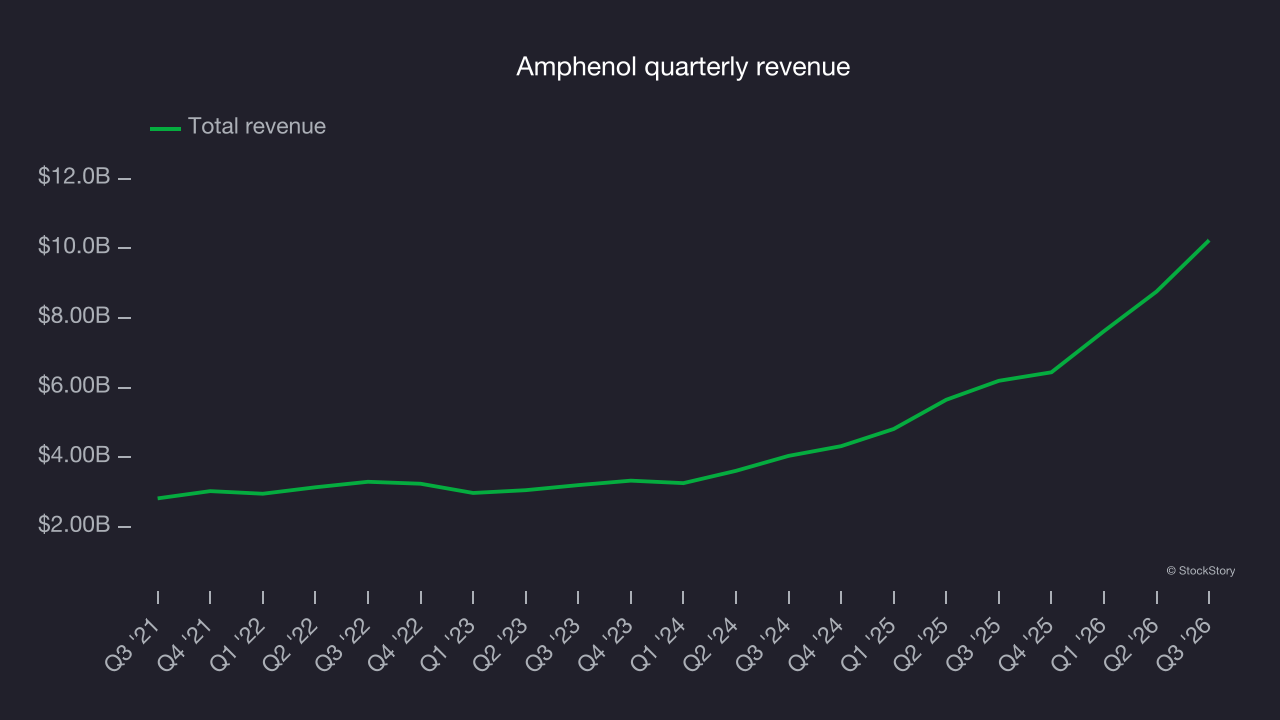
Long-term growth matters most, but within business services, a half-decade historical view may miss recent innovations or disruptive industry trends. Amphenol’s annualized revenue growth of 52.4% over the last two years is above its five-year trend, suggesting its demand was strong and recently accelerated. 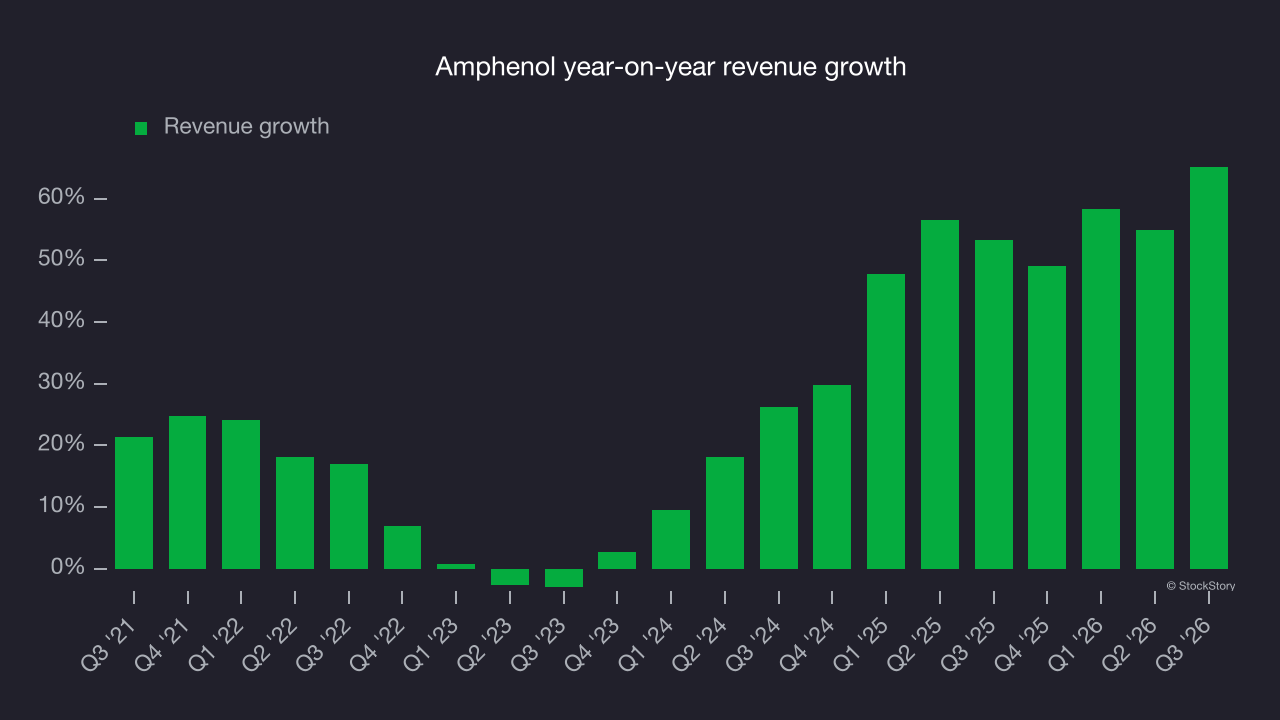
This quarter, Amphenol reported year-on-year revenue growth of 65.1%, and its $10.23 billion of revenue beat Wall Street’s consensus estimates by 7.4%. Company management is currently guiding for a 61.5% year-on-year increase in revenue next quarter.
Looking further ahead, sell-side analysts expect revenue to grow 23% over the next 12 months, according to S&P, a deceleration versus the last two years. Still, this projection is strong given its scale and suggests the market expects success for its products and services.
Adjusted operating margin
Amphenol has performed well over the last five years. It demonstrated high profitability for a business services company, with an average adjusted operating margin of 24.6%.
Looking at the trend in its profitability, Amphenol’s adjusted operating margin rose by 8.4 percentage points over the last five years, as its revenue growth provided significant operating leverage.
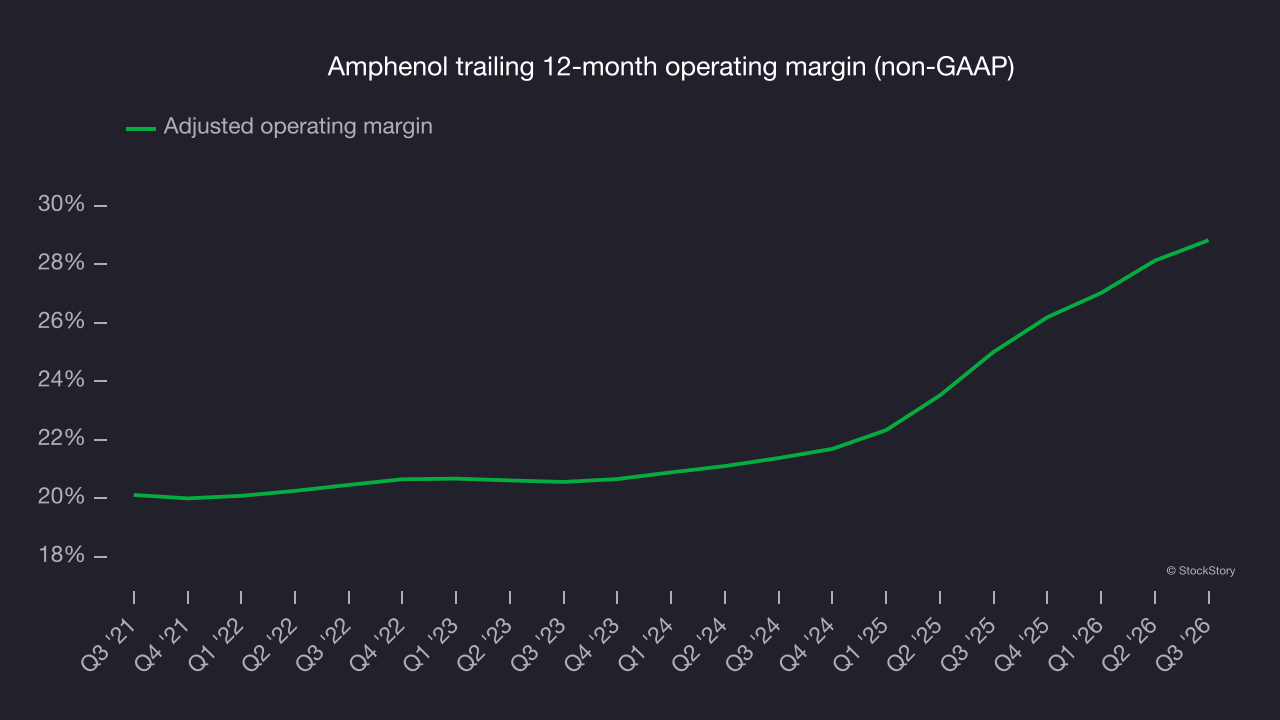
In Q3, Amphenol generated an adjusted operating margin of 30%, up 2.5 percentage points year on year. The increase was a positive sign of improved efficiency.
Earnings per share
Revenue trends explain a company’s historical growth, but the long-term change in earnings per share (EPS) points to the profitability of that growth. For example, a company could inflate its revenue through excessive spending on advertising and promotions.
Amphenol’s EPS grew at a 33.5% compounded annual growth rate over the last five years, higher than its 26.3% annualized revenue growth. This indicates the company became more profitable on a per-share basis as it expanded.
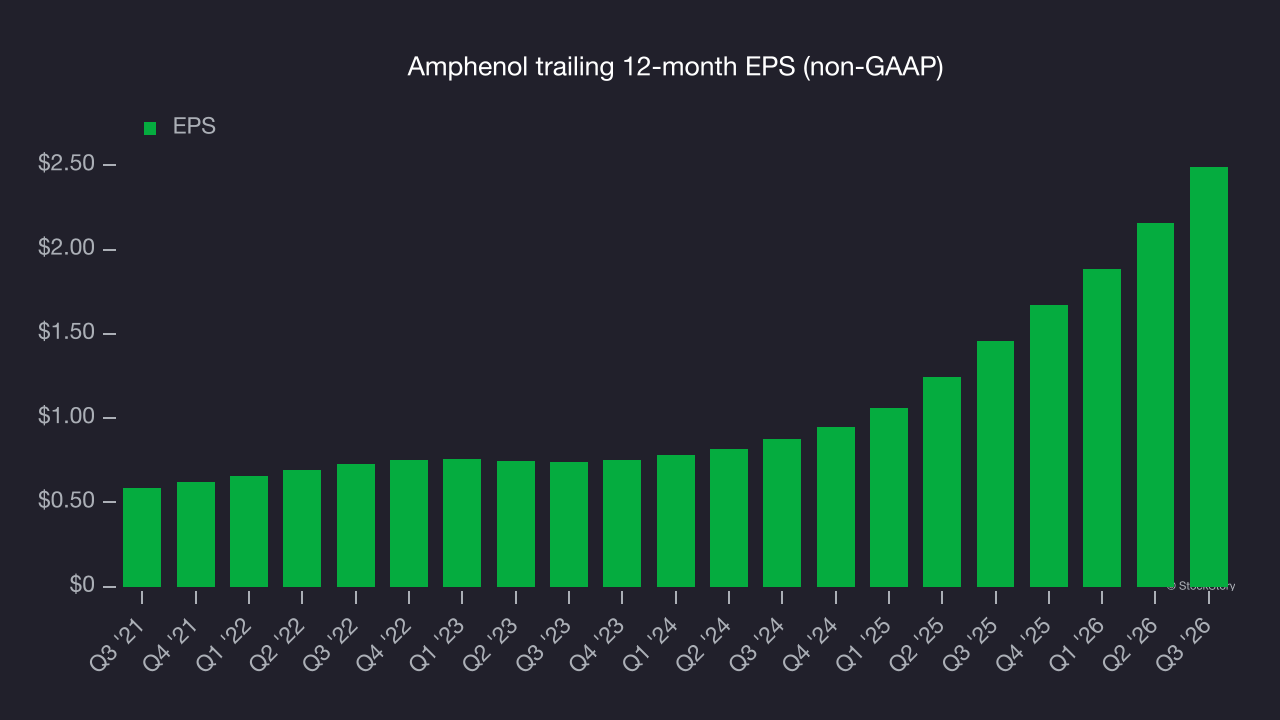
Diving into Amphenol’s quality of earnings can give us a better understanding of its performance. As we mentioned earlier, Amphenol’s adjusted operating margin expanded by 8.4 percentage points over the last five years. This was the most relevant factor (aside from the revenue impact) behind its higher earnings; interest expenses and taxes can also affect EPS but don’t tell us as much about a company’s fundamentals.
As with revenue, we analyze EPS over a shorter period to check for changes in the business.
For Amphenol, its two-year annual EPS growth of 68.7% was higher than its five-year trend. That acceleration is a positive sign, especially given the already high base.
In Q3, Amphenol reported adjusted EPS of $0.80, up from $0.47 in the same quarter last year. This result beat analysts’ consensus estimates by 9.5%. Over the next 12 months, Wall Street expects Amphenol’s full-year EPS to grow 24.5% from $2.49 to $3.10, according to S&P.
Key takeaways from Amphenol’s Q3 results
A wide revenue beat and next-quarter EPS guidance well above analysts’ consensus estimates were key positives in Amphenol’s Q3 report. Shares surged 6.9% to $83.57 immediately after the results.
Amphenol had a solid quarter, but assessing whether the stock is a buy requires a broader view. The latest quarter matters, but longer-term fundamentals and valuation carry more weight when deciding whether to buy the stock. For more on Amphenol, read our full research report here (it’s free).