Integrated energy company ExxonMobil (NYSE: XOM) fell short of the market’s revenue expectations in Q3 2026, but revenue rose 29.6% year on year to $110.5 billion. Its GAAP profit of $3.72 per share was 7% below analysts’ consensus estimates.
For more on ExxonMobil, read our free full research report.
ExxonMobil (XOM) Q3 2026 highlights:
- Revenue $110.5 billion vs S&P analysts’ consensus estimates of $118.3 billion (29.6% year-on-year growth, 6.6% miss)
- EPS (GAAP) $3.72 vs analysts’ consensus estimates of $4.00 (7% miss)
- Operating margin 19.2%, up from 12.9% in the same quarter last year
- Oil production down -3% year on year
- Market capitalization $753.7 billion
Revenue growth
Cyclical industries such as energy can make mediocre companies look strong for a time, but a long-term view reveals which businesses can actually withstand and adapt to changing conditions. Over the last five years, ExxonMobil grew its revenue at a mediocre 9.8% compounded annual growth rate, falling short of the benchmark for the energy upstream and integrated energy sector.
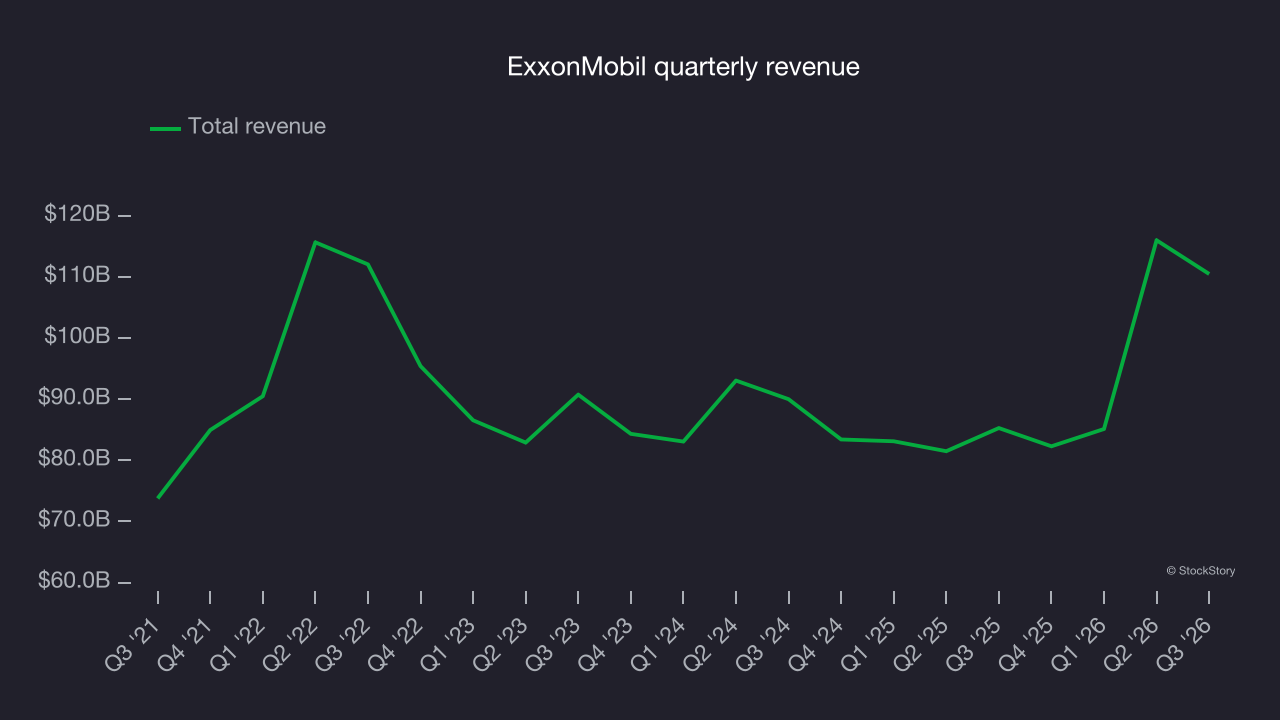
Within energy, a single time frame, even a long one, only sheds light on how well a company rode the last commodity cycle. An even longer, ten-year view helps assess whether a company compounds through cycles. ExxonMobil’s annualized revenue growth of 5.8% over the last ten years is below its five-year trend, but the results were still good.
While looking at revenue is important, it can also introduce noise around commodity prices and M&A. Analyzing drivers of revenue, on the other hand, highlights what is happening inside the asset base and whether the economic footprint of a company is expanding. Over the last two years, ExxonMobil’s oil production averaged 9.9% year-on-year growth. On the other hand, its natural gas production averaged 1.1% year-on-year declines.
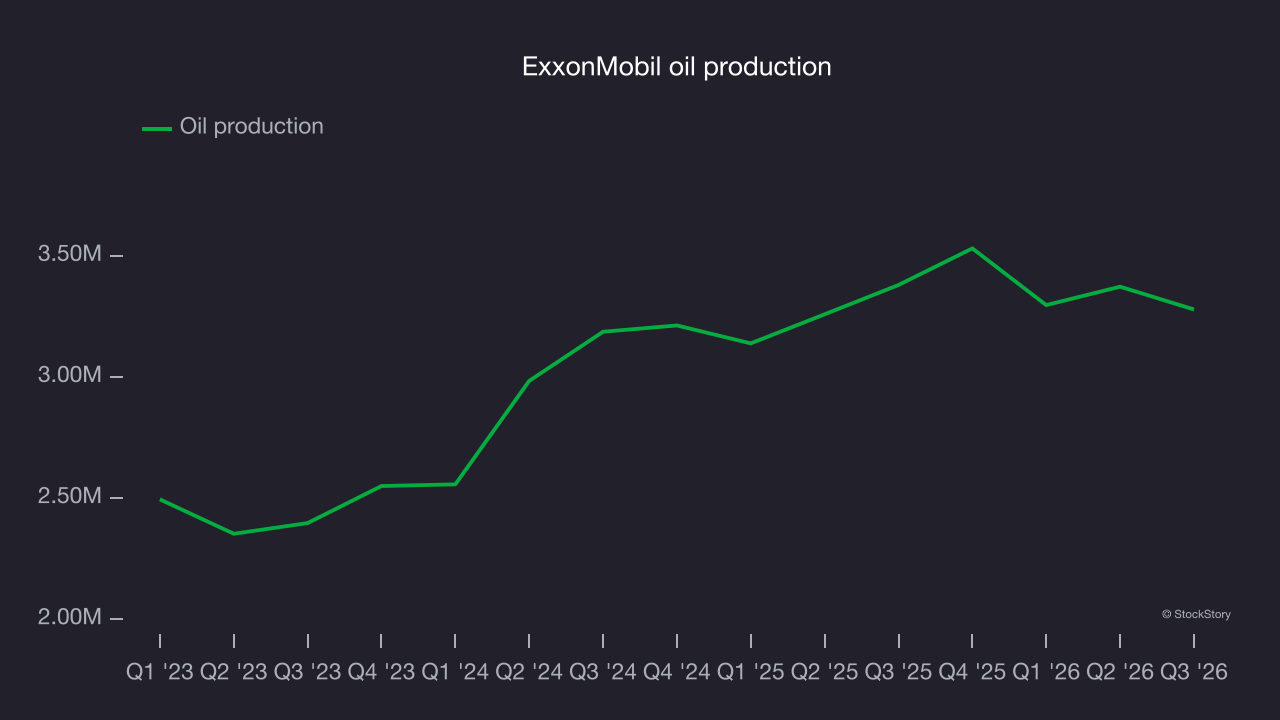
This quarter, ExxonMobil generated a strong 29.6% year-on-year revenue growth rate, but its $110.5 billion of revenue fell short of Wall Street’s high expectations. Its oil production fell by 3% year on year.
Adjusted EBITDA margin
Adjusted EBITDA margin captures the operating profitability of an energy producer by removing accounting effects related to depletion and capitalized drilling costs. It reveals how much cash the asset base generates before capital structure and reinvestment requirements shape reported earnings.
ExxonMobil was profitable over the last five years but held back by its large cost base. Its average EBITDA margin of 22.5% was weak for an upstream and integrated energy business.
ExxonMobil’s EBITDA margin may have fluctuated slightly, but it has generally stayed the same over the last year. This raises questions about the company’s expense base because its revenue growth should have given it leverage on its fixed costs, resulting in better economies of scale and profitability.
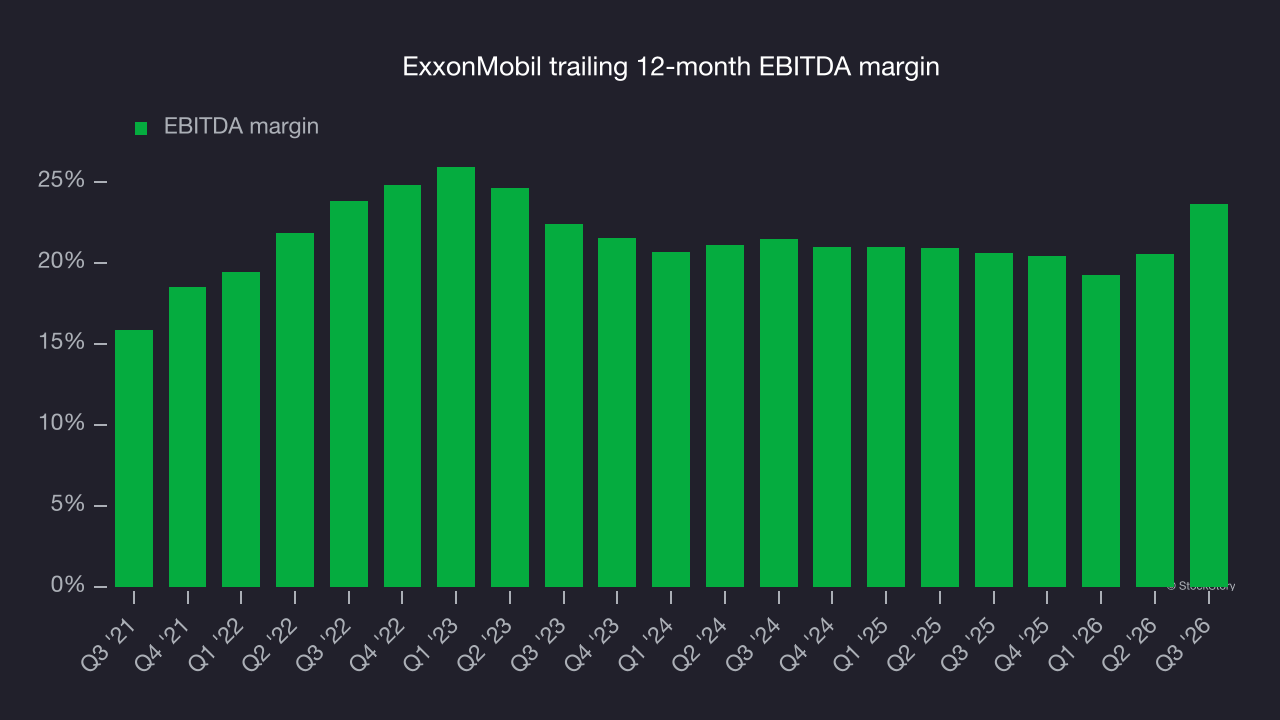
In Q3, ExxonMobil generated an EBITDA margin of 31.5%, up 11 percentage points year on year. This increase was a positive development and shows it was more efficient. Adjusted EBITDA beat Wall Street’s consensus estimates by 17.1%.
Key takeaways from ExxonMobil’s Q3 results
ExxonMobil’s revenue and EPS both fell short of Wall Street’s consensus estimates, making this a weaker quarter with few positives. Shares edged higher 1.9% to $186.82 immediately after the report.
To assess ExxonMobil as an investment right now, consider valuation and business quality as well as the latest earnings. For more on those factors, read the full research report here (it’s free).