
Local television broadcasting and media company Gray Television (NYSE: GTN) reported revenue ahead of Wall Street’s expectations in Q2 CY2026, with sales up 8.7% year on year to $839 million. On top of that, next quarter’s revenue guidance ($950 million at the midpoint) was surprisingly good and 6% above what analysts were expecting. Its GAAP profit of $0.21 per share was significantly above analysts’ consensus estimates.
Is now the time to buy Gray Television? Find out by accessing our full research report, it’s free.
Gray Television (GTN) Q2 CY2026 Highlights:
- Revenue: $839 million vs analyst estimates of $795.1 million (8.7% year-on-year growth, 5.5% beat)
- EPS (GAAP): $0.21 vs analyst estimates of -$0.08 (significant beat)
- Adjusted EBITDA: $214 million vs analyst estimates of $189.6 million (25.5% margin, 12.9% beat)
- Revenue Guidance for Q3 CY2026 is $950 million at the midpoint, above analyst estimates of $896.4 million
- Operating Margin: 16.2%, up from 10.6% in the same quarter last year
- Free Cash Flow was $121.2 million, up from -$18 million in the same quarter last year
- Market Capitalization: $436.5 million
Hilton Howell, Jr., Executive Chairman and CEO, commented, “Our second quarter 2026 results are starting to reflect the benefits of our M&A activity. We met or exceeded our second quarter guidance across every metric except corporate expense, which was higher due to transaction-related costs, and our net leverage ratio improved during the quarter. We are particularly pleased with political advertising, which significantly exceeded our second quarter guidance, and is trending ahead of not only 2024 but also 2022 year-to-date levels. Our Net Retransmission Revenue returned to year-over-year growth even excluding the 2026 acquisitions, despite the blackout that ended on May 1.
Company Overview
Specializing in local media coverage, Gray Television (NYSE: GTN) is a broadcast company supplying digital media to various markets in the United States.
Revenue Growth
A company’s long-term sales performance can indicate its overall quality. Any business can experience short-term success, but top-performing ones enjoy sustained growth for years. Unfortunately, Gray Television’s 4.8% annualized revenue growth over the last five years was weak. This fell short of our benchmark for the consumer discretionary sector and is a poor baseline for our analysis.
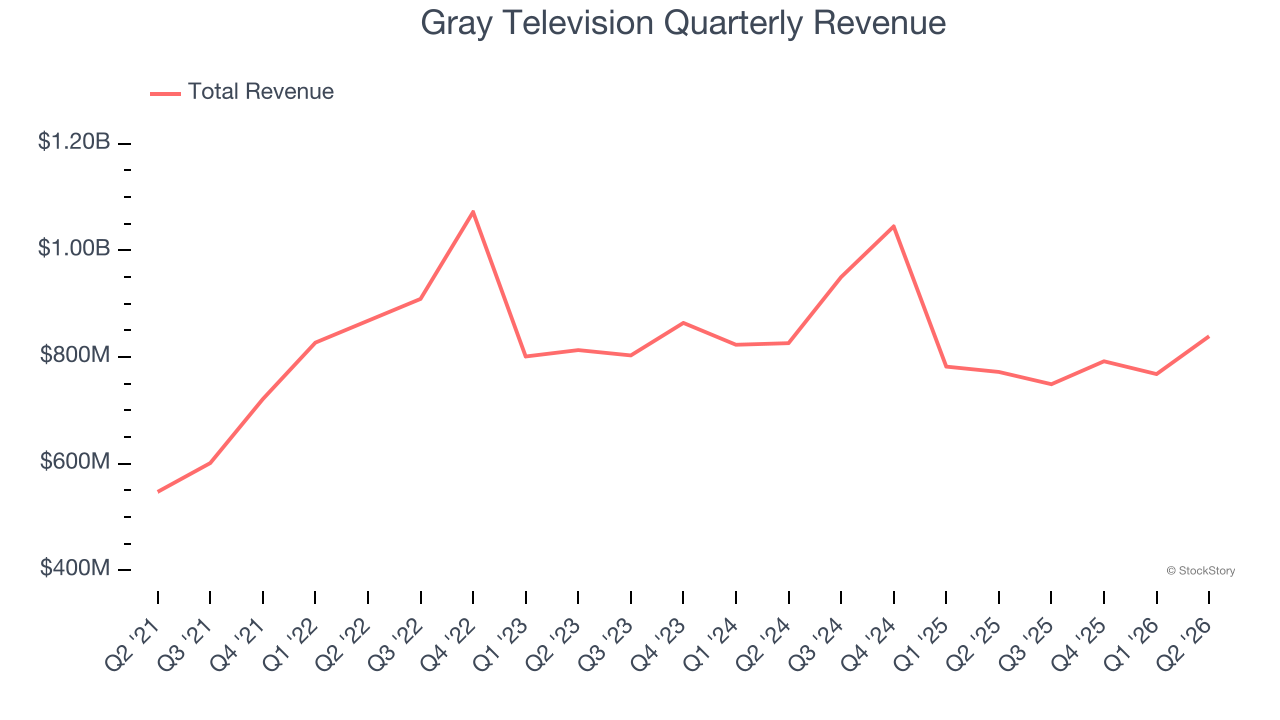
We at StockStory place the most emphasis on long-term growth, but within consumer discretionary, a stretched historical view may miss a company riding a successful new product or trend. Gray Television’s performance shows it grew in the past but relinquished its gains over the last two years, as its revenue fell by 2.6% annually. 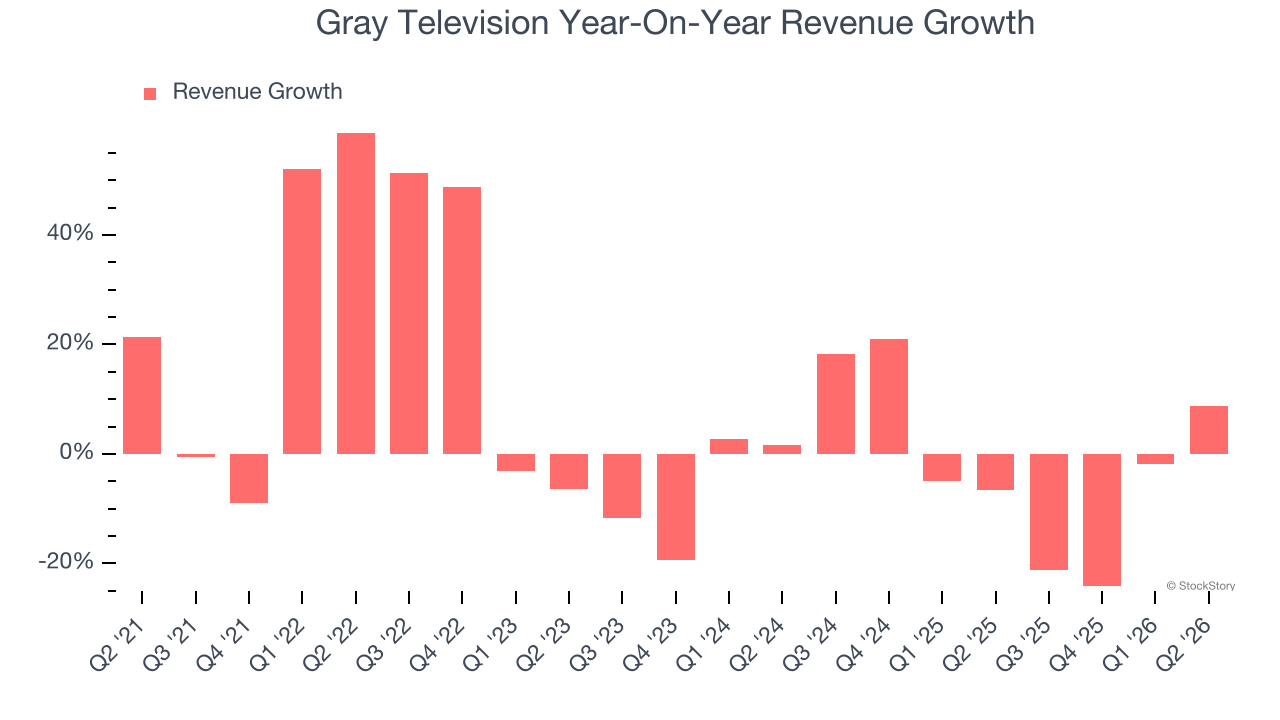
We can better understand the company’s revenue dynamics by analyzing its most important segments, Retransmission and Advertising, which are 42.6% and 42.8% of revenue. Over the last two years, Gray Television’s Retransmission revenue (affiliate and licensing fees) averaged 1.6% year-on-year declines while its Advertising revenue (marketing services) averaged 4.5% declines. 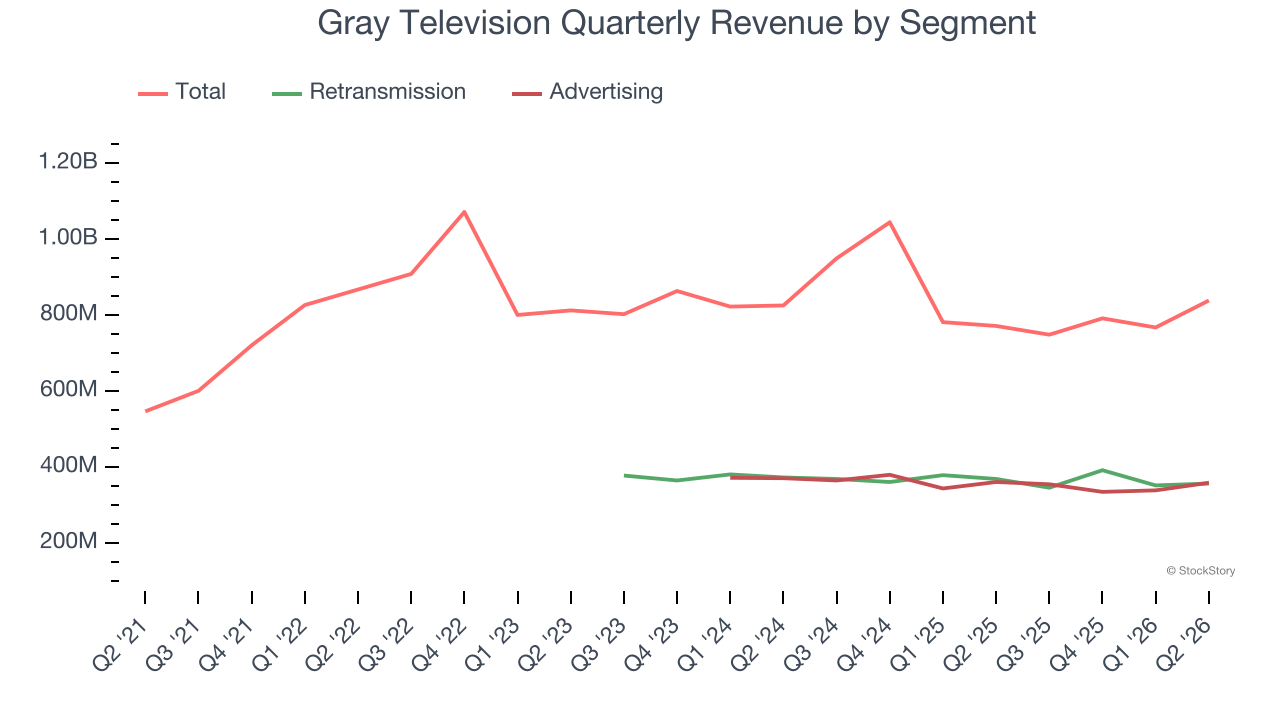
This quarter, Gray Television reported year-on-year revenue growth of 8.7%, and its $839 million of revenue exceeded Wall Street’s estimates by 5.5%. Company management is currently guiding for a 26.8% year-on-year increase in sales next quarter.
Looking further ahead, sell-side analysts expect revenue to grow 8.9% over the next 12 months. Although this projection suggests its newer products and services will fuel better top-line performance, it is still below the sector average.
ONE MORE THING: The $21 AI Application Stock Wall Street Forgot. While Wall Street obsesses over who’s building AI, one company is already using it to print money. And nobody’s paying attention.
AI chip stocks trade at ridiculous valuations. This company processes a trillion consumer signals monthly using AI and trades at a third of the price. The gap won’t last. The institutions will figure it out. You need to see this first. Read the FREE Report Before They Notice.
Operating Margin
Gray Television’s operating margin has been trending down over the last 12 months and averaged 17.7% over the last two years. The company’s profitability was mediocre for a consumer discretionary business and shows it couldn’t pass its higher operating expenses onto its customers.
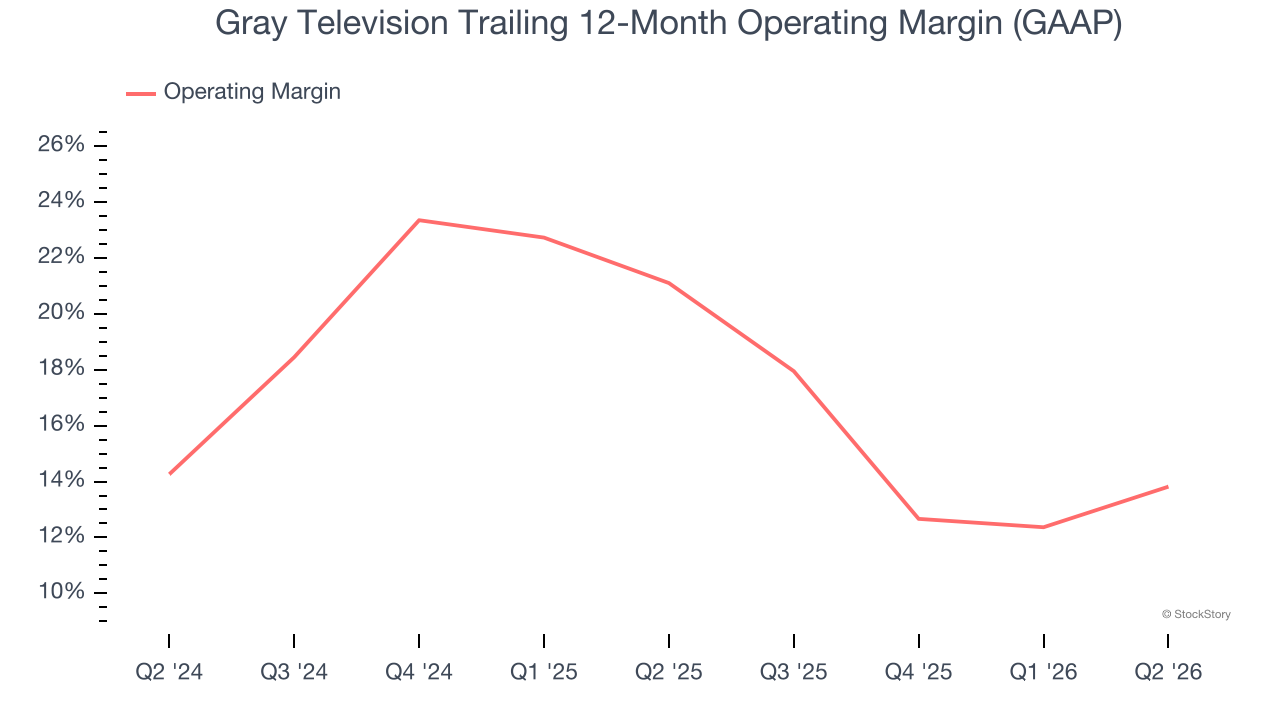
In Q2, Gray Television generated an operating margin profit margin of 16.2%, up 5.6 percentage points year on year. This increase was a welcome development and shows it was more efficient.
Earnings Per Share
We track the long-term change in earnings per share (EPS) for the same reason as long-term revenue growth. Compared to revenue, however, EPS highlights whether a company’s growth is profitable.
Sadly for Gray Television, its EPS declined by 16.6% annually over the last five years while its revenue grew by 4.8%. This tells us the company became less profitable on a per-share basis as it expanded.
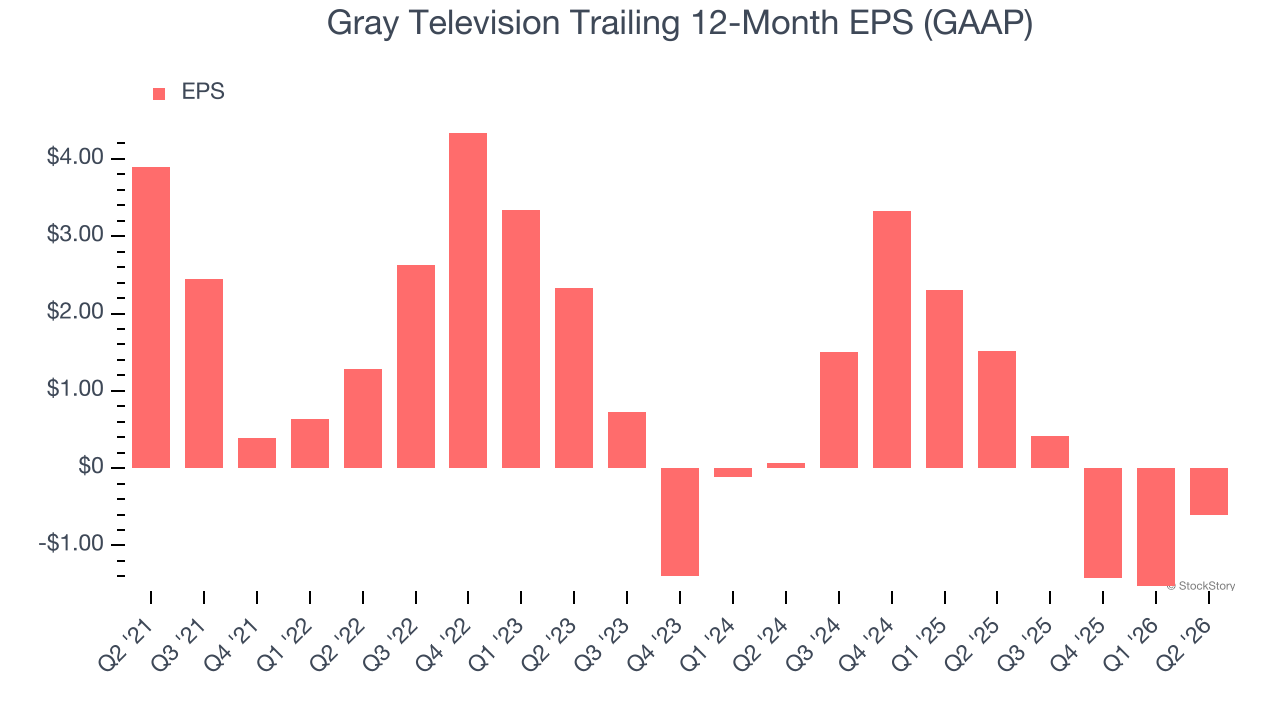
In Q2, Gray Television reported EPS of $0.21, up from negative $0.71 in the same quarter last year. This print easily cleared analysts’ estimates, and shareholders should be content with the results. Over the next 12 months, Wall Street is optimistic. Analysts forecast Gray Television’s full-year EPS will flip from negative $0.61 to positive $1.46.
Key Takeaways from Gray Television’s Q2 Results
It was good to see Gray Television beat analysts’ EPS expectations this quarter. We were also glad its revenue guidance for next quarter trumped Wall Street’s estimates. Zooming out, we think this was a good print with some key areas of upside. The stock traded up 8.9% to $4.66 immediately following the results.
Gray Television may have had a good quarter, but does that mean you should invest right now? If you’re making that decision, you should consider the bigger picture of valuation, business qualities, as well as the latest earnings. We cover that in our actionable full research report which you can read here (it’s free).