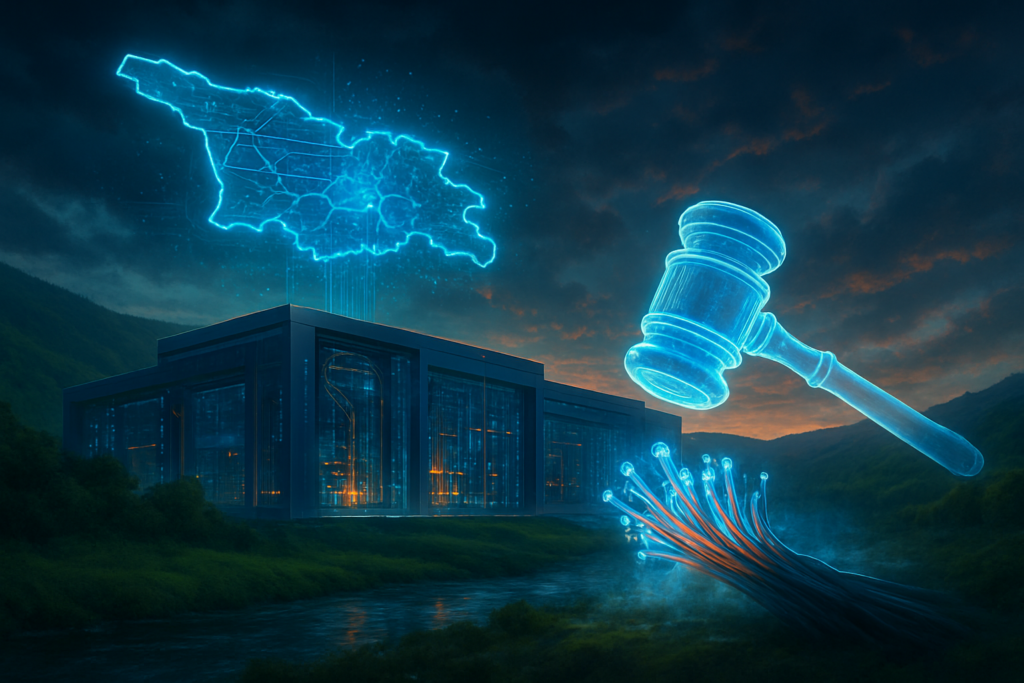
As the artificial intelligence revolution continues to accelerate, the state of Georgia—long a crown jewel for corporate relocation—has reached a sudden and dramatic breaking point. In a move that has sent shockwaves through the technology and energy sectors, Georgia lawmakers in the 2026 legislative session have introduced a series of aggressive bills aimed at halting the construction of new AI-driven datacenters. This legislative push, characterized by a proposed statewide moratorium and the repeal of long-standing tax incentives, marks a fundamental shift in how the "Top State for Business" views the environmental and economic costs of hosting the brains of the modern internet.
The urgency behind these measures stems from a burgeoning resource crisis that has pitted the world’s largest tech giants against local residents and environmental advocates. As of January 27, 2026, the strain on Georgia’s electrical grid and water supplies has reached historic levels, with utility providers forced to propose massive infrastructure expansions that critics say will lock the state into fossil fuel dependence for decades. This regional conflict is now being viewed as a national bellwether for the "resource-constrained" era of AI, where the digital frontier meets the physical limits of planetary capacity.
The Legislative "Barrage": HB 1012 and the Technical Strain
At the heart of the current legislative battle is House Bill 1012, introduced in January 2026 by Representative Ruwa Romman (D-Duluth). The bill proposes the first statewide moratorium on new datacenter construction in the United States, effectively freezing all new project approvals until March 1, 2027. This technical "pause" is designed to allow the state to overhaul its regulatory framework, which lawmakers argue was built for a pre-AI era. Unlike traditional data storage facilities, modern AI datacenters require exponentially more power and specialized cooling systems to support high-density GPU clusters, such as the Blackwell and Rubin chips from Nvidia (NASDAQ: NVDA).
The technical specifications of these facilities are staggering. A single large-scale AI campus can now consume up to 5 million gallons of water per day for cooling—roughly equivalent to the daily usage of a mid-sized city. Furthermore, the Southern Company (NYSE: SO), through its subsidiary Georgia Power, recently approved a 10-gigawatt energy expansion to meet this demand. This plan involves the construction of five new methane gas-burning plants, a technical pivot that environmentalists argue contradicts the state's decarbonization goals. Initial reactions from the AI research community suggest that while these bans may protect local resources, they risk creating a "compute desert" in the Southeast, potentially slowing the deployment of low-latency AI services in the region.
Corporate Fallout: Hyperscalers at the Crossroads
The legislative pivot represents a significant threat to the strategic positioning of tech giants who have invested billions in the "Silicon Peach." Microsoft (NASDAQ: MSFT) has been particularly aggressive in its Georgia expansion, with its Fayetteville "AI Superfactory" opening earlier this month and a 160-acre campus in Douglasville slated for 2026 completion. A statewide moratorium would jeopardize the second and third phases of these projects, potentially forcing Microsoft to re-evaluate its $1 billion "Project Firecracker" in Rome, Georgia. Similarly, Google (NASDAQ: GOOGL), which recently acquired 948 acres in Monroe County, faces a future where its land-banking strategy may be rendered obsolete by regulatory hurdles.
For these companies, the disruption extends beyond physical construction to their financial bottom lines. Senate Bill 410, sponsored by Senator Matt Brass (R-Newnan), seeks to repeal the lucrative sales and use tax exemptions that originally lured the industry to Georgia. If passed, the sudden loss of these incentives would fundamentally alter the ROI calculations for companies like Meta (NASDAQ: META), which operates a massive multi-building campus in Stanton Springs. Specialized AI cloud providers like CoreWeave, which relies on high-density deployments in Douglasville, may find themselves caught in a competitive disadvantage compared to rivals in states that maintain more lenient regulatory environments.
The Resource Crisis: AI’s Wider Significance
This legislative push in Georgia fits into a broader global trend of "resource nationalism" in the AI landscape. As generative AI models grow in complexity, the "invisible" infrastructure of the cloud is becoming increasingly visible to the public through rising utility bills and environmental degradation. Senator Chuck Hufstetler (R-Rome) introduced SB 34 specifically to address "ratepayer bag-holding," a phenomenon where residential customers are expected to pay an average of $20 more per month to subsidize the grid upgrades required by private tech firms. This has sparked a populist backlash that transcends traditional party lines, uniting environmentalists and fiscal conservatives.
Comparatively, this moment mirrors the regulatory crackdown on cryptocurrency mining in 2021, but with significantly higher stakes. While crypto was often dismissed as speculative, AI is viewed as essential infrastructure for the future of the global economy. The conflict in Georgia highlights a critical paradox: the very technology designed to optimize efficiency is currently one of the greatest drivers of resource consumption. If Georgia succeeds in curbing this expansion, it could set a precedent for other "data center alleys" in Virginia, Texas, and Ohio, potentially leading to a fragmented domestic AI infrastructure.
Future Developments: From Gas to Micro-Nukes?
Looking ahead, the next 12 to 24 months will be a period of intense negotiation and technological pivoting. If HB 1012 passes, experts predict a surge in "edge computing" developments, where AI processing is distributed across smaller, less resource-intensive nodes rather than centralized mega-campuses. We may also see tech giants take their energy needs into their own hands. Microsoft and Google have already begun exploring Small Modular Reactors (SMRs) and other advanced nuclear technologies to bypass the traditional grid, though these solutions are likely a decade away from large-scale deployment.
The immediate challenge remains the 2026 legislative session's outcome. Should the moratorium fail, industry experts predict a "land rush" of developers attempting to grandfather in projects before the 2027 sunset of existing tax breaks. However, the political appetite for unbridled growth has clearly soured. We expect to see a new breed of "Green Datacenter" certifications emerge, where companies must prove net-zero water usage and 24/7 carbon-free energy sourcing to gain zoning approval in a post-moratorium Georgia.
A New Era for the Silicon Peach
The legislative battle currently unfolding in Atlanta represents a seminal moment in AI history. For the first time, the rapid physical expansion of the AI frontier has collided with the legislative will of a major American state, signaling that the era of "growth at any cost" is coming to a close. The key takeaway for investors and tech leaders is clear: physical infrastructure, once an afterthought in the software-dominated tech world, has become the primary bottleneck and political flashpoint for the next decade of innovation.
As we move through the early months of 2026, all eyes will be on the Georgia General Assembly. The outcome of HB 1012 and SB 410 will provide a blueprint for how modern society balances the promise of artificial intelligence with the preservation of essential natural resources. For now, the "Silicon Peach" is a house divided, caught between its desire to lead the AI revolution and its duty to protect the ratepayers and environment that make that revolution possible.
This content is intended for informational purposes only and represents analysis of current AI developments.
TokenRing AI delivers enterprise-grade solutions for multi-agent AI workflow orchestration, AI-powered development tools, and seamless remote collaboration platforms.
For more information, visit https://www.tokenring.ai/.