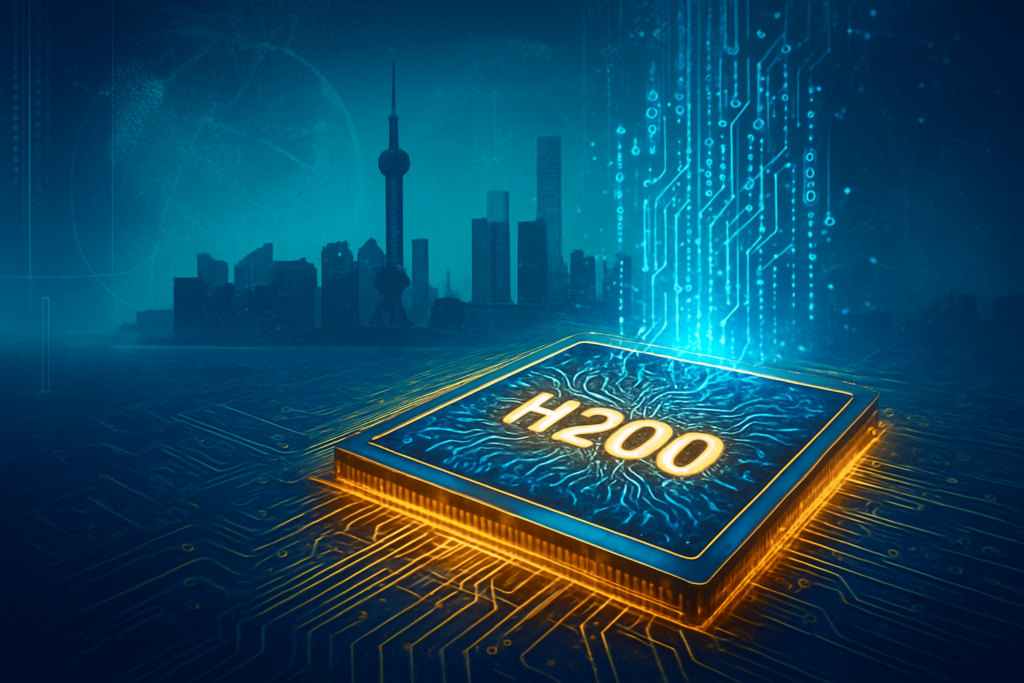
In a week that has redefined the intersection of Silicon Valley ambition and Beijing’s industrial policy, Nvidia CEO Jensen Huang’s high-profile visit to Shanghai has signaled a tentative but significant thaw in the AI chip wars. As of January 27, 2026, the tech world is processing the fallout of the U.S. Bureau of Industry and Security’s (BIS) mid-month decision to clear the Nvidia (NASDAQ: NVDA) H200 Tensor Core GPU for export to China. This pivot, moving away from a multi-year "presumption of denial," comes at a critical juncture for Nvidia as it seeks to defend its dominance in a market that was rapidly slipping toward domestic alternatives.
Huang’s arrival in Shanghai on January 23, 2026, was marked by a strategic blend of corporate diplomacy and public relations. Spotted at local wet markets in Lujiazui and visiting Nvidia’s expanded Zhangjiang research facility, Huang’s presence was more than a morale booster for the company’s 4,000 local employees; it was a high-stakes outreach mission to reassure key partners like Alibaba (NYSE: BABA) and Tencent (HKG:0700) that Nvidia remains a reliable partner. This visit occurs against a backdrop of a complex "customs poker" game, where initial U.S. approvals for the H200 were met with a brief retaliatory blockade by Chinese customs, only to be followed by a fragile "in-principle" approval for major Chinese tech giants to resume large-scale procurement.
The return of Nvidia hardware to the Chinese mainland is not a return to the status quo, but rather the introduction of a carefully regulated "technological leash." The H200 being exported is the standard version featuring 141GB of HBM3e memory, but its export is governed by the updated January 2026 BIS framework. Under these rules, the H200 falls just below the newly established Total Processing Performance (TPP) ceiling of 21,000 and the DRAM bandwidth cap of 6,500 GB/s. This allows the U.S. to permit the sale of high-performance hardware while ensuring that China remains at least one full generation behind the state-of-the-art Blackwell (B200) and two generations behind the upcoming Rubin (R100) architectures, both of which remain strictly prohibited.
Technically, the H200 represents a massive leap over the previous "H20" models that were specifically throttled for the Chinese market in 2024 and 2025. While the H20 was often criticized by Chinese engineers as "barely sufficient" for training large language models (LLMs), the H200 offers the raw memory bandwidth required for the most demanding generative AI tasks. However, this access comes with new strings attached: every chip must undergo performance verification in U.S.-based laboratories before shipment, and Nvidia must certify that all domestic U.S. demand is fully met before a single unit is exported to China.
Initial reactions from the AI research community in Beijing and Shanghai have been mixed. While lead researchers at ByteDance and Baidu (NASDAQ: BIDU) have welcomed the prospect of more potent compute power, there is an underlying current of skepticism. Industry experts note that the 25% revenue tariff—widely referred to as the "Trump Cut" or Section 232 tariff—makes the H200 a significantly more expensive investment than local alternatives. The requirement for chips to be "blessed" by U.S. labs has also raised concerns regarding supply chain predictability and the potential for sudden regulatory reversals.
For Nvidia, the resumption of H200 exports is a calculated effort to maintain its grip on the global AI chip market—a position identified as Item 1 in our ongoing analysis of industry dominance. Despite its global lead, Nvidia’s market share in China has plummeted from over 90% in 2022 to an estimated 10% in early 2026. By re-entering the market with the H200, Nvidia aims to lock Chinese developers back into its CUDA software ecosystem, making it harder for domestic rivals to gain a permanent foothold. The strategic advantage here is clear: if the world’s most populous market continues to build on Nvidia software, the company retains its long-term platform monopoly.
Chinese tech giants are navigating this shift with extreme caution. ByteDance has emerged as the most aggressive buyer, reportedly earmarking $14 billion for H200-class clusters in 2026 to stabilize its global recommendation engines. Meanwhile, Alibaba and Tencent have received "in-principle" approval for orders exceeding 200,000 units each. However, these firms are not abandoning their "Plan B." Both are under immense pressure from Beijing to diversify their infrastructure, leading to a dual-track strategy where they purchase Nvidia hardware for performance while simultaneously scaling up domestic units like Alibaba’s T-Head and Baidu’s Kunlunxin.
The competitive landscape for local AI labs is also shifting. Startups that were previously starved of high-end compute may now find the H200 accessible, potentially leading to a new wave of generative AI breakthroughs within China. However, the high cost of the H200 due to tariffs may favor only the "Big Tech" players, potentially stifling the growth of smaller Chinese AI firms that cannot afford the 25% premium. This creates a market where only the most well-capitalized firms can compete at the frontier of AI research.
The H200 export saga serves as a perfect case study for the geopolitical trade impacts (Item 23 on our list) that currently define the global economy. The U.S. strategy appears to have shifted from total denial to a "monetized containment" model. By allowing the sale of "lagging" high-end chips and taxing them heavily, the U.S. Treasury gains revenue while ensuring that Chinese AI labs remain dependent on American-designed hardware that is perpetually one step behind. This creates a "technological ceiling" that prevents China from reaching parity in AI capabilities while avoiding the total decoupling that could lead to a rapid, uncontrolled explosion of the black market.
This development fits into a broader trend of "Sovereign AI," where nations are increasingly viewing compute power as a national resource. Beijing’s response—blocking shipments for 24 hours before granting conditional approval—demonstrates its own leverage. The condition that Chinese firms must purchase a significant volume of domestic chips, such as Huawei’s Ascend 910D, alongside Nvidia's H200, is a clear signal that China is no longer willing to be a passive consumer of Western technology. The geopolitical "leash" works both ways; while the U.S. controls the supply, China controls the access to its massive market.
Comparing this to previous milestones, such as the 2022 export bans, the 2026 H200 situation is far more nuanced. It reflects a world where the total isolation of a superpower's tech sector is deemed impossible or too costly. Instead, we are seeing the emergence of a "regulated flow" where trade continues under heavy surveillance and financial penalty. The primary concern for the global community remains the potential for "flashpoints"—sudden regulatory changes that could strand billions of dollars in infrastructure investment overnight, leading to systemic instability in the tech sector.
Looking ahead, the next 12 to 18 months will be a period of intense observation. Experts predict that the H200 will likely be the last major Nvidia chip to see this kind of "regulated release" before the gap between U.S. and Chinese capabilities potentially widens further with the Rubin architecture. We expect to see a surge in "hybrid clusters," where Chinese data centers attempt to interoperate Nvidia H200s with domestic accelerators, a technical challenge that will test the limits of cross-platform AI networking and software optimization.
The long-term challenge remains the sustainability of this arrangement. As Huawei and other domestic players like Moore Threads continue to improve their "Huashan" products, the value proposition of a tariff-burdened, generation-old Nvidia chip may diminish. If domestic Chinese hardware can reach 80% of Nvidia’s performance at 50% of the cost (without the geopolitical strings), the "green light" for the H200 may eventually be viewed as a footnote in a larger story of technological divergence.
The return of Nvidia’s H200 to China, punctuated by Jensen Huang’s Shanghai charm offensive, marks a pivotal moment in AI history. It represents a transition from aggressive decoupling to a complex, managed interdependence. The key takeaway for the industry is that while Nvidia (NASDAQ: NVDA) remains the undisputed king of AI compute, its path forward in the world's second-largest economy is now fraught with regulatory hurdles, heavy taxation, and a mandate to coexist with local rivals.
In the coming weeks, market watchers should keep a close eye on the actual volume of H200 shipments clearing Chinese customs and the specific deployment strategies of Alibaba and ByteDance. This "technological peace" is fragile and subject to the whims of both Washington and Beijing. As we move further into 2026, the success of the H200 export program will serve as a bellwether for the future of globalized technology in an age of fragmented geopolitics.
This content is intended for informational purposes only and represents analysis of current AI developments.
TokenRing AI delivers enterprise-grade solutions for multi-agent AI workflow orchestration, AI-powered development tools, and seamless remote collaboration platforms.
For more information, visit https://www.tokenring.ai/.