Rising at a CAGR of 33.4%, the market is driven by stringent weight regulations, ESG mandates, and rapid commercialization of electric air taxi platforms
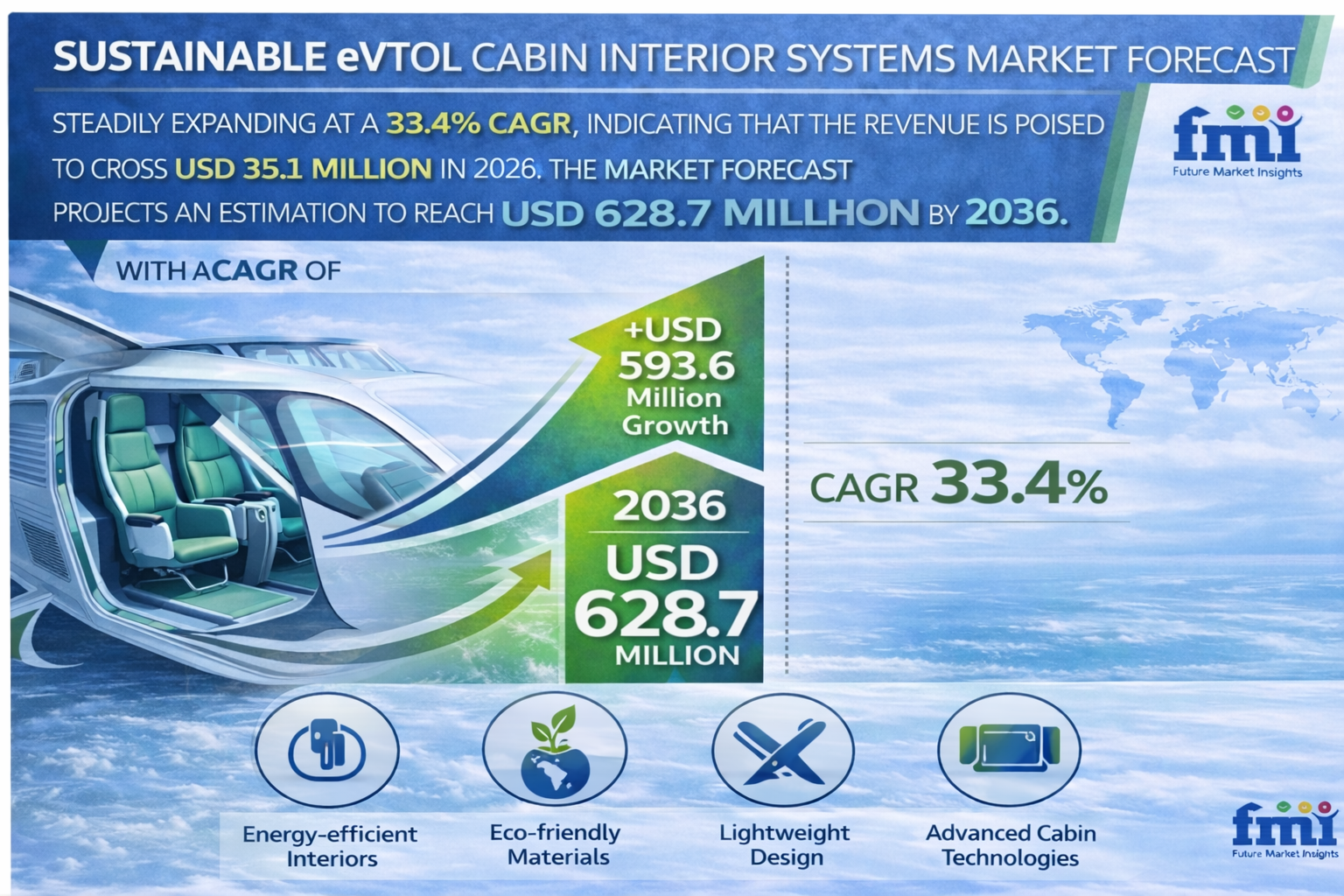
NEWARK, DE / ACCESS Newswire / March 24, 2026 / The global sustainable eVTOL cabin interior systems market is entering a high-growth phase as the aviation industry accelerates the transition toward electric vertical mobility and environmentally responsible aircraft design. Valued at USD 26.3 million in 2025, the market is projected to reach USD 35.1 million in 2026 and surge to USD 628.7 million by 2036, registering a robust CAGR of 33.4% during the forecast period.
This exponential growth reflects a fundamental shift in aircraft interior engineering, where sustainability, weight optimization, and regulatory compliance are becoming inseparable. Unlike traditional aviation interiors, sustainable eVTOL cabin systems must meet ultra-strict payload constraints while incorporating recycled and bio-based materials that align with evolving ESG mandates and certification requirements.
Get Access of Report Sample:
https://www.futuremarketinsights.com/reports/sample/rep-gb-32438
Market Value Analysis: Weight Constraints and Certification Pressures Driving Adoption
Between 2026 and 2030, the sustainable eVTOL cabin interior systems market is expected to witness rapid expansion as airframe OEMs finalize designs for commercial launch. Procurement teams are under intense pressure to meet strict weight budgets, often down to the gram, as battery limitations directly impact flight range and operational viability.
Airframe manufacturers are increasingly prioritizing:
Ultra-lightweight seating systems and modular cabin components
Recycled thermoplastics and PCR composite materials
Circular supply chains for traceable material sourcing
Rapid-swap interior architectures for high-frequency operations
Delays in selecting certified sustainable materials can significantly extend testing cycles and postpone type certification, ultimately impacting commercialization timelines and investor confidence.
From 2030 to 2036, market growth will be fueled by improvements in battery energy density and the emergence of modular cabin systems that allow operators to dynamically reconfigure interiors for passenger and cargo applications.
Technology Evolution: Sustainable Materials and Lightweight Engineering Transform Cabin Design
The evolution of sustainable eVTOL cabin interiors is being shaped by the convergence of material science, aerospace engineering, and environmental compliance. Key innovations include:
Recycled and bio-based composite panels for reduced carbon footprint
Lightweight seating structures designed for 16G crash compliance
Low-VOC adhesives and sustainable upholstery materials
Thermoformable composites enabling rapid manufacturing cycles
Modular interior systems for quick maintenance and replacement
A critical challenge lies in balancing sustainability with performance. Bio-based materials often require additional coatings or resins to meet flammability and durability standards, which can offset weight advantages. As a result, material innovation is focused on achieving optimal strength-to-weight ratios without compromising environmental goals.
An industry analyst notes:
"The real challenge is not just making interiors sustainable-it is ensuring they meet aviation-grade safety, durability, and weight requirements simultaneously. Suppliers that solve this equation will define the future of eVTOL cabin design."
Precision Interior Engineering Becoming Central to eVTOL Commercialization
As the eVTOL industry moves toward commercialization, cabin interiors are emerging as mission-critical components rather than secondary design elements. These systems enable:
Lightweight passenger seating for maximum payload efficiency
Acoustic damping to mitigate rotor noise in urban environments
Rapid turnaround operations through modular design
Enhanced passenger comfort within compact cabin footprints
Compliance with stringent aviation safety and sustainability standards
This shift is redefining competitive dynamics, where interior system performance directly influences aircraft range, operational efficiency, and passenger experience.
Segment Spotlight
Seating Systems Lead Component Segment (31.0%)
Seating dominates due to strict crash-test requirements and its significant impact on overall weight distribution.
Recycled Thermoplastics Dominate Material Segment (34.0%)
These materials enable rapid production and lightweight construction, aligning with aggressive manufacturing timelines.
Passenger Air Taxi eVTOLs Lead Application Segment (56.0%)
Early commercialization efforts are heavily focused on urban passenger transport.
OEM Line-Fit Installations Dominate Fitment (72.0%)
Standardized factory installations streamline certification and production processes.
Lightweighting for Range Extension Leads Value Proposition (39.0%)
Weight reduction remains the most critical factor influencing design decisions.
Regional Insights: Middle East and North America Leading Early Adoption
Country |
CAGR (2026-2036) |
Key Growth Drivers |
United Arab Emirates |
35.6% |
Sovereign investments in urban air mobility infrastructure |
United States |
34.8% |
Venture-backed startups and defense collaborations |
United Kingdom |
32.1% |
Structured regulatory testing corridors |
Germany |
31.4% |
Advanced manufacturing capabilities |
South Korea |
31.0% |
Integration of electronics and lightweight materials innovation |
France |
30.8% |
Focus on sustainable luxury cabin design |
Brazil |
29.7% |
Strong regional aerospace manufacturing expertise |
Opportunities: Circular Materials and Modular Design Unlock New Value
Key growth opportunities in the market include:
Self-healing and durable surface coatings for extended lifecycle
Embedded sensors for real-time structural health monitoring
Acoustic metamaterials for enhanced passenger comfort
Modular rapid-swap cabin architectures
Digital material passports for lifecycle traceability
These innovations are enabling scalable, cost-efficient, and sustainable interior solutions tailored for high-frequency urban air mobility operations.
Competitive Landscape: Innovation and Certification Expertise Define Market Leadership
The sustainable eVTOL cabin interior systems market is characterized by a mix of established aerospace suppliers and emerging material innovators.
Leading players include:
Diehl Aviation
Expliseat
Safran Seats
RECARO Aircraft Seating
Acro Aircraft Seating
Bcomp
Gen Phoenix
Competitive differentiation is increasingly driven by:
Ability to meet stringent certification requirements
Expertise in lightweight and sustainable material integration
Scalability of manufacturing processes
Speed of validation and deployment
Future Outlook: Sustainable Interiors Becoming Core to eVTOL Ecosystems
Looking ahead to 2036, sustainable cabin interior systems will play a central role in enabling scalable and commercially viable eVTOL operations.
Key trends include:
Integration of circular materials across all cabin components
Expansion of modular and reconfigurable interior systems
Increasing alignment between sustainability and performance metrics
Growth of urban air mobility networks worldwide
Standardization of certification pathways for new materials
As the eVTOL industry evolves, sustainable cabin interiors will transition from a regulatory requirement to a strategic differentiator-shaping the future of urban air transportation.
For an in-depth analysis of evolving formulation trends and to access the complete strategic outlook for the Sustainable eVTOL Cabin Interior Systems Market through 2036, visit the official report page at: https://www.futuremarketinsights.com/reports/sustainable-evtol-cabin-interior-systems-market
Browse More Automotive Industry Reports:
Aircraft Gearbox Market - https://www.futuremarketinsights.com/reports/aircraft-gearbox-market
Two-Wheeler Aftermarket Components & Consumables Market - https://www.futuremarketinsights.com/reports/two-wheeler-aftermarket-components-market
One-Pedal Brake Control Modules Market - https://www.futuremarketinsights.com/reports/one-pedal-brake-control-modules-market
Low-Noise Low-Dust EV Brake Components Market - https://www.futuremarketinsights.com/reports/low-noise-low-dust-ev-brake-components-market
Regenerative Brake Calibration Services Market - https://www.futuremarketinsights.com/reports/regenerative-brake-calibration-services-market
About Future Market Insights (FMI)
Future Market Insights (FMI) is a leading provider of market intelligence and consulting services, serving clients in over 150 countries. Headquartered in Delaware, USA, with a global delivery center in India and offices in the UK and UAE, FMI delivers actionable insights to businesses across industries including automotive, technology, consumer products, manufacturing, energy, and chemicals.
An ESOMAR-certified research organization, FMI provides custom and syndicated market reports and consulting services, supporting both Fortune 1,000 companies and SMEs. Its team of 300+ experienced analysts ensures credible, data-driven insights to help clients navigate global markets and identify growth opportunities.
For Press & Corporate Inquiries
Rahul Singh
AVP - Marketing and Growth Strategy
Future Market Insights, Inc.
+91 8600020075
For Sales - sales@futuremarketinsights.com
For Media - Rahul.singh@futuremarketinsights.com
For web - https://www.futuremarketinsights.com/
SOURCE: Future Market Insights, Inc.
View the original press release on ACCESS Newswire