The White House has confirmed that President Donald Trump will meet his Chinese counterpart, Xi Jinping, in May. The meeting between leaders of the world’s two biggest economies — whose relations have been strained but remain economically intertwined — will be watched closely by markets, including Nvidia (NVDA) investors.
The U.S. chip giant’s once-sprawling China business has come to a standstill amid the back-and-forth over export control restrictions and China’s aspiration to become self-sufficient in artificial intelligence (AI) chips.
U.S. Chip Export Restrictions Took a Toll on Nvidia’s China Business
Nvidia has long rued the U.S. ban on exports of high-end AI chips to China, which has virtually locked the company out of the world’s second-biggest market for AI chips. Last year, CEO Jensen Huang said that China was a $50 billion opportunity for the company in 2025 alone if the company was “able to address it with competitive products.”
During the fiscal Q4 2026 earnings call last month, Nvidia CFO Colette Kress said, “While small amounts of H200 products for China-based customers were approved by the U.S. government, we have yet to generate any revenue. And we do not know whether any imports will be allowed into China.” Nvidia has incidentally stopped accounting for any China revenues in its forward guidance, given the uncertainty over that market.
Notably, while the U.S. allowed exports of H200 chips to China after Nvidia agreed to a 25% revenue cut, China reportedly blocked their imports in January but is said to have allowed imports now. China has been looking to support domestic AI chip producers, including the likes of Alibaba (BABA), which last year agreed to supply AI chips to state-owned telecommunication provider China Unicom. Chinese commentators have been critical of Nvidia selling “inferior” chips to the country. It hasn’t helped that Trump has publicly flaunted that the country is selling “obsolete” chips to China.
Nvidia has long argued that U.S. export control bans are counterproductive and would only spur innovation in China. Pointing to a spate of initial public offerings (IPOs) from Chinese chip companies, Colette said during the fiscal Q4 earnings call that its Chinese competitors “are making progress and have the potential to disrupt the structure of the global AI industry over the long term.”
Meanwhile, it's not that China does not need Nvidia chips to fulfill its AI ambitions, and there have been intermittent reports of these being smuggled into the communist country. In one of the largest enforcement actions to date, federal prosecutors charged three individuals, including a co-founder and Senior VP of Super Micro Computer (SMCI), Yih-Shyan "Wally" Liaw, with conspiring to smuggle $2.5 billion worth of AI servers containing Nvidia GPUs to China.
Would the U.S. Allow Exports of High-End Chips to China?
We shouldn’t really expect Trump to allow exports of more advanced chips to China during his visit, given the political climate back home, where Democrats want the country to freeze Nvidia's existing export licenses after the chip-smuggling case. However, warming of relations between the two countries would still be incrementally positive for chip companies like Nvidia. We could see the needle move forward on chip exports to China, and it could be a bargaining chip in the talks.
It would, however, be folly to expect it to be business as usual for Nvidia in China ever again. The country has built its own tech stack and has its own versions of Alphabet's (GOOG) (GOOGL) Google, Meta Platforms' (META) Facebook, and Netflix (NFLX). Given the strategic importance of AI, it is no surprise that the world’s second-biggest economy is looking to build its own AI ecosystem with domestic AI models and chips.
Over the long term, China will likely also look at exporting AI capabilities — signs of such plans are already visible. For instance, Alibaba, which is a key AI player in China, has announced data centers globally in countries like France, the UAE, Brazil, and Japan.
Should You Buy NVDA Stock?
All said, China remains a wild card for Nvidia, and like the company, even markets don’t seem to be accounting for much revenue from the country while valuing the stock. This means that any positive progress on U.S chip exports to China following Trump's meeting with Xi would be incrementally positive for Nvidia.
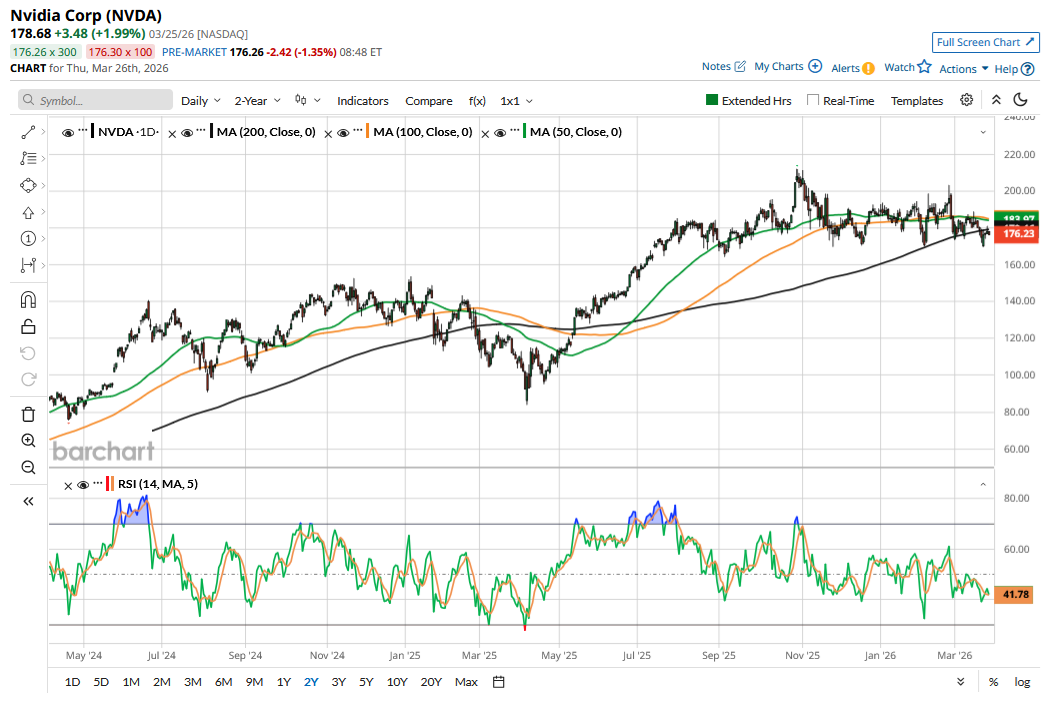
As for Nvidia stock, for quite some time now, I have been noting that investors should temper their expectations and not expect it to keep doubling every year. However, the stock could still deliver decent returns from these levels as Nvidia remains central to the AI revolution despite rising competition from both U.S. and Chinese companies.
On the date of publication, Mohit Oberoi had a position in: NVDA , GOOG , META , NFLX , BABA . All information and data in this article is solely for informational purposes. For more information please view the Barchart Disclosure Policy here.
More news from Barchart
- Google Just Unveiled TurboQuant: Should You Sell Sandisk Stock Now?
- Investors Have Been Waiting to Buy the Dip in This Hot Biopharma Stock
- Netflix Is Attractive to Value Buyers - Shorting Puts Can Set a Lower Buy-In Point
- Nvidia Is Doubling Down on the Energy Industry with SLB. Does That Strengthen the NVDA Bull Case Now?