The gamified learning market has moved from investor curiosity to institutional category in under a decade. What began as a handful of scrappy classroom apps in the mid-2010s has matured into a multi-billion-dollar segment attracting attention from strategic acquirers, private equity, and public market analysts alike.
The shift is visible in the numbers. Kahoot listed publicly in 2019. Duolingo followed with a widely-watched IPO in 2021. Roblox demonstrated that education-adjacent platforms could sustain multi-billion-dollar valuations. And a next generation of platforms including Blooket, Prodigy, and Gimkit is now scaling on freemium models that resemble consumer software far more than traditional edtech.
This analysis examines the current state of the gamified learning market heading into 2026, the growth drivers investors are pricing in, the competitive landscape at the platform level, and the risks that could reshape the sector over the next several years.
What Is the Current State of the Gamified Learning Market?
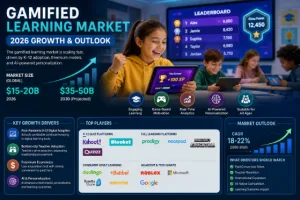
The gamified learning market in 2026 sits within the broader edtech sector and is estimated at roughly $15-20 billion globally, with credible industry projections pointing toward $35-50 billion by 2030 depending on scope definitions. Growth is being driven by post-pandemic K-12 digital adoption, freemium monetization models, and consumer demand for adult learning platforms like Duolingo.
The category is easier to describe than to measure precisely. Analyst firms differ on where gamified learning ends and adjacent categories (general edtech, corporate training, mobile gaming) begin.
Two broad segments account for most of the current market value. K-12 classroom platforms including Kahoot, Blooket, Gimkit, Quizizz, and Prodigy dominate the school-based segment. Consumer language and skills platforms including Duolingo, Rosetta Stone, and Babbel dominate the adult self-paced segment.
Institutional adoption in K-12 has been the more visible growth story since 2020. National Education Association survey data from 2025 showed 82% of US teachers using at least three digital platforms weekly, up from 61% in 2020. That level of adoption has created durable installed bases that platforms can now monetize through school-wide licensing and premium teacher tiers.
The consumer segment tells a different story. Duolingo’s public filings show sustained double-digit annual revenue growth and profitable operations, demonstrating that gamified learning can support both mass-market user counts and paid conversion economics at scale. That combination has been notably rare in adjacent edtech categories.
What Are the Key Drivers of Gamified Learning Market Growth?
The key drivers of gamified learning market growth include post-pandemic K-12 digital infrastructure investment, teacher-led bottom-up adoption patterns that bypass traditional district procurement, freemium monetization economics that lower customer acquisition costs, and consumer demand for engaging alternatives to traditional online courses.
Each driver operates on a different time horizon, which is why the sector has been able to maintain growth even as some drivers plateau.
Driver 1: K-12 digital infrastructure investment. The 2020-2022 wave of federal ESSER funding accelerated device and connectivity purchases across US public schools. That created a Chromebook installed base that platforms could target without the friction of hardware sales. Similar dynamics played out in the UK, Australia, and parts of Southeast Asia.
Driver 2: Bottom-up teacher adoption. Unlike traditional edtech that required district-level sales cycles measured in years, current-generation gamified learning platforms grew primarily through individual teachers adopting free tools and then convincing colleagues. This inverted the sales motion and cut go-to-market costs dramatically.
Driver 3: Freemium unit economics. Platforms like Blooket, Kahoot, and Quizizz use free plans as the primary acquisition channel, then convert a percentage of engaged users to paid tiers. This mirrors the SaaS playbook that produced companies like Slack and Dropbox, applied to education. The conversion mechanism typically activates once a teacher has moved from occasional to weekly use of the platform; for example, teachers who host a Blooket game session multiple times per month are meaningfully more likely to upgrade than one-time users.
Driver 4: Consumer adult learning demand. Duolingo’s success demonstrated a large addressable market for adult learners willing to engage daily with gamified content. Language, coding, finance, and increasingly professional skills verticals have followed similar patterns with varying success.
Driver 5: AI-assisted content generation. Since 2024, platforms have integrated AI to help teachers generate question sets and lesson content in minutes rather than hours. This reduced one of the biggest barriers to platform adoption and expanded the addressable user base.
Who Are the Major Players in the Gamified Learning Market?
The major players in the gamified learning market include publicly traded companies like Kahoot (Oslo), Duolingo (Nasdaq), and Roblox (NYSE), alongside private companies with significant scale including Blooket, Gimkit, Prodigy, Quizizz, and Nearpod. Together these platforms serve hundreds of millions of monthly active users across K-12 and consumer segments globally.
Here is the competitive landscape as it stands in 2026, organized by segment and ownership status.
K-12 classroom quiz platforms — Kahoot (public), Blooket (private), Gimkit (private), Quizizz (private-VC backed). This subcategory has seen the most competitive pressure as platforms compete on feature depth, game mode variety, and free-tier generosity. Gamified learning platforms like Blooket have grown primarily through freemium adoption, with paid conversion driven by teachers who want expanded analytics and premium features after months of consistent classroom use.
Full learning platforms — Prodigy (private), Nearpod (owned by Renaissance Learning), Minecraft Education (owned by Microsoft). These provide more integrated lesson delivery than pure quiz tools and typically serve district-level rather than individual teacher purchasing decisions.
Consumer adult learning — Duolingo (public), Babbel (private), Rosetta Stone (public via Cambium/private equity ownership), Memrise (private). Language dominates this segment, but adjacent verticals in coding (Codecademy), finance, and general skills continue to attract capital.
Adjacent platforms with education verticals — Roblox (public, education initiatives), Microsoft (Minecraft Education, Teams for Education), Google (Classroom, Workspace for Education). These tech giants influence the sector without competing head-on with pure gamified learning specialists.
Here is a summary comparison of the market positioning across major segments.
| Segment | Ownership | Typical Revenue Model | User Scale |
| K-12 Classroom Quiz | Mostly private + Kahoot public | Freemium + district licensing | 10M-100M MAU |
| Full Learning Platform | Mixed public/private | District licensing + premium tiers | 10M-50M MAU |
| Consumer Adult | Mostly public | Freemium subscriptions | 50M-500M MAU |
| Tech Giant Education | Public | Bundled with productivity | 100M+ MAU |
What Risks and Headwinds Face the Gamified Learning Sector?
The gamified learning sector faces several material risks including declining school technology budgets after federal pandemic funding sunsets, growing regulatory scrutiny over student data privacy, market saturation in mature classroom quiz categories, competition from AI-native learning tools, and the ongoing challenge of proving durable learning outcomes rather than short-term engagement metrics.
Each risk has different implications for different subsegments and revenue models.
Risk 1: Post-ESSER budget contraction. US school technology spending has begun normalizing as one-time federal pandemic funds have been fully deployed or expired. Platforms heavily dependent on district licensing revenue face renewed budget pressure. Consumer-facing platforms and free-tier-driven K-12 platforms are less exposed.
Risk 2: Student data privacy regulation. Growing state-level regulation, particularly in California, Illinois, and New York, has raised compliance costs for edtech platforms. COPPA enforcement has intensified, and platforms without robust privacy infrastructure face potential penalties and access restrictions.
Risk 3: Category saturation. The classroom quiz platform category is showing signs of maturity. Teacher survey data suggests most US teachers have already selected their primary quiz platform, which shifts competition from acquisition to retention and expansion revenue.
Risk 4: AI-native competitors. New platforms built AI-first (rather than adding AI features to existing platforms) are creating competitive pressure across most subsegments. This is not yet a valuation-threatening dynamic, but it warrants monitoring over the next 24-36 months.
Risk 5: Learning outcome scrutiny. Growing academic pressure to demonstrate durable learning outcomes (rather than in-session engagement metrics) could reshape platform positioning. Platforms with strong retention data are better positioned than those emphasizing session length or completion rate alone.
Risk 6: International expansion complexity. Growth beyond core English-speaking markets has proven harder than initial projections suggested for most platforms. Curriculum localization, language variants, and local competition create meaningful barriers.
Frequently Asked Questions
How big is the gamified learning market in 2026?
The gamified learning market in 2026 is estimated at approximately $15-20 billion globally, sitting within the broader $400+ billion global edtech sector. Growth projections vary by analyst but generally point toward the $35-50 billion range by 2030, driven by continued K-12 digital adoption and expanding consumer adult learning platforms.
Which gamified learning companies are publicly traded?
Kahoot (Oslo Stock Exchange), Duolingo (Nasdaq), and Roblox (NYSE) are the most prominent publicly traded gamified learning companies as of 2026. Microsoft and Google offer significant education products but are diversified technology conglomerates rather than pure-play edtech investments for market analysis purposes.
What is the typical revenue model for gamified learning platforms?
The typical revenue model for gamified learning platforms is freemium: a robust free tier drives user acquisition, while paid tiers (individual teacher subscriptions, school licenses, or consumer subscriptions) drive monetization. Some platforms also generate revenue through district-level enterprise licensing, professional development services, or premium content marketplaces for teachers.
Is the gamified learning market still growing in 2026?
Yes, the gamified learning market is still growing in 2026, though the growth rate has moderated from the pandemic-era acceleration of 2020-2022. Analyst consensus points toward double-digit annual growth continuing through 2028, driven by expanding international adoption, AI-enhanced feature development, and consumer adult learning segment expansion.
What are the biggest competitive threats to established platforms?
The biggest competitive threats to established gamified learning platforms are AI-native competitors that build learning tools with generative AI at their core, tech giant education initiatives that bundle learning tools with productivity suites, and vertical-specific platforms that offer deeper domain expertise than general-purpose quiz tools. Each threat operates on different time horizons and impact scales.
How has AI affected the gamified learning market?
AI has affected the gamified learning market primarily by reducing content creation friction for teachers, enabling automatic question generation, and personalizing learning paths based on student performance. Since 2024, most major platforms have integrated AI features. The competitive question in 2026 is whether AI-native new entrants will displace existing platforms that added AI later.
What should investors watch in the gamified learning sector in 2026?
Investors watching the gamified learning sector in 2026 should track paid-tier conversion rates, teacher retention metrics beyond the first year of adoption, international revenue mix, exposure to district budget cycles, and the pace at which AI-native competitors take share in specific subcategories. Public filings from Kahoot and Duolingo remain the best proxy data for private-market analysis.
Are there any recent M&A trends in the sector?
Yes, recent M&A trends in the gamified learning sector include strategic acquisitions by larger edtech consolidators (Renaissance Learning acquiring Nearpod in 2021 set an ongoing pattern), private equity roll-ups of complementary platforms, and selective tech giant acquisitions of specialized learning tools. Valuation multiples have compressed from 2021 peaks but remain healthy for platforms with strong unit economics.
Conclusion
The gamified learning market in 2026 is neither the hype-driven category it was in 2021 nor the stagnant space that some post-pandemic pessimism suggested it would become. Growth has moderated but continues, and the subsegments have differentiated enough that generalized market commentary now misses more than it captures.
For strategic analysts, the more useful framework is subsegment-specific: K-12 quiz platforms competing on freemium unit economics and international expansion, consumer adult learning platforms competing on subscription retention and category expansion, and full learning platforms competing on district-level integration depth. Each subsegment has different growth trajectories, competitive dynamics, and risk exposures worth monitoring separately.
The single clearest signal for the next 18-24 months will be paid conversion trends across the freemium-heavy classroom quiz category. Platforms that can demonstrate durable teacher retention and expansion revenue will likely command premium valuations. Platforms that plateau on free-tier engagement without converting to sustainable revenue will face the same repricing that hit many pandemic-era edtech names in 2022-2023.