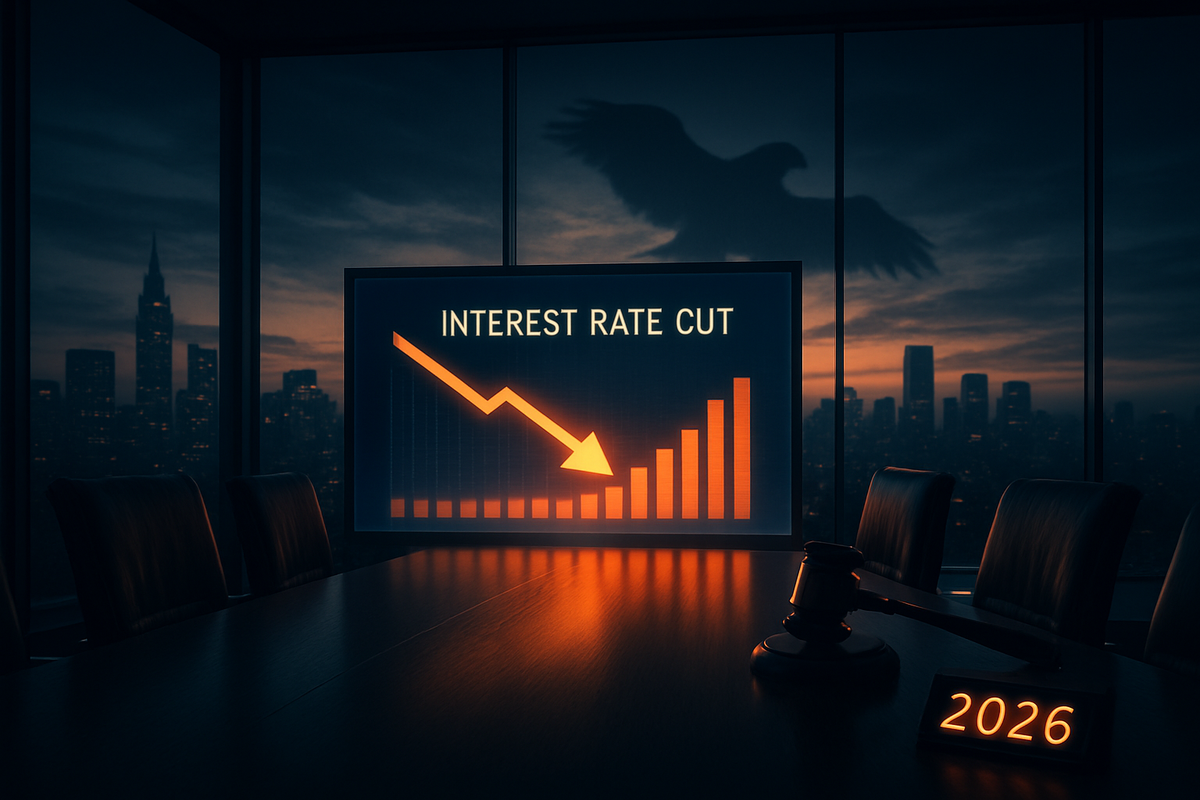
As the holiday season settles over Wall Street, the financial world is still vibrating from the Federal Reserve’s final act of 2025. In its December 10 meeting, the Federal Open Market Committee (FOMC) delivered a 25-basis-point rate cut, bringing the benchmark federal funds rate to a target range of 3.50% to 3.75%. However, what was intended as a gift to the markets was wrapped in a distinctly "hawkish" paper, leaving investors to grapple with a future where the "easy money" era remains a distant memory.
The move, while technically an easing of policy, was paired with a Summary of Economic Projections (SEP) that signaled a "higher-for-longer" floor. With the "Dot Plot" now projecting only one additional cut for the entirety of 2026, the central bank has effectively slammed the brakes on expectations for a rapid return to neutral rates. This "hawkish cut" has sent a clear message: the Fed is satisfied with the current restrictive stance, even as labor market cracks begin to show and a looming leadership transition at the central bank adds a layer of unprecedented political uncertainty.
A Contentious Pivot Amidst a Data Blackout
The December 2025 FOMC meeting was anything but routine. Held against the backdrop of a partial U.S. government shutdown that delayed critical November employment and inflation data, the committee was forced to fly partially blind, relying on private-sector proxies and "stale" October reports. This lack of clarity contributed to one of the most fractured votes in recent history, a 9-3 split that highlighted deep ideological rifts within the Fed.
While Chair Jerome Powell successfully steered the majority toward a 25-basis-point reduction, he faced significant dissent from both sides of the aisle. Governor Stephen Miran, a recent addition to the board, pushed for a more aggressive 50-basis-point cut to preemptively address a "fragile" labor market. Conversely, regional presidents Jeffrey Schmid and Austan Goolsbee favored a complete pause, citing "sticky" inflation—currently hovering at 2.7%—fueled by recent trade policy shifts and tariffs. In his press conference, Powell characterized the move as "cautious normalization," suggesting that the Fed has reached the "range of plausible estimates of neutral," a phrase that many interpreted as a signal that the cutting cycle is nearing its end.
Winners and Losers: Financials Diverge as Tech Faces Reality
The market reaction to the "hawkish cut" was swift and fragmented, revealing a landscape where "quality" and "resilience" are the new watchwords. The banking sector, typically a beneficiary of a steeper yield curve, saw a mixed bag of results. JPMorgan Chase & Co. (NYSE: JPM) saw its shares slide 4.7% following the announcement, as management warned of rising 2026 expenses and a cooling lending environment. In contrast, Wells Fargo & Co. (NYSE: WFC) surged 2.03%, buoyed by optimism regarding the potential removal of its long-standing asset cap and an improved outlook for net interest margins (NIM) in a stable-rate environment. Bank of America Corp. (NYSE: BAC) also showed resilience, gaining 0.4% as investors pivoted toward high-quality financials with strong balance sheets.
The technology sector, particularly the "Magnificent Seven," found little holiday cheer in the Fed's cautious stance. Microsoft Corp. (NASDAQ: MSFT) plummeted 2.74% as investors reassessed the high capital intensity of AI infrastructure in a world where the cost of capital remains elevated. Apple Inc. (NASDAQ: AAPL) and NVIDIA Corp. (NASDAQ: NVDA) remained relatively flat but volatile, as the market scrutinized valuations that many fear have outpaced the reality of a "soft landing" economy. Meanwhile, the real estate sector provided a rare bright spot; logistics giant Prologis, Inc. (NYSE: PLD) climbed 1.77%, as the "soft landing" narrative suggests continued demand for industrial space despite the Fed’s restraint.
Historical Echoes and the 'Powell Exit'
Analysts are increasingly drawing parallels between the current climate and the "mid-cycle adjustments" of 1995 and 2019. Like the Greenspan era of the mid-90s, the Fed is attempting to engineer a soft landing after a period of aggressive tightening. However, the 2025 context is complicated by a unique "term premium" in the bond market. The 10-year Treasury yield (US10Y) spiked to 4.20% following the December decision, reflecting investor fears that inflation may remain structurally higher due to shifting global trade dynamics—a challenge that was largely absent during the 2019 easing cycle.
Adding to the complexity is the looming "Powell Exit." With Jerome Powell’s term as Chair set to expire in May 2026, the market is already pricing in a "regime shift." Speculation regarding potential successors, such as Kevin Hassett or Christopher Waller, has created a "floor" for stock valuations, as many expect a more politically aligned successor to be more dovish. This has created a fascinating disconnect: while the Fed’s own "Dot Plot" forecasts only one cut in 2026, market futures—specifically SOFR (Secured Overnight Financing Rate) futures—are still pricing in at least two cuts, betting that a new Chair will be forced to move faster to manage federal debt and support growth.
Navigating the 2026 Horizon
Looking ahead, the first half of 2026 promises to be a period of significant volatility. The "lame duck" period for Chair Powell may lead to a communication vacuum, leaving markets sensitive to every piece of incoming data. If inflation continues to cool toward the Fed's 2% target, the pressure to cut rates more aggressively will mount, especially if the "fragile" labor market Miran warned about begins to crack. Conversely, if tariff-induced price spikes prove more than "one-time effects," the Fed may be forced to hold rates at 3.5% for the duration of the year, a scenario that could lead to a painful re-rating of growth stocks.
Strategic pivots will be required for both institutional and retail investors. The "easy trades" of 2024 and early 2025 are over. In this new "neutral" environment, stock picking will likely outperform broad index tracking. Investors should keep a close eye on sectors that benefit from a stable but elevated rate environment, such as infrastructure REITs like American Tower Corp. (NYSE: AMT), which can leverage long-term contracts against a clearer terminal rate.
The Final Word on the December Pivot
The Federal Reserve’s December 2025 decision will likely be remembered as the moment the "pivot party" ended and the "normalization grind" began. By delivering a cut but signaling a pause, the FOMC has successfully regained some of its "inflation-fighting" credibility, but at the cost of market certainty. The 9-3 split vote serves as a stark reminder that the path forward is anything but unanimous, and the upcoming leadership transition in May 2026 introduces a wildcard that no economic model can fully account for.
As we move into 2026, investors should watch for three key indicators: the persistence of "tariff inflation," the stability of the unemployment rate, and the political theater surrounding the next Fed Chair nominee. The "hawkish cut" of 2025 has set the stage for a year where the Federal Reserve will no longer be the market's tailwind, but rather a cautious observer in an increasingly unpredictable global economy.
This content is intended for informational purposes only and is not financial advice.