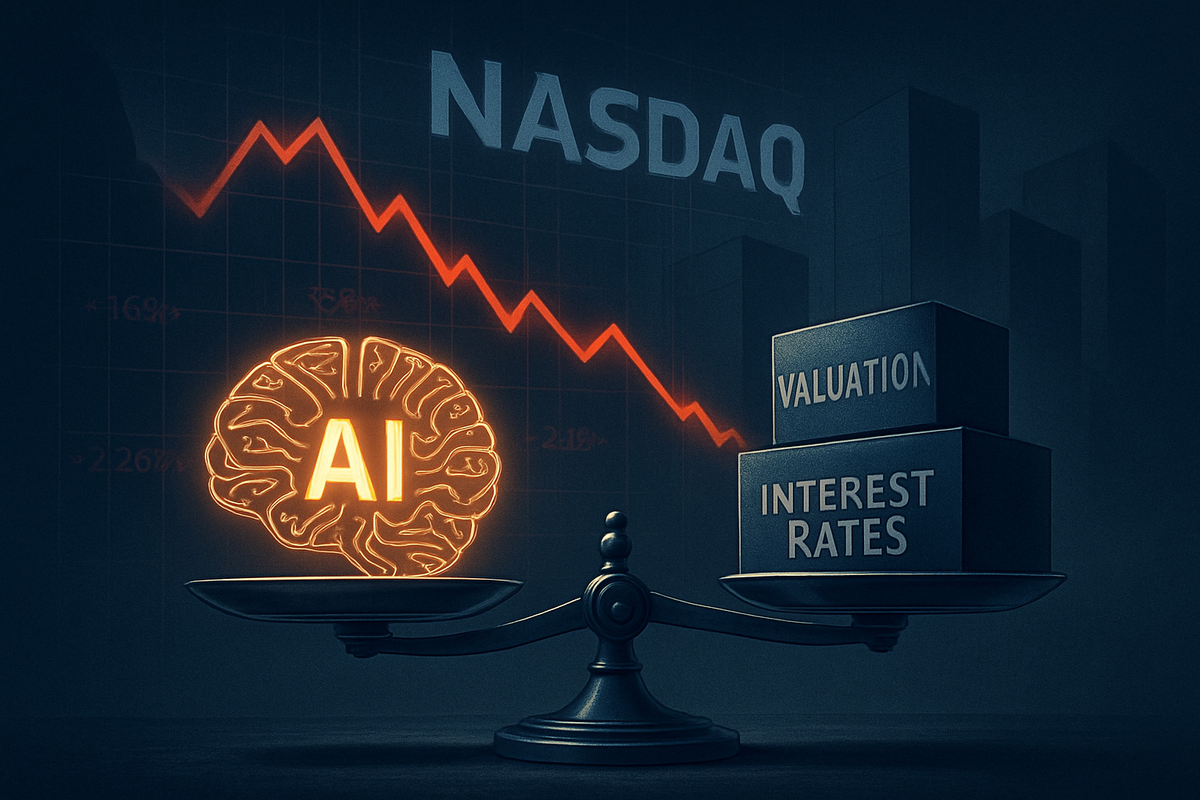
As the final trading sessions of 2025 unfold, the exuberant rally that defined much of the year for large-cap technology shares is hitting a formidable wall of skepticism. Investors are increasingly pivoting away from the "growth at any cost" mentality that propelled the Nasdaq Composite to record highs earlier this autumn, opting instead for a "Great De-Risking" strategy. This shift is driven by a combination of plateauing artificial intelligence (AI) sentiment, a surprisingly hawkish stance from the Federal Reserve, and a growing demand for tangible returns on the hundreds of billions of dollars poured into AI infrastructure over the last three years.
The immediate implications are visible across the board: the Nasdaq Composite, which had been the darling of the 2025 market, has retreated significantly from its October peaks, currently hovering around the 23,474 mark. While the index remains up more than 20% for the year, the late-December slump suggests that the "scarcity premium" previously enjoyed by the world’s largest tech firms is evaporating. As the market transitions into 2026, the focus has shifted from the "build" phase of the AI revolution to the "application" phase, leaving high-multiple stocks vulnerable to any perceived weakness in execution or monetization.
The current pressure on the Nasdaq is the culmination of a volatile fourth quarter. Following a triumphant summer where Nvidia (Nasdaq: NVDA) briefly touched a staggering $5 trillion market capitalization, the narrative began to sour in November. The primary catalyst was a "CapEx fatigue" that gripped institutional investors. Major hyperscalers collectively reported nearly $400 billion in annual capital expenditures directed toward data centers and specialized chips, yet the subsequent earnings calls failed to provide the granular evidence of bottom-line growth that the market now demands.
The situation was further complicated by the Federal Reserve's December 2025 meeting. While the central bank delivered a 25-basis-point cut—bringing the federal funds rate to a range of 3.50%–3.75%—it paired the move with a cautious outlook for 2026. Citing a sticky inflation rate of 3.1% and the lingering economic ripples of new trade tariffs, the Fed projected only one additional cut for the coming year. This "hawkish surprise" sent shockwaves through the tech sector, as higher-for-longer interest rates make the lofty price-to-earnings (P/E) multiples of tech giants—many still trading near 30x—increasingly difficult to justify.
Market reactions have been swift and decisive. Trading volume in the final weeks of December has remained thin, around 13 billion shares, but the selling pressure in the Nasdaq 100, currently near 25,644, has been concentrated in former leaders. Technical analysts have pointed to a "double top" reversal in the charts of several major players, signaling that the momentum which carried the market through 2024 and most of 2025 may finally be exhausted.
The impact of this valuation squeeze is not being felt equally across the "Magnificent Seven." Nvidia (Nasdaq: NVDA) has seen its shares fall approximately 5% in late December as the market questions the sustainability of its triple-digit growth rates in a post-infrastructure-boom world. Similarly, Microsoft (Nasdaq: MSFT) has faced technical weakness, with its premium valuation coming under intense scrutiny as investors look for more aggressive AI integration within its legacy software suites.
On the losing end of the spectrum, Tesla (Nasdaq: TSLA) has emerged as a severe laggard. The electric vehicle pioneer dived 3.3% in the final week of December alone, plagued by delivery misses and eroding margins that have persisted throughout 2025. Apple (Nasdaq: AAPL) also finds itself in a defensive position; despite a 10% gain on the year, it has underperformed its peers due to a perceived "slow-play" on agentic AI features and mounting regulatory pressure on its App Store ecosystem.
Conversely, some firms are proving more resilient. Alphabet (Nasdaq: GOOGL) remains a 2025 outperformer, up roughly 66% for the year thanks to breakthroughs in its Gemini 3 model and a surge in cloud revenue. However, even Alphabet is not immune, as recent court rulings have forced the company to share proprietary query data with competitors, structurally thinning its competitive moat. Amazon (Nasdaq: AMZN) is being viewed by many as a "safe harbor," with its $2.5 trillion market cap supported by accelerating revenue in AWS and newfound efficiencies in its e-commerce operations. Meta (Nasdaq: META) has also maintained late-year momentum, bolstered by its strategic acquisition of the AI startup Manus and favorable tax treatment under recent legislation.
This renewed pressure on tech is a signal of a broader maturation within the digital economy. The industry is moving away from the speculative "AI gold rush" and into a period of "Valuation Normalization." This trend mirrors the post-dot-com era or the 2022 correction, where the market eventually decoupled "hype" from "utility." The wider significance lies in the rotation of capital; as large-cap tech stalls, the "S&P 493"—the broader market excluding the top tech titans—has begun to outperform, suggesting a healthier, more diversified market breadth.
Regulatory shifts are also playing a pivotal role. The "One Big Beautiful Bill Act," signed into law in July 2025, has been a double-edged sword. While it restored the immediate expensing of domestic R&D costs—providing a massive cash-flow boost for firms like Meta—it also imposed strict supply chain integrity mandates. These mandates have forced companies to aggressively "de-risk" their exposure to prohibited foreign entities, particularly in the semiconductor space, leading to increased operational costs and logistical hurdles that are now weighing on margins.
Furthermore, the regulatory landscape has shifted from threats of corporate "breakups" to "behavioral remediation." The landmark rulings against Google's data monopoly represent a new era of forced transparency. This precedent could soon affect other platforms, potentially leveling the playing field for smaller competitors and mid-cap software firms like Palantir (Nasdaq: PLTR) and Salesforce (NYSE: CRM), who are eager to capitalize on the "Application Layer" of AI.
Looking ahead to 2026, the tech sector is expected to undergo a significant strategic pivot. The "AI infrastructure" trade, which focused on the hardware and chips necessary to build large language models, is reaching a point of diminishing returns. The next frontier is the "Agentic Era," where the focus shifts to software companies that can successfully deploy autonomous AI agents to drive productivity. Investors will likely favor companies that can demonstrate high energy efficiency in their data solutions, as power constraints become a primary bottleneck for further expansion.
Short-term volatility is almost certain as the market enters the new year. We may see a period of "tax-loss harvesting" in 2025's laggards, followed by a selective "window dressing" as fund managers reposition for a more value-oriented environment. The primary challenge for Big Tech will be maintaining earnings growth in a 3.5% interest rate environment while navigating a more restrictive global trade landscape. However, for those companies that can successfully monetize their AI investments, the current pullback may represent a necessary consolidation before the next leg of growth.
The final days of 2025 serve as a stark reminder that even the most powerful secular trends are subject to the gravity of valuation. The key takeaway for investors is that the "AI premium" is no longer a guarantee; it must be earned through transparent revenue growth and disciplined capital allocation. The Nasdaq’s retreat from its peaks is not necessarily a sign of a looming crash, but rather a transition toward a more discerning and "precarious prosperity."
Moving forward, the market will likely remain bifurcated. The winners will be those who can navigate the transition from building AI to applying it, all while managing the headwinds of regulatory scrutiny and a less accommodative Federal Reserve. Investors should keep a close watch on Q1 2026 earnings guidance and any further shifts in the Fed's "dot plot," as these will be the primary indicators of whether the current pressure is a temporary dip or the start of a more prolonged sector rotation.
This content is intended for informational purposes only and is not financial advice