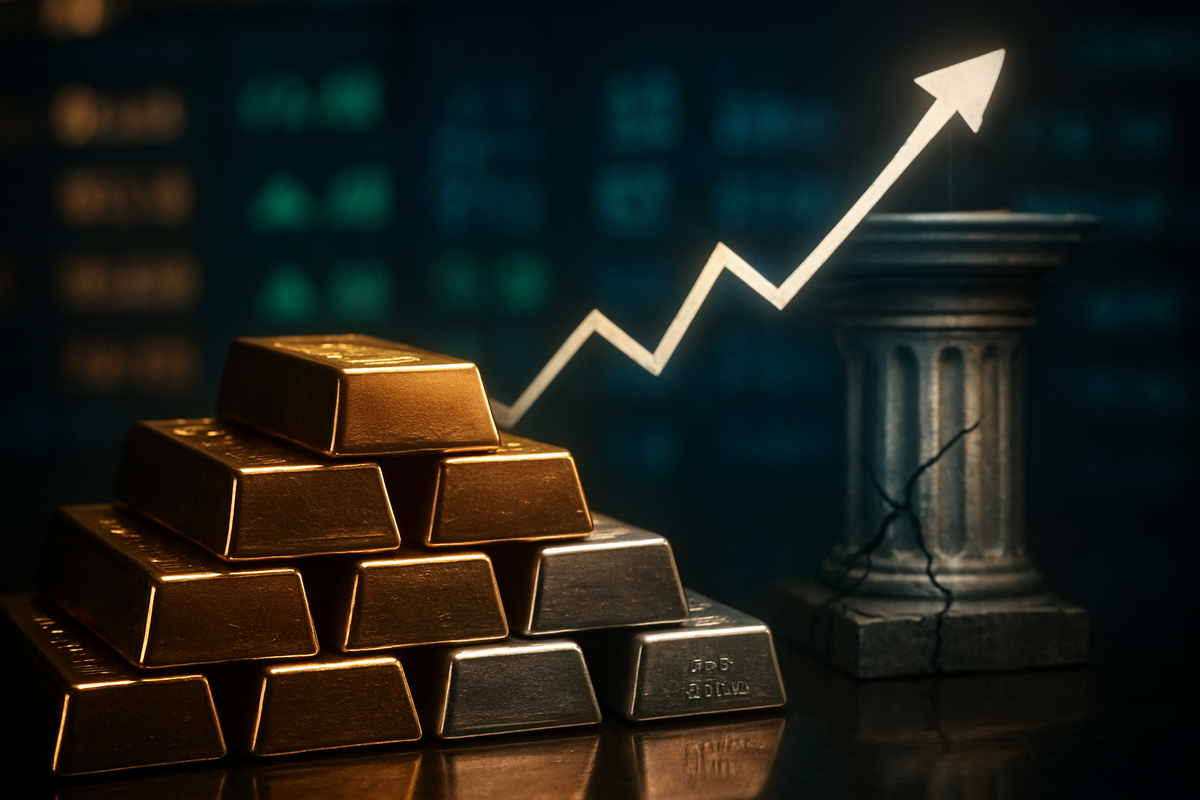
CHICAGO — January 19, 2026 — In a historic session for commodities, gold and silver futures have rocketed to fresh all-time highs, marking a seismic shift in global asset allocation. As of midday trading, gold futures for February delivery surged to a staggering $4,689.39 per ounce, while silver futures broke through psychological barriers to hit $94.08 per ounce. The dual rally comes as investors grapple with a deteriorating geopolitical landscape and a domestic political crisis that has cast doubt on the long-standing independence of the Federal Reserve.
The flight to "hard assets" has been further accelerated by a decisive move in the fixed-income market, where the 10-year Treasury yield fell below the critical 4.15% threshold, settling at 4.14%. This decline in yields—traditionally a signal of economic cooling or a precursor to central bank easing—has stripped away the opportunity cost of holding non-yielding metals. With major U.S. financial institutions reporting lackluster quarterly earnings and the threat of aggressive trade tariffs looming over Europe, the market is signaling a lack of confidence in traditional paper assets and a preference for the "ultimate insurance" of precious metals.
A Perfect Storm of Political and Economic Triggers
The immediate catalyst for the January surge was a series of unprecedented political developments that began over the weekend. On January 17, the White House announced a 10% tariff on eight key European allies, including Germany and France, effective February 1. This "Greenland Tariff" is a strategic move aimed at pressuring Denmark into a territorial sale, a move that has drawn sharp condemnation from Brussels and sent shockwaves through international trade circles. Analysts suggest this weaponization of trade policy has prompted a massive rotation out of the U.S. dollar and into neutral reserve assets.
Simultaneously, the U.S. Supreme Court is set to hear oral arguments this Wednesday in the case of Trump v. Cook. The case centers on the executive branch’s authority to remove Federal Reserve Governor Lisa Cook, a move that critics argue would effectively end the central bank's independence. "The market is pricing in the 'politicization of the pivot,'" said Sarah Sterling, Chief Macro Strategist at Global Capital Insights. "If the Fed becomes an arm of the executive branch, the inflation-fighting mandate is dead. Gold at $4,600 is simply the market’s way of saying it no longer trusts the currency's guardian."
Compounding the anxiety is a shaky start to the fourth-quarter earnings season. JPMorgan Chase & Co. (NYSE: JPM), Bank of America Corp (NYSE: BAC), and Wells Fargo & Co. (NYSE: WFC) all reported results last week that missed analyst expectations on net interest income. Shares across the banking sector fell between 3.4% and 4.6% as investors reacted to new legislative proposals to cap credit card interest rates at 10%. This regulatory overhang has triggered a significant "rotation of capital" from financial stocks into the silver and gold markets.
Winners and Losers in the "Metallization Crisis"
The meteoric rise of silver to nearly $95 an ounce has created a stark divide in the corporate world. Among the biggest winners are the primary miners who are now seeing profit margins expand at an exponential rate. Newmont Corporation (NYSE: NEM) and Barrick Gold Corp (NYSE: GOLD) saw their shares jump 8% and 7.2%, respectively, in early trading. In the silver space, Pan American Silver Corp (NYSE: PAAS) has become a top performer, as the silver market moves into "backwardation"—a rare state where the current price of the metal is higher than prices for future delivery, indicating a desperate scramble for physical supply.
However, the industrial side of the ledger tells a more cautionary tale. The solar energy sector is currently facing what experts call a "Metallization Crisis." Most solar panel manufacturers rely heavily on silver paste for conductivity. While traditional manufacturers are seeing their margins evaporate, First Solar, Inc. (NASDAQ: FSLR) has emerged as a surprising beneficiary. Because First Solar uses thin-film Cadmium Telluride technology rather than silver-intensive crystalline silicon, its cost structure remains relatively insulated from the silver spike, giving it a massive competitive edge over international rivals.
Conversely, consumer electronics giants are feeling the heat. Apple Inc. (NASDAQ: AAPL) is reportedly facing increased production costs for its upcoming 6G-enabled devices, which require significantly more silver for high-frequency signal integrity. Analysts at Tech-Sights Research estimate that at $94/oz, the silver content alone could add nearly $40 to the manufacturing cost of a high-end smartphone. This "commodity inflation" is expected to be passed on to consumers, potentially pushing the next generation of premium hardware past the $2,000 price point.
Historical Precedents and the Structural Silver Deficit
The current rally is more than just a momentary spike; it is the culmination of a six-year structural deficit in the silver market. Unlike the "Hunt Brothers" era of 1980, today’s demand is driven by the irreversible trends of the AI revolution and the global energy transition. AI data centers now consume three times more silver per server unit than traditional facilities due to higher power densities. This fundamental shift has forced silver to decouple from its historical relationship with gold, as the gold-to-silver ratio compressed from 80:1 in 2024 to nearly 50:1 today.
The decline of the 10-year Treasury yield below 4.15% is also reminiscent of the late-2023 "pivot party," but with a darker undertone. In 2023, falling yields were celebrated as a sign that inflation was beaten. In 2026, falling yields are being interpreted as a flight to the safety of government bonds amid a collapsing geopolitical order. "When you have the 10-year yield falling at the same time gold is hitting record highs, it’s a classic 'crisis correlation,'" noted David Chen, a senior bond trader. "It means the market is no longer betting on a 'soft landing,' but rather preparing for a period of profound instability."
Looking Ahead: The Road to $5,000 Gold
In the short term, the market's eyes are fixed on the Supreme Court. A ruling that favors executive control over the Federal Reserve could provide the rocket fuel necessary to push gold toward the psychological $5,000 mark. Meanwhile, the silver market is watching the COMEX inventories, which have reached their lowest levels in over a decade. If institutional investors continue to demand physical delivery over paper settlements, silver could realistically test the $100 level before the end of the first quarter.
Strategic pivots are already underway. Heavy industrial users of silver are likely to accelerate "thrifting" programs—searching for ways to use less of the metal or substitute it with copper—though such transitions take years to validate. For the average investor, the challenge will be navigating a market where "risk-free" assets like Treasuries no longer feel entirely risk-free. The coming months will likely see a surge in demand for physical bullion and "vaulted" digital assets as the public reacts to the dual threats of currency debasement and trade war inflation.
Conclusion: A New Era for Hard Assets
The events of January 19, 2026, will likely be remembered as the moment the "Safe-Haven Trade" became the dominant market theme of the decade. The convergence of a sub-4.15% 10-year yield, disappointing bank earnings from giants like Citigroup Inc. (NYSE: C), and the specter of a constitutional crisis over Fed independence has created an environment where gold and silver are no longer seen as "alternative" investments, but as essential core holdings.
Moving forward, the market remains in a state of high alert. While the current prices for gold and silver are at record highs, the underlying drivers—geopolitical volatility, structural supply deficits, and political pressure on monetary policy—show no signs of abating. Investors should keep a close watch on the February 1 tariff deadline and the Supreme Court's deliberations. In this new economic reality, the traditional 60/40 portfolio is being challenged by a world where the only certainty is the enduring value of precious metals.
This content is intended for informational purposes only and is not financial advice.