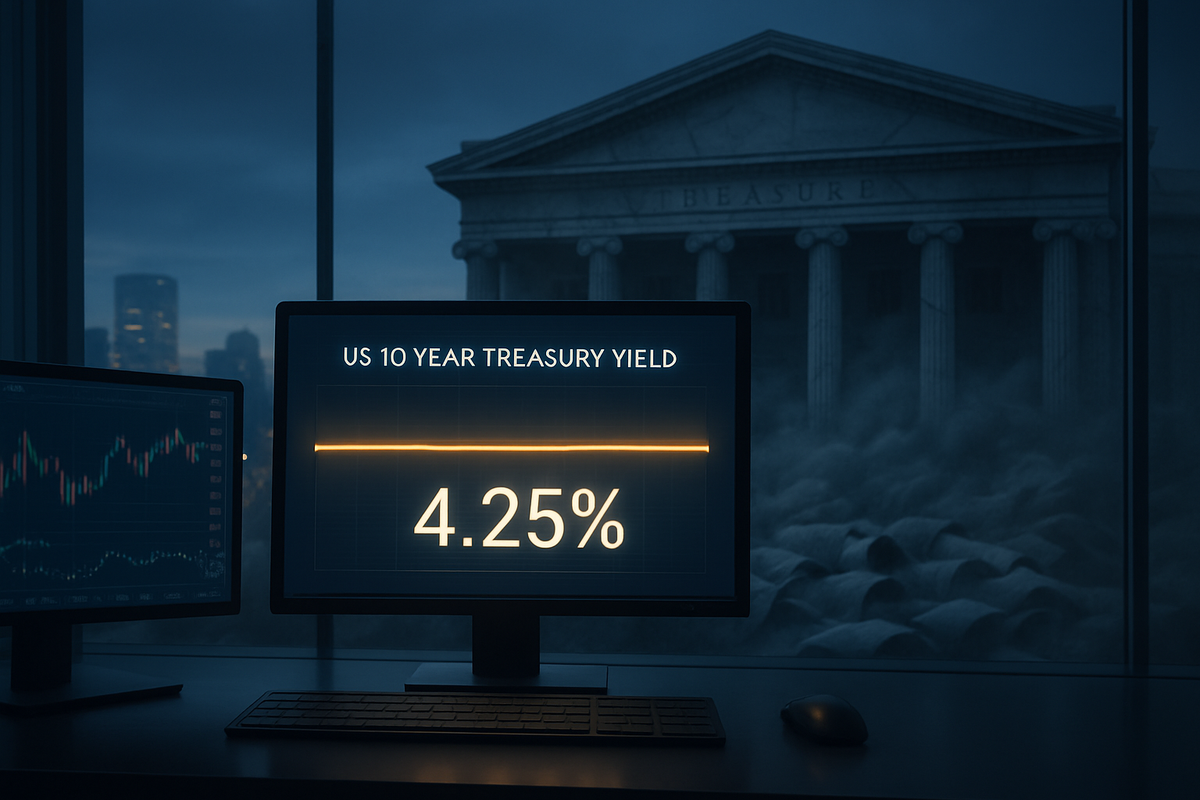
As the calendar turns to mid-January 2026, a peculiar calm has settled over the bond market, even as the federal government’s balance sheet screams for attention. The 10-year Treasury yield, the world’s most critical benchmark for borrowing costs, has anchored itself firmly around the 4.25% mark. For investors, this level represents a "Goldilocks" equilibrium—high enough to attract global capital but stable enough to prevent a total freeze in the credit markets. However, beneath this surface-level stability lies a growing anxiety regarding what the International Monetary Fund (IMF) and the Congressional Budget Office (CBO) are calling "unsustainable public finances."
The paradox of 2026 is that yields are refusing to spike further despite a federal deficit projected to approach $2 trillion this fiscal year. With interest payments on the national debt now officially exceeding the annual defense budget, the U.S. is entering a fiscal era without modern precedent. Yet, the market’s "sanguine but cautious" stance suggests that for now, the demand for the world’s safest liquid asset is outweighing the long-term fear of a fiscal cliff.
The 4.25% Equilibrium and the 'Debt Wall'
The stabilization of the 10-year yield at 4.25% is the culmination of a "soft landing" engineered by the Federal Reserve throughout late 2025. Following a series of three "insurance" rate cuts in the final quarter of last year, the Fed successfully moderated inflation to approximately 2.8% while maintaining GDP growth in the 2.1% to 2.4% range. This pivot signaled to the markets that the "higher-for-longer" era had transitioned into a "stable-for-now" regime.
However, the primary driver of the current yield floor is not just Fed policy, but the sheer volume of issuance. The U.S. Treasury is currently facing a "Debt Wall," with approximately $9.2 trillion in debt maturing in 2026—roughly 25% of all outstanding federal debt. When combined with new deficit spending, the government must borrow nearly $11 trillion in gross terms this year. This massive supply has forced the "term premium"—the extra yield investors demand for the risk of holding long-term bonds—to remain elevated, preventing yields from falling even as inflation cools.
Initially, market reactions to the January CBO report were muted. While the $601 billion first-quarter deficit was staggering, it was slightly lower than the previous year due to a surge in tariff revenues. This provided a temporary reprieve for bond bulls, but the underlying "coupon shock" remains. Much of the debt being refinanced this month was originally issued at rates between 0.5% and 1.5% during the pandemic era; replacing it with debt at 4.25% is effectively doubling the interest burden on the American taxpayer in real-time.
Winners and Losers in a Higher-for-Longer World
This 4.25% environment has created a sharply bifurcated landscape for public companies, favoring those with "sticky" low-cost funding while punishing those reliant on high-multiple growth or constant refinancing.
The primary beneficiaries have been the major financial institutions. JPMorgan Chase & Co. (NYSE: JPM) and Bank of America Corp. (NYSE: BAC) have seen their Net Interest Margins (NIM) expand as the yield curve maintains its current slope. These banks are able to price commercial and retail loans against the 4.25% benchmark while keeping their deposit costs relatively contained, a dynamic that has driven record earnings in the first weeks of 2026. Similarly, industrial giants like Caterpillar Inc. (NYSE: CAT) continue to thrive, as the high yields reflect a robust nominal growth environment fueled by domestic manufacturing and infrastructure tailwinds.
Conversely, the "losers" are found in the sectors most sensitive to discount rates. High-growth tech stocks, including NVIDIA Corp. (NASDAQ: NVDA) and Microsoft Corp. (NASDAQ: MSFT), face persistent "multiple compression." When investors can earn a nearly risk-free 4.25% from the government, they are less willing to pay premium valuations for future earnings, leading to a rotation out of growth and into value. Real estate has also felt the sting. Cellular tower REIT American Tower Corp. (NYSE: AMT) and retail giant Simon Property Group (NYSE: SPG) have struggled to compete for income-seeking investors, as their dividend yields now sit uncomfortably close to the risk-free Treasury rate.
Historical Precedents and the Crowding-Out Effect
The current situation fits into a broader global trend of "fiscal dominance," where government borrowing needs begin to dictate the direction of monetary policy. Historically, the U.S. has seen similar moments of fiscal tension. In 1994, "bond vigilantes" famously sent yields soaring from 5.2% to 8% to protest deficit spending, forcing the Clinton administration toward fiscal discipline. In contrast, the 2011 S&P downgrade saw yields actually fall as a global "flight-to-quality" during the Eurozone crisis drove investors toward the safety of the U.S. Dollar.
The 2026 scenario appears to be a hybrid of these two historical precedents. While there is no immediate "revolt" by bondholders, the rebuilding of the term premium suggests that the market is no longer willing to ignore the $34 trillion-plus national debt. This has significant ripple effects on global competitors; as U.S. yields remain high, they exert upward pressure on rates in Europe and Japan, potentially "crowding out" private investment globally.
From a policy perspective, the IMF’s warning that the U.S. debt-to-GDP ratio could hit 140% by 2030 has reignited debates in Washington. There is an emerging consensus that the "low-rate era" of the 2010s was a historical anomaly and that 4% to 4.5% may be the new permanent floor for long-term borrowing costs.
Strategic Pivots and the Road to Mid-2026
Looking ahead, the next six months will be a critical test for the 4.25% anchor. Short-term, the market will be hyper-focused on the results of the upcoming February and May Treasury auctions. Any sign of "tailing"—where the government has to offer higher-than-expected yields to attract buyers—could trigger a sudden spike toward 4.75% or 5.0%.
Long-term, corporations will need to adapt to a world where "cheap money" is no longer a strategic option. We may see a wave of strategic pivots, including aggressive debt-deleveraging and a move toward internal financing of capital projects. For the broader market, the "opportunity cost" of capital has fundamentally shifted. If the U.S. cannot provide a credible path to deficit reduction by the 2026 midterms, the "sanguine" mood of the market could quickly turn into a "repricing event" that forces a much more painful adjustment in equity valuations.
Conclusion: A Fragile Stability
In summary, the 10-year Treasury yield at 4.25% is the precarious linchpin of the early 2026 economy. It reflects a delicate balance between a resilient U.S. economy and a government spending habit that the IMF describes as "unsustainable." While the Fed has successfully navigated the "soft landing," the fiscal side of the ledger remains an unresolved risk that could overshadow corporate earnings and economic growth in the months to come.
Investors should watch for two key signals in the second quarter: the "bid-to-cover" ratios at Treasury auctions and any shift in the "equity risk premium" relative to these yields. The 4.25% level is currently an anchor, but in a world of $2 trillion deficits, even the strongest anchors can be dragged by the tide of fiscal reality.
This content is intended for informational purposes only and is not financial advice.