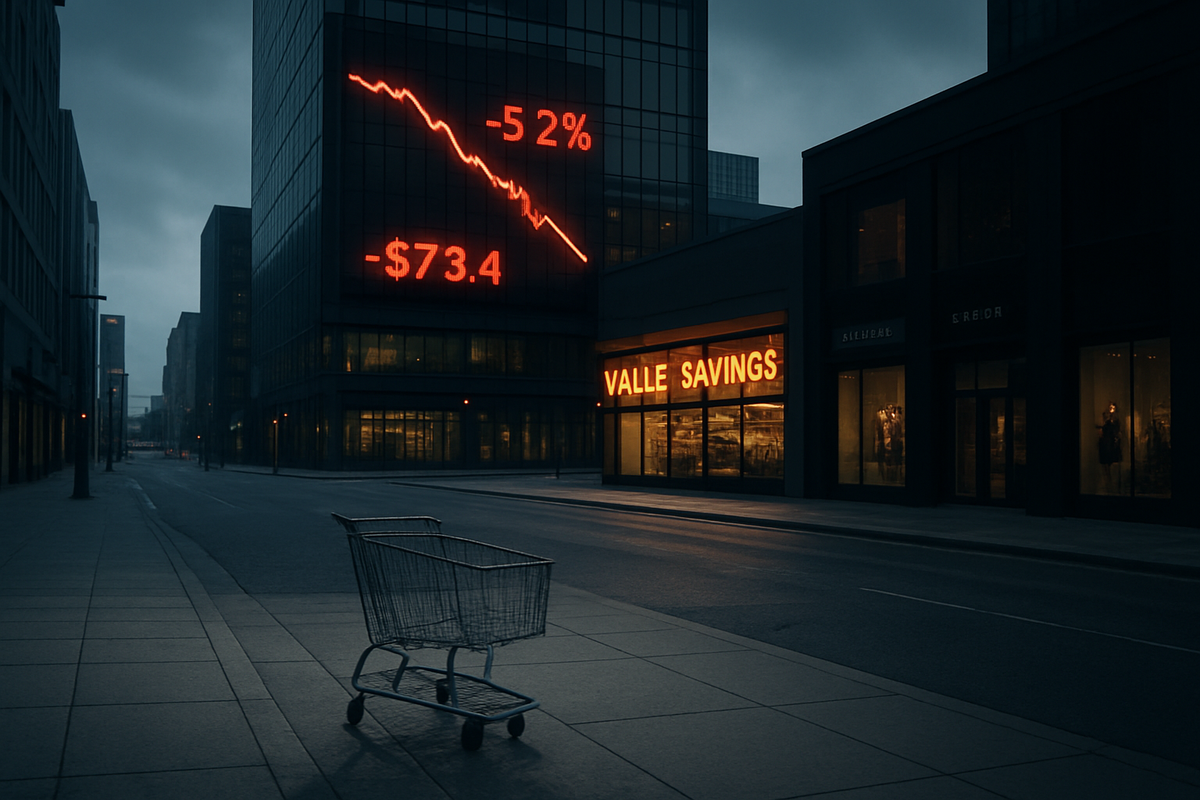
The American consumer, long the indomitable engine of the global economy, appears to be finally losing steam. Fresh data released in late January 2026 confirms a sobering reality: U.S. consumer spending has fallen by its widest margin in four years, mirroring the structural weaknesses first glimpsed during the "Valentine’s Day Massacre" of 2025. This downturn, driven by a combination of persistent "tariff shocks," a softening labor market, and a significant "flight to value," suggests that the post-pandemic spending era has reached a definitive and chilly conclusion.
The immediate implications for the market are stark. With real disposable income flattening and the personal savings rate dipping to a precarious 3.5%, economists are sounding the alarm on a potential "jobless expansion." As the Federal Reserve prepares for its January 27-28 policy meeting, the sharp contraction in retail and automotive sales is placing immense pressure on policymakers to reconsider their "wait-and-see" approach to interest rates, even as core inflation remains stubbornly above target.
A Post-Holiday Freeze: The Numbers Behind the Slump
The latest data drop from the Commerce Department and high-frequency indicators from private analysts paint a grim picture of the 2026 kickoff. Preliminary retail sales figures for January indicate a broad-based retreat, with the automotive sector leading the decline. According to a recent report from J.D. Power, new-vehicle retail sales are projected to fall by 3.7% compared to January 2025, reaching just 908,500 units. This decline is not merely a seasonal blip; it represents the weakest start to a calendar year for the industry since 2021.
The timeline leading to this moment is marked by the cumulative weight of 2025's economic shifts. Following the passage of the "One Big Beautiful Bill Act" and the subsequent "April 2025 tariff shock," businesses have spent the last nine months passing increased import costs directly to consumers. While a robust export market managed to prop up a 5.4% GDP estimate in the final quarter of 2025, that momentum has failed to trickle down to the domestic high street. By mid-January 2026, the Federal Reserve’s Beige Book noted that while the ultra-wealthy continued to spend, the middle and lower-income segments were facing a "standstill," with service sector activity slumping significantly.
Key stakeholders, including major retail associations and labor economists, have pointed to "wage volatility" as a primary culprit. A report from PYMNTS released on January 27, 2026, highlighted a $14 billion annualized reduction in spending directly tied to inconsistent income streams. This volatility has forced households—already operating with thin savings buffers—to slash discretionary spending the moment a paycheck fluctuates. Market reactions were swift, with consumer-facing stocks experiencing heightened volatility as investors recalibrate expectations for the 2026 fiscal year.
Winners and Losers: The "Flight to Value" Reshapes the Market
In this environment of contraction, the retail landscape is splitting into two distinct camps. The clear "losers" in the current data cycle are mid-tier discretionary brands and high-ticket luxury items. Apple Inc. (NASDAQ: AAPL) and high-end automotive manufacturers like General Motors (NYSE: GM) are facing headwinds as consumers defer upgrades and luxury purchases. The cooling labor market, with jobless claims ticking toward the 200,000 mark in late January, has particularly dampened the "aspirational" consumer segment that previously fueled growth in tech and premium apparel.
Conversely, "value plays" are emerging as the defensive winners. Walmart Inc. (NYSE: WMT) and Amazon.com, Inc. (NASDAQ: AMZN) have seen a surge in "private-label" sales as consumers aggressively trade down from national brands to save on essentials. This "flight to value" is also benefiting discount giants like Target Corporation (NYSE: TGT), though even they are forced to compete on razor-thin margins. Analysts at Bain & Company suggest that while overall retail growth will slow to 3.5% in 2026, discount retailers will likely capture a larger share of that shrinking pie.
The financial sector also faces a mixed bag. While JPMorgan Chase & Co. (NYSE: JPM) and other major lenders are seeing increased credit card usage—often a sign of households "spending beyond their means" to cover basics—this is offset by the risk of rising delinquency rates. Banks that are heavily exposed to subprime auto loans or middle-market consumer credit are particularly vulnerable as the savings rate hits historic lows, leaving little margin for error if the labor market continues to soften.
Policy Ripple Effects and the Ghost of 2021
The current spending slump fits into a broader trend of "normalization" after the fiscal excesses of the mid-2020s. Historically, the last time spending saw such a precipitous drop was in early 2021, though the causes then were pandemic-related supply constraints. Today’s decline is more structural, tied to the long-tail effects of trade policy and the exhaustion of excess savings. This has created a "policy trap" for the Federal Reserve. Core PCE (Personal Consumption Expenditures) inflation is stuck at 2.8%, well above the 2% target, yet the real economy is clearly signaling a need for relief.
The significance of this event extends to international trade. With reduced net migration estimated to weaken consumption by up to $110 billion over the 2025–2026 period, the U.S. is becoming increasingly reliant on external demand. However, the ripple effects of the 2025 tariffs have made domestic goods more expensive to produce, further squeezing the "Made in USA" initiative that was intended to bolster growth. This precedent suggests that without a strategic pivot in trade or fiscal policy, the U.S. could be entering a period of prolonged stagnation similar to the "lost years" seen in other developed economies following major trade shocks.
The Road Ahead: Strategic Pivots and Stagnation Risks
In the short term, expect a wave of corporate "right-sizing" as companies adapt to a lower-growth environment. Retailers will likely double down on automation and supply chain efficiency to maintain margins in the face of sagging volumes. We may also see a surge in "Buy Now, Pay Later" (BNPL) services as consumers look for ways to bridge the gap between their flat wages and the rising costs of living. Strategic pivots toward value-oriented product lines will be the theme of Q1 and Q2 earnings calls across the consumer goods sector.
Long-term, the market faces the challenge of a "jobless expansion." If consumer spending remains at this four-year low, the 2026 GDP growth could easily slide toward the 1.5% mark projected by Moody’s Ratings. Investors should look for opportunities in defensive sectors like consumer staples and healthcare, while remaining cautious about cyclical stocks that depend on a robust middle class. The "K-shaped" recovery of the 2020s has finally matured into a "K-shaped" reality where only the top tier of the economy remains insulated from the current chill.
Final Assessment: What Investors Should Watch
The January 2026 data drop is a clarion call that the "spending-at-any-cost" mentality is over. The key takeaway for investors is the fragility of the current expansion; when the primary engine of the U.S. economy—the consumer—misfires to this degree, the entire vehicle slows down. The immediate focus will be on the Federal Reserve’s next move. If the Fed remains hawkish on inflation despite the spending slump, the risk of a technical recession in the latter half of 2026 becomes a very real possibility.
Moving forward, the market will be hyper-sensitive to any further softening in the labor market. Watch for February's retail sales and the next core PCE release for confirmation of whether January was an anomaly or the start of a deep winter. For now, the "flight to value" isn't just a consumer trend—it's the only viable strategy for investors looking to navigate a market where the consumer's wallet is finally snapped shut.
This content is intended for informational purposes only and is not financial advice