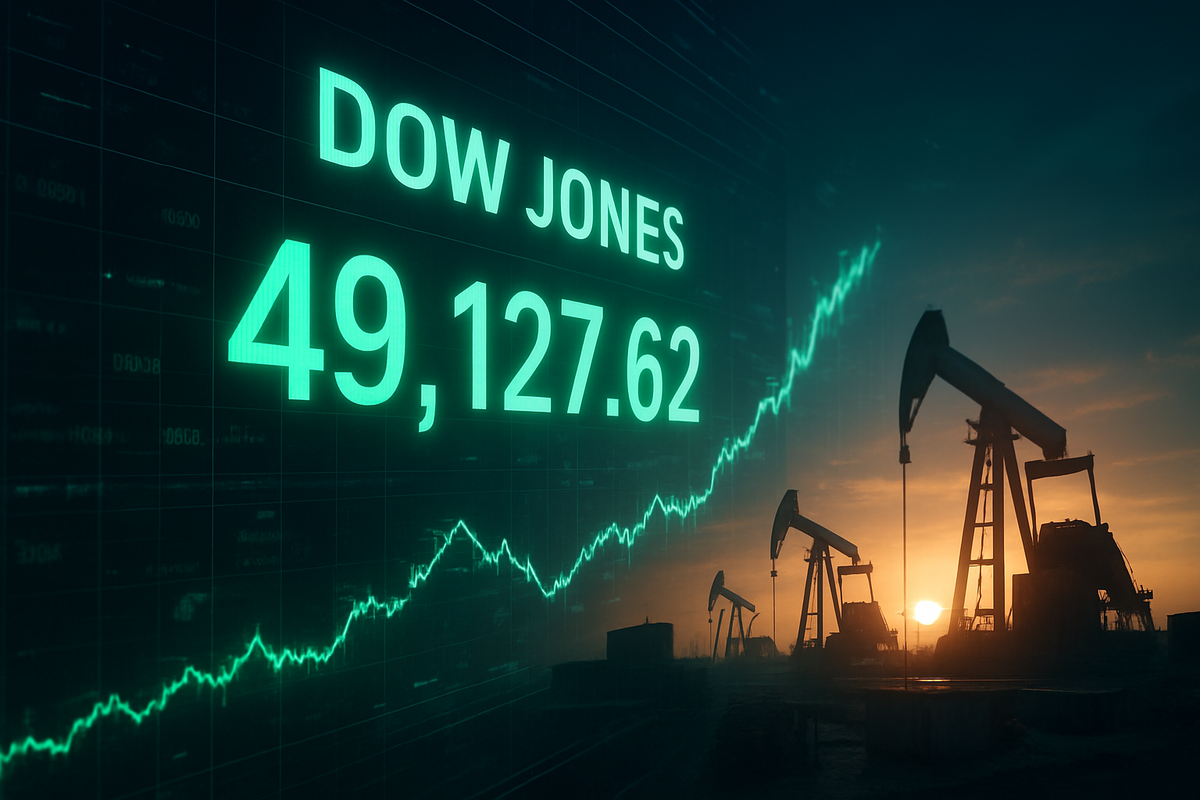
The Dow Jones Industrial Average (DJIA) surged to a historic milestone on Monday, January 5, 2026, crossing the 49,100 threshold for the first time in history. This monumental rally, which saw the index climb more than 730 points to an intraday high of 49,127.62, marks a definitive shift in market leadership. While the blue-chip index reached new heights, the tech-heavy Nasdaq and the broader S&P 500 remained largely stagnant, struggling under the weight of valuation fatigue and a massive migration of capital away from growth stocks.
The immediate catalyst for this divergence is a dramatic escalation of geopolitical events in South America, coupled with a fundamental reassessment of the "Old Economy." As investors grapple with the implications of a sudden regime change in Venezuela and a potential overhaul of global energy markets, the Dow’s composition of industrial, energy, and financial giants has positioned it as the primary beneficiary of a new era of market volatility.
The "Venezuela Shock" and the Road to 49,100
The Dow’s record-breaking ascent was fueled by what traders are calling the "Venezuela Shock." Over the weekend of January 3–4, 2026, a series of rapid geopolitical developments culminated in the capture of President Nicolás Maduro by U.S.-led forces. This followed a month-long maritime blockade that had already crippled Venezuelan oil exports, reducing them from over 1 million barrels per day to a mere 258,000. The sudden removal of the Maduro administration and the announcement of a U.S.-led transition sparked an immediate frenzy in the energy and industrial sectors.
The timeline leading to this moment began in late 2025, when the U.S. administration intensified sanctions and naval positioning in the Caribbean. By the time markets opened on the first Monday of 2026, the prospect of U.S. companies gaining unprecedented access to the world’s largest proven oil reserves had fundamentally altered the global energy outlook. The Dow, which is price-weighted and heavily influenced by industrial and energy behemoths, responded with its most aggressive single-day rally in over two years.
Market participants reacted with a mixture of shock and opportunism. While the geopolitical implications of the intervention remain a subject of intense debate in Washington and abroad, Wall Street’s verdict was clear: a "pro-Western" Venezuela represents a massive infrastructure and extraction opportunity. This sentiment provided the necessary momentum to push the Dow past its previous resistance levels, even as high-multiple tech stocks faced a "sell-the-news" environment.
Winners and Losers: The Energy and Industrial Surge
The primary winners in this new market landscape are the "Old Economy" titans that dominate the Dow. Chevron (NYSE: CVX), which has maintained a complicated but persistent footprint in Venezuela for years, saw its shares jump over 6% as it was tapped as a lead partner in the country’s energy reconstruction. Other energy service giants like SLB (NYSE: SLB) and Halliburton (NYSE: HAL) also saw significant gains, as the market anticipates a multi-billion dollar effort to modernize Venezuela’s crumbling oil infrastructure.
Beyond energy, industrial heavyweights like Caterpillar (NYSE: CAT) and Boeing (NYSE: BA) thrived on expectations of massive logistics and construction contracts. Financial institutions also joined the rally; Goldman Sachs (NYSE: GS) and JPMorgan Chase (NYSE: JPM) benefited from a steepening yield curve and the prospect of underwriting the massive debt and equity deals required for Venezuelan redevelopment. For these companies, the 49,100 milestone is not just a number, but a reflection of their renewed central role in the global economy.
Conversely, the Nasdaq’s underperformance highlights the "losers" of this rotation. Mega-cap tech leaders such as Nvidia (NASDAQ: NVDA), Microsoft (NASDAQ: MSFT), and Amazon (NASDAQ: AMZN) faced a "valuation reset" as investors pulled capital to fund their entries into cyclical and value stocks. After two years of AI-driven dominance, these high-growth names are seeing their momentum stall, as the market questions whether the return on AI investment can compete with the tangible, immediate profits promised by the "Blue-Collar AI" and energy boom.
The Great Rotation and the Rise of "Blue-Collar AI"
This event fits into a broader industry trend known as the "Great Rotation." Throughout 2025, analysts noted a growing weariness with the "Magnificent Seven" tech stocks. The Dow’s outperformance signals a shift toward the "Impressive 493"—the rest of the S&P 500 that had been left behind during the tech frenzy. This rotation is driven by a "buy the dip, sell the rip" mentality regarding software, where any tech rally is used as an exit point to move into stable, high-dividend blue-chips.
A significant part of this shift is the emergence of "Blue-Collar AI." Unlike the consumer-facing or generative AI that dominated 2024, this new phase focuses on the integration of artificial intelligence into physical industries. Companies like Caterpillar (NYSE: CAT) are now seen as AI plays because of their autonomous mining and construction equipment. The Venezuela reconstruction is expected to be a testing ground for these technologies, creating a ripple effect where industrial efficiency becomes the new driver of margin expansion, rather than just software subscriptions.
Historically, this resembles the market shifts seen during the energy crises of the 1970s or the post-war reconstruction periods, where industrial capacity was valued more than speculative growth. The current yield curve environment, which has reached its steepest level since 2022, further supports this trend by favoring the traditional banking and lending models that support heavy industry.
What Comes Next: The Road to 50,000
In the short term, the market is laser-focused on the 50,000 mark. Analysts suggest that if the transition in Venezuela remains relatively stable and oil production begins to ramp up toward pre-crisis levels, the Dow could reach this psychological milestone before the end of the first quarter. However, the path is fraught with potential strategic pivots. If the geopolitical situation in Caracas destabilizes or leads to a broader regional conflict, the current "risk-on" sentiment for industrials could quickly evaporate.
Long-term, the challenge for the market will be maintaining this balance. The "Great Rotation" requires that the "Old Economy" companies continue to show real earnings growth from these new opportunities. Investors should watch for the first round of reconstruction contracts and the subsequent impact on the "Petrodollar." There is also the possibility of a regulatory response from the U.S. government to prevent excessive profiteering, which could dampen the enthusiasm for energy and defense stocks.
Wrap-Up: A New Market Paradigm
The Dow’s crossing of 49,100 represents more than just a record high; it is a signal that the market's center of gravity has shifted. The combination of the "Venezuela Shock" and the exhaustion of the tech trade has breathed new life into the blue-chip stocks that many had written off as relics of a bygone era. The key takeaway for investors is that the "Old Economy" is no longer just a safe haven—it is currently the primary engine of growth.
Moving forward, the market will likely remain bifurcated. While the Dow may continue its march toward 50,000, the Nasdaq and S&P 500 will have to prove that their valuations are sustainable in an environment where capital is increasingly expensive and geopolitically sensitive. Investors should keep a close eye on energy prices, Treasury yields, and the stability of the Venezuelan transition. The next few months will determine if this record-breaking run is the start of a multi-year industrial boom or a temporary spike driven by geopolitical opportunism.
This content is intended for informational purposes only and is not financial advice.