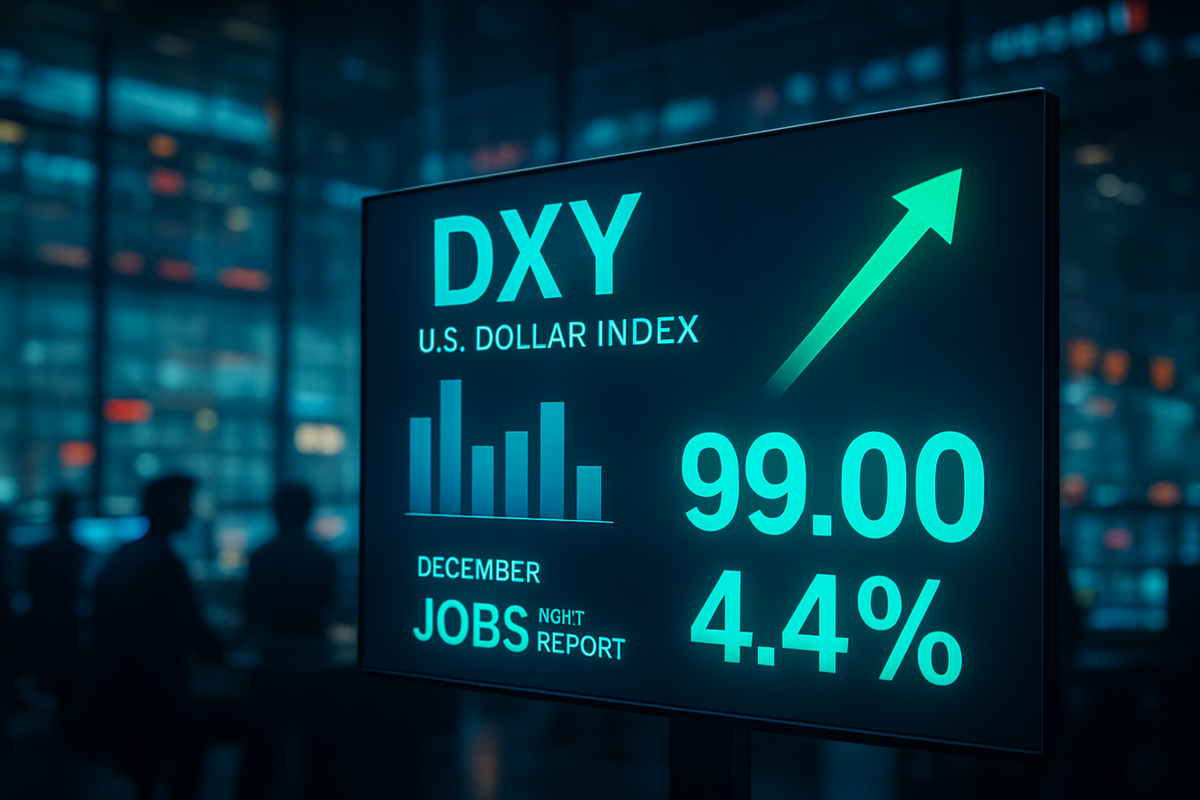
The United States labor market sent a complex signal to global markets this morning, as the December employment report revealed a cooling hiring environment paired with unexpectedly resilient wage growth. On January 9, 2026, the Bureau of Labor Statistics reported that the economy added 50,000 non-farm payrolls in the final month of 2025, a figure that fell slightly short of the 55,000 to 60,000 consensus. However, the internal metrics of the report—specifically a dip in the unemployment rate to 4.4% and a 3.8% year-over-year increase in average hourly earnings—triggered a sharp rally in the U.S. Dollar.
The immediate market reaction saw the U.S. Dollar Index (DXY) break above the critical 99.00 threshold for the first time in over a year. This volatility reflects a growing realization among investors that the Federal Reserve may not be in a position to lower interest rates as aggressively as previously hoped. With wage inflation remaining "sticky" and the unemployment rate tightening despite slower hiring, the "higher-for-longer" narrative has regained its grip on Wall Street, sending ripples through currency and equity markets alike.
Labor Market Resilience Defies Hiring Slowdown
The December jobs report, released at 8:30 a.m. ET, provided a nuanced portrait of an economy in transition. While the headline addition of 50,000 jobs was the lowest in several months, the report was characterized by significant underlying strength. The unemployment rate’s surprise drop from 4.6% in November to 4.4% in December caught many analysts off guard, even as the labor force participation rate edged down to 62.4%. Furthermore, the 0.3% month-over-month increase in wages brought the annual growth rate to 3.8%, exceeding the 3.6% forecast and signaling that labor costs are not yet cooling at a pace that would satisfy a dovish Federal Reserve.
The timeline leading up to this release was marked by extreme uncertainty. Following a federal government shutdown in late 2025 and a wave of corporate restructuring packages, October’s payroll figures were revised downward to a loss of 173,000 jobs. This historical volatility made the December data a high-stakes "tie-breaker" for market sentiment. Key stakeholders, including Federal Reserve Chair Jerome Powell and Treasury officials, have been closely monitoring these figures to determine if the economy is heading for a "soft landing" or a more pronounced stagnation. The initial market reaction suggests the former, as the probability of the Fed holding rates steady at its late January meeting surged to nearly 90% shortly after the data hit the wires.
Winners and Losers in a Strong-Dollar Regime
The surge in the U.S. Dollar has created a stark divide between domestic winners and multinational losers. Large financial institutions are among the primary beneficiaries of the "higher-for-longer" interest rate environment. JPMorgan Chase & Co. (NYSE: JPM) is expected to see continued growth in its Net Interest Income (NII), with projections targeting $95 billion for 2026 as the yield curve begins to steepen. Similarly, The Goldman Sachs Group, Inc. (NYSE: GS) has seen a resurgence in its investment banking and capital markets segments, as stable but high rates provide a more predictable valuation floor for M&A activity.
Conversely, the strong dollar acts as a significant headwind for American tech giants and exporters. Microsoft Corporation (NASDAQ: MSFT), which generates a substantial portion of its revenue from international markets, faces an estimated 3% to 5% drag on top-line growth due to unfavorable foreign exchange conversions. Apple Inc. (NASDAQ: AAPL) is also under pressure; a stronger greenback makes its hardware more expensive in critical markets like Europe and China, where the company has already struggled with a 17% decline in sales late last year. In the retail and industrial sectors, Nike, Inc. (NYSE: NKE) and Caterpillar Inc. (NYSE: CAT) are feeling the pinch. Nike’s gross margins have come under fire from a "triple threat" of international revenue suppression, domestic tariffs, and inventory discounting, while Caterpillar has reported a $1.5 billion headwind from currency fluctuations and rising tariff-related costs.
Broadening the Macroeconomic Lens
This latest bout of dollar volatility fits into a broader trend of "American Exceptionalism" in the global economy. While other major economies struggle with stagnant growth, the U.S. labor market's ability to maintain low unemployment and high wages—even in the face of restrictive monetary policy—keeps the dollar as the world's premier safe-haven currency. This trend is further amplified by geopolitical and regulatory factors. Investors are currently awaiting a U.S. Supreme Court ruling regarding emergency tariff powers, a decision that could fundamentally alter trade dynamics and further strengthen the dollar if new protectionist measures are upheld.
Historically, periods of a strengthening dollar and tightening labor markets have often preceded a "K-shaped" recovery, where capital-intensive firms thrive while consumer-facing and export-dependent companies struggle. The current scenario draws parallels to the mid-1990s, where a resilient U.S. economy forced the Fed to maintain high rates despite global headwinds, leading to a sustained period of dollar dominance. The ripple effects are already being felt by competitors in the Eurozone and Japan, as their respective central banks must now weigh the risks of imported inflation against the need to support their own fragile recoveries.
The Path Forward: What to Watch Next
In the short term, all eyes will turn to the Federal Open Market Committee (FOMC) meeting scheduled for late January. The December jobs data has effectively taken a rate cut off the table, shifting the conversation toward when—or if—the Fed will pivot later in 2026. Strategic adaptations will be required for multinational corporations; we may see an increase in currency hedging activities and a shift in supply chain focus toward domestic production to mitigate the impact of both the strong dollar and potential new tariffs.
Market opportunities may emerge in mid-cap domestic companies that are less exposed to international currency risks and stand to benefit from a robust U.S. consumer base. However, the challenge remains for the broader market to digest these high valuations in an environment where the "risk-free" rate remains elevated. If the DXY continues its march toward the 100.00 level, it could trigger a more significant correction in global equities as the cost of dollar-denominated debt becomes increasingly burdensome for emerging markets and international corporations.
Summary and Final Assessment
The December jobs report has cemented the U.S. Dollar's position as the dominant force in the early 2026 financial landscape. By delivering a "mixed-to-strong" set of data, the labor market has provided the Federal Reserve with the justification needed to maintain a restrictive policy stance. The key takeaways for investors are clear: the U.S. economy remains remarkably resilient at the core, but this strength comes at a cost for multinational earnings and global trade competitiveness.
Moving forward, the market will likely remain in a state of "high-alert" volatility. Investors should closely watch for the upcoming earnings season to see how companies like Applied Materials, Inc. (NASDAQ: AMAT) and The Coca-Cola Company (NYSE: KO) are navigating these FX headwinds. While the strong dollar reflects U.S. economic vitality, its continued ascent will test the limits of global financial stability and corporate profit margins in the months to come.
This content is intended for informational purposes only and is not financial advice.