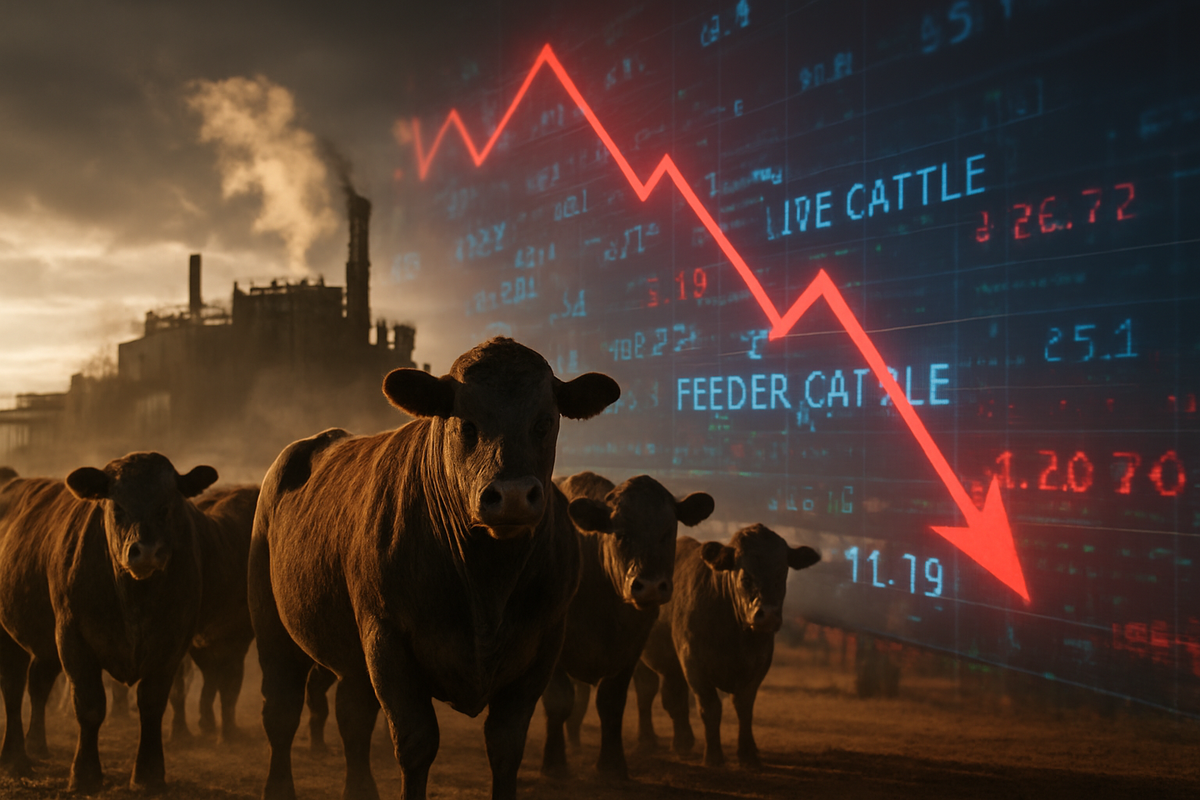
The U.S. cattle market was rocked this week by a sudden and violent sell-off in futures contracts, as a looming labor strike at one of the nation’s largest beef processing facilities sent shockwaves through the Chicago Mercantile Exchange (CME). On February 5, 2026, live and feeder cattle futures tumbled to their daily limits within minutes of the opening bell, a stark contrast to the fundamentally tight supply landscape that has recently pushed cash trades to historic highs of $245 per hundredweight.
The volatility was ignited by a near-unanimous strike authorization vote at the JBS SA (OTC: JBSAY) processing plant in Greeley, Colorado. While the physical supply of cattle remains at a 75-year low, the threat of a major plant shutdown—even a temporary one—created a localized panic. This event has highlighted the extreme sensitivity of the modern livestock market, where automated trading algorithms can override fundamental supply-and-demand realities in seconds, causing massive price swings that leave producers and investors reeling.
The crisis began late on Wednesday, February 4, 2026, when workers represented by the United Food and Commercial Workers (UFCW) Local 7 at the JBS Greeley facility voted 99% in favor of authorizing a strike. The Greeley plant is a cornerstone of American beef production, boasting a daily slaughter capacity of approximately 5,000 to 5,500 head. This represents nearly 5% of the total U.S. beef processing capacity. Given the plant's scale, the prospect of a work stoppage immediately signaled a potential bottleneck in the supply chain, where cattle ready for market would have nowhere to go, effectively stripping power from the producers.
The market reaction on Thursday morning was instantaneous and severe. When the CME opened, the most active April Live Cattle contracts (LCJ26) plummeted by more than $6.00, dropping to 235.25 cents per pound. March Feeder Cattle (FCH26) fared even worse, seeing losses of up to $7.50 as the "limit-down" circuit breakers were triggered. This flash-crash occurred despite the fact that just 24 hours earlier, physical cash cattle were trading at record levels across the Southern Plains and Nebraska.
The timeline leading to this moment has been defined by escalating tension. Labor negotiations at the Greeley facility have been ongoing for months, with workers demanding significant wage increases to combat three years of cumulative inflation and improved safety protocols. The facility has a storied and often troubled history, including a multi-million dollar settlement in 2021 regarding religious discrimination and more recent investigations into labor practices involving third-party contractors. This historical friction made the 99% strike vote particularly credible to market participants, who feared a repeat of past disruptions.
Initial reactions from industry analysts were a mix of shock and skepticism. While the threat to processing capacity is real, many pointed out that the underlying fundamentals—the smallest U.S. cattle herd since the 1950s—should theoretically provide a floor for prices. However, in the heat of the morning session, the fear of a "back-up" of market-ready cattle, which would force feedlots to accept lower prices to move animals, took precedence over the long-term scarcity narrative.
The primary company at the center of this storm, JBS SA (OTC: JBSAY), finds itself in a precarious position. As the world’s largest protein producer, JBS has the global footprint to absorb localized shocks, but its North American beef division is currently battling a severe "margin squeeze." High prices for live cattle, driven by the thin national herd, have made it difficult for packers to turn a profit on boxed beef sales. A strike at Greeley would not only halt production but also damage JBS’s ability to fulfill high-value retail and export contracts, though the company might paradoxically benefit if the stoppage forces a drop in the cash prices they pay for cattle at their other facilities.
Tyson Foods (NYSE: TSN), the largest U.S. competitor, stands as both a potential beneficiary and a fellow victim of the market’s instability. In the short term, if JBS Greeley goes offline, Tyson could see an uptick in demand for its own beef products as buyers scramble for supply. However, Tyson has its own set of challenges; the company recently shuttered its Lexington, Nebraska plant to "right-size" its operations in the face of dwindling cattle numbers. For Tyson, the extreme volatility in the futures market makes hedging cattle costs nearly impossible, adding further risk to a beef segment that reported a $143 million adjusted operating loss in the previous quarter.
Other players in the industry, such as Cargill and National Beef—the latter majority-owned by Marfrig Global Foods (OTC: MRGNY)—are also watching the Greeley situation closely. These "Big Four" packers control over 80% of the U.S. beef market. When one major plant falters, the leverage shifts almost entirely to the remaining packers. Feedlots and independent ranchers are the clear losers in this scenario; they face the double-whammy of falling futures values for their assets and the potential loss of a critical buyer for their physical livestock.
In the broader investment landscape, exchange-traded products that track livestock, such as the iPath Series B Bloomberg Livestock Subindex Total Return ETN (NYSE: COW), saw sharp declines following the news. Investors who were "long" on cattle based on the tight supply fundamentals were caught off guard by the technical breakdown in price action. The event serves as a reminder that in the meatpacking industry, operational risks can often overshadow even the most bullish supply-and-demand backdrop.
This event is a quintessential example of the "de-coupling" that can occur in the cattle market. Historically, the 2019 fire at a Tyson facility in Holcomb, Kansas, serves as the most frequent comparison. In that instance, the loss of processing capacity caused cattle prices to crater while wholesale beef prices soared, leading to record-high profits for the packers who remained operational. The market's reaction to the JBS strike vote suggests that traders—and specifically the automated algorithms that now dominate the CME—are programmed to front-run this exact scenario.
The role of automated trading algorithms cannot be overstated. Analysts noted that the initial $4.00 drop on February 5 occurred in the first 15 seconds of trade. High-frequency trading (HFT) platforms are designed to scrape news headlines for keywords like "strike," "closure," or "authorization." When the JBS news hit, these "black box" funds triggered massive sell orders that overwhelmed the relatively thin liquidity of the cattle pits. This "Velocity Logic" triggered the CME's automated circuit breakers, pausing trade but failing to stop the downward momentum once trading resumed.
Furthermore, the strike comes at a time of extreme vulnerability for the U.S. food supply chain. The January 2026 Cattle Inventory report confirmed the national herd at just 86.2 million head, a staggering 75-year low. This scarcity has been exacerbated by a 14-month closure of the southern border to Mexican feeder cattle due to concerns over the New World screwworm. With supply already at a breaking point, the industry can ill afford the loss of a major processing hub like Greeley.
Regulatory implications are also looming. The Biden-Harris administration has spent years attempting to increase competition in the meatpacking sector through the Packers and Stockyards Act. The sudden price collapse following the JBS news is likely to reignite calls for greater transparency in how futures markets interact with physical trade. Critics argue that the dominance of algorithmic trading in livestock creates "artificial" volatility that hurts the very producers the government is trying to protect.
Looking ahead, the immediate focus remains on the negotiating table in Greeley. If a strike is averted or a short-term extension is reached, the market is likely to see a sharp "relief rally" as the algorithms switch back to buying mode to reflect the tight cash market. However, if workers actually walk off the job, the market could enter a period of prolonged divergence, where futures remain depressed despite record-low cattle numbers.
In the long term, this volatility may force a strategic pivot for both producers and investors. Feedlots may begin to demand more diverse marketing options, moving away from a reliance on the "Big Four" to avoid being held hostage by a single plant's labor relations. For investors, the event highlights the need for sophisticated risk management tools that account for "headline risk" in addition to traditional supply data. We may see a shift toward more private, direct-to-consumer beef supply chains that bypass the centralized volatility of the CME altogether.
The potential for a "bullish" outcome remains if the strike is short-lived. The massive amount of "sideline" capital waiting to play the record-low inventory story could come rushing back in, potentially driving cattle prices to the $250-$260 range by summer. However, the scars from this week's volatility will likely make traders more cautious, as they now know exactly how quickly a labor dispute can erase months of fundamental gains.
The JBS Greeley strike authorization has proven to be a watershed moment for the 2026 cattle market. It demonstrated that even in an era of record-high prices and generational supply shortages, the "bottleneck" of processing capacity remains the ultimate arbiter of market value. The immediate sell-off was a technical and algorithmic event, but its consequences are very real for the ranchers and feedlot operators who saw the value of their herds drop by thousands of dollars per head in a single morning.
Moving forward, the market remains on a knife-edge. The underlying scarcity of cattle is a fact that cannot be ignored for long, but the fragility of the processing infrastructure and the hair-trigger nature of automated trading have introduced a new level of risk. Investors should keep a close eye on the CME’s "Velocity Logic" events and any further labor developments across the meatpacking sector, as the Greeley vote may be just the first in a series of challenges as workers seek a larger share of the record-high beef prices.
As of mid-February, the "Greeley Gap" remains the most important chart pattern in the livestock world. Whether it is filled by a labor resolution or widened by a full-scale walkout will determine the trajectory of the U.S. beef industry for the remainder of the year. For now, the takeaway is clear: in the modern market, fundamentals propose, but the machines and the meatpackers dispose.
This content is intended for informational purposes only and is not financial advice.