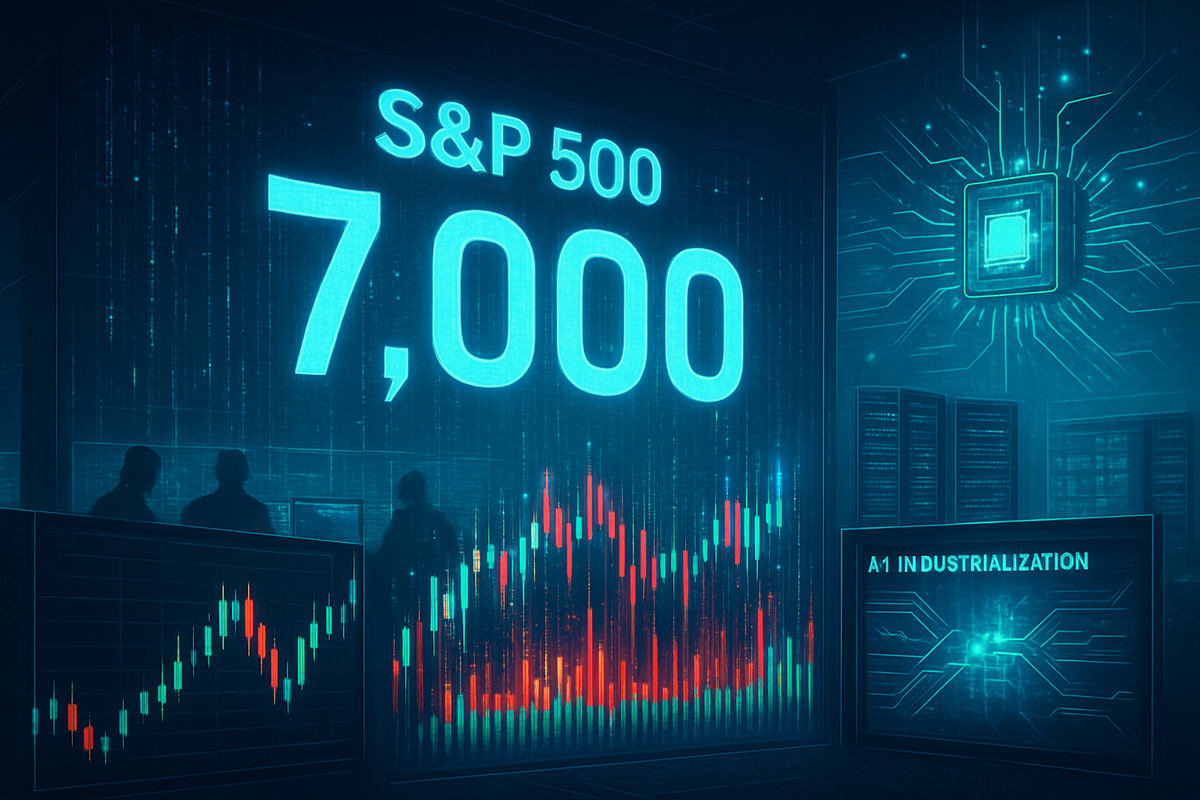
As of February 11, 2026, the global financial community is fixated on the S&P 500 (INDEXSP: .INX) as it battles to secure a foothold above the historic 7,000-point milestone. After a relentless multi-year rally fueled by the transition from artificial intelligence speculation to large-scale industrialization, the index has reached a critical juncture. The current market environment is defined by a fierce tug-of-war between institutional hedging strategies and the fundamental growth of the "AI economy," leaving investors to wonder if this psychological barrier is a ceiling or a launchpad.
The immediate implications of this struggle are palpable. Following a brief breach of the 7,000 level in late January, the index has settled into a period of high-stakes consolidation. Today’s trading session saw the index close at 6,941.81, down 0.3%, as disappointing retail sales data and massive corporate bond offerings injected a dose of caution into the market. The ability of the index to reclaim 7,000 is now viewed as the ultimate litmus test for the sustainability of the current bull cycle.
The Battle of the Gamma Wall: 7,000 vs. 7,020
The technical landscape surrounding the 7,000 mark is dominated by a phenomenon known as a "Gamma Wall." In the world of options trading, a Gamma Wall occurs when there is a massive concentration of open interest at a specific strike price—in this case, 7,000. For market makers who sell these options, this concentration requires constant hedging. When the index approaches 7,000, these dealers must adjust their positions, often creating a "sticky" effect or a "ceiling" that prevents the index from breaking out cleanly.
The current struggle is centered in the narrow corridor between 7,000 and 7,020. Technical analysts note that every attempt to sustain price action above 7,000 has been met with immediate "gamma-related" selling. This creates a "Sisyphus moment" for the market, where bulls push the index to the brink of a breakout only to see it roll back down under the weight of dealer hedging and profit-taking. As long as the index remains below 7,000, it stays in a "negative gamma" environment, which tends to accelerate intraday volatility and magnify downward moves.
The timeline leading to this confrontation began in late 2025, when the S&P 500 accelerated its ascent from the 6,500 level. Driven by record-breaking earnings from the technology sector and a broadening of the rally into industrials, the index reached 6,900 by the start of 2026. However, as the 7,000 strike became the primary target for call buyers, the options market effectively "walled off" the level, requiring a significant fundamental catalyst to punch through the heavy concentration of sell orders.
Winners and Losers in the Fight for 7,000
The current volatility has created a bifurcated market. On one side are the traditional leaders of the AI revolution, such as NVIDIA (NASDAQ: NVDA) and Microsoft (NASDAQ: MSFT). While these companies continue to report robust earnings, they are also facing the "law of large numbers" and increased scrutiny over their capital expenditures. For instance, Alphabet (NASDAQ: GOOGL) recently made headlines by offloading $20 billion in bonds to fund its aggressive AI infrastructure expansion, a move that slightly dampened investor sentiment today as it highlighted the staggering costs of staying competitive.
Conversely, the "losers" in the short term appear to be the pure-play software companies that have yet to translate AI hype into tangible revenue. The market is increasingly rewarding "physical AI" companies—those that provide the hardware, cooling, and power infrastructure necessary for the AI era. Companies like Vertiv Holdings Co (NYSE: VRT) and Eaton Corporation (NYSE: ETN) have become surprising winners in this multi-year rally, as their products are essential for the industrialization of data centers.
The "other 493" companies in the S&P 500 are also seeing a change in fortune. As AI productivity gains begin to "leak" into sectors like healthcare and manufacturing, many value-oriented stocks are providing a cushion for the index. This rotation was evident today, as the Dow Jones Industrial Average (INDEXDJX: .DJI) hit a fresh record high even while the tech-heavy S&P 500 and Nasdaq retreated, suggesting that investors are seeking safety in industrial giants while the tech sector digests the 7,000 Gamma Wall.
The Era of AI Industrialization
This rally is fundamentally different from the speculative bubbles of the past. We have entered the phase of "AI Industrialization," where the focus has shifted from the novelty of large language models to the physical build-out of the global AI grid. This transition has turned AI into a multi-year macroeconomic trend rather than a short-term tech fad. The build-out of power grids, cooling systems, and massive data center clusters represents a significant portion of current US capital expenditure, providing a floor for economic growth even as consumer spending shows signs of cooling.
The significance of 7,000 also lies in its historical context. Much like the 1,000 mark in the late 90s or the 4,000 mark in 2021, these round numbers act as psychological anchors for the public. A sustained move above 7,000 would signal a "new normal" for equity valuations, predicated on the idea that AI-driven productivity gains can justify higher price-to-earnings multiples. However, if the market fails to clear this hurdle, it may invite comparisons to the "lost decade" of the 2000s, where psychological resistance levels turned into multi-year tops.
Furthermore, the policy implications are significant. The Federal Reserve is closely watching this milestone, as a "melt-up" beyond 7,100 could signal loosening financial conditions that might reignite inflationary pressures. On the other hand, the shift toward industrialization is seen as a supply-side positive, potentially allowing for higher growth without the typical inflationary drawbacks seen in consumption-heavy economies.
What Comes Next: 7,100 Target or 6,945 Support?
Looking ahead, the market is facing a binary setup. To the upside, the target is 7,100—a level that represents a key Fibonacci extension and the point where the current Gamma Wall would likely collapse, triggering a short-covering "melt-up." For this to happen, the market needs a "goldilocks" economic signal: inflation that remains stable while AI-related earnings continue to beat expectations. A successful back-to-back close above 7,020 would likely be the signal that the 7,000 ceiling has finally been shattered.
To the downside, the 6,945 level is the line in the sand. This support zone has held firm throughout early February, acting as a consolidation floor. If the index breaks below 6,945, technical analysts warn of a potential slide toward 6,800, a level described as the "line in the sand" between a healthy correction and a more significant 10% pullback. A break below 6,800 would likely force institutional investors to hedge more aggressively, potentially ending the current bullish phase of the AI industrialization cycle.
The coming weeks will be defined by strategic pivots. Companies that have over-leveraged to build AI capacity may find themselves vulnerable if the 7,000 level proves insurmountable, while those with "clean" balance sheets and practical AI applications will likely remain the preferred choice for cautious investors.
Navigating the 7,000 Milestone
The battle for 7,000 is more than just a numbers game; it is a clash between the future of industrial technology and the reality of market mechanics. The "Gamma Wall" at 7,000 represents a formidable obstacle, but the underlying engine of AI industrialization remains powerful. Investors should watch the 6,945 support level closely; as long as it holds, the structural integrity of the bull market remains intact.
Moving forward, the focus will shift from "who is building AI" to "who is profiting from AI." This shift in the investment thesis will continue to drive sector rotation and create opportunities in previously overlooked corners of the market. While the 7,000 mark is currently a source of friction, its eventual resolution—whether to the upside or downside—will set the tone for the remainder of 2026.
In the coming months, the key catalysts will be the quarterly earnings reports from the heavyweights of the AI grid and the macro data regarding US productivity. If the "AI Industrialization" phase can prove its worth through tangible bottom-line growth across the broader S&P 500, the 7,000 milestone will likely be remembered not as a peak, but as a stepping stone to even greater heights.
This content is intended for informational purposes only and is not financial advice.