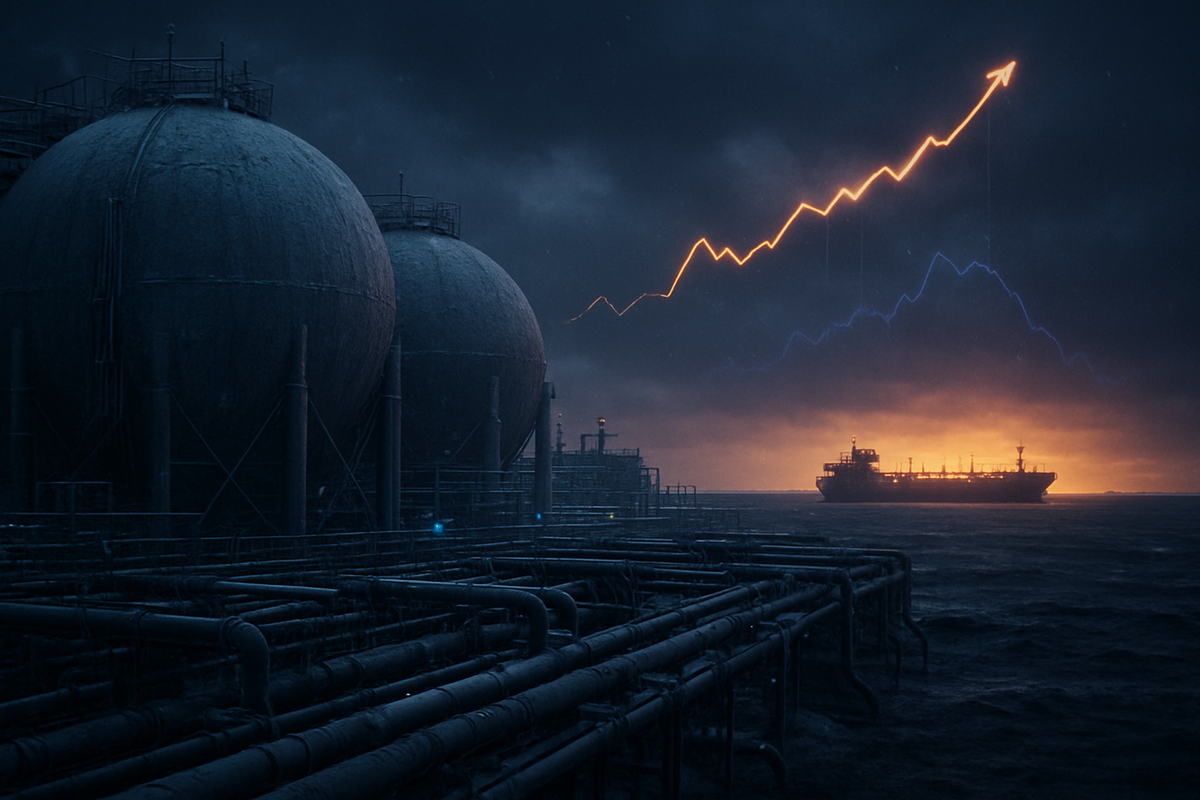
As of February 2, 2026, the European continent finds itself grappling with a familiar and chilling specter: an energy crunch that has seen natural gas storage levels plummet to their lowest levels since the 2022 crisis. After a series of deceptive winter "comfort zones" in 2023 and 2024, a combination of an unforgiving Arctic cold snap and a relaxation of aggressive storage mandates has left the European Union’s energy reserves at a critical juncture. With storage facilities in key hubs like Germany and the Netherlands dipping toward 30% capacity, the vulnerability of the European energy grid is once again under the global microscope.
Across the Atlantic, the narrative is one of surging demand and rising costs. According to the latest data from the World Bank, U.S. natural gas prices have experienced a sharp 12.1% surge, driven by a "call" on domestic supply that has never been louder. This price hike reflects a fundamental shift in the global energy trade; the United States is no longer just a peripheral player but the primary guarantor of European energy security. However, this security comes at a premium, as American consumers and industrial giants find themselves competing with a hungry European market for the same molecules of methane.
The Cold Snap and the Policy Pivot
The current predicament began to take shape in late 2025, following a period of relative complacency in European energy policy. After the 2022 invasion of Ukraine by Russia, the EU had mandated a 90% storage fill target by November of each year. However, by late 2025, these requirements were slightly eased to 75.4% in several jurisdictions to reduce the financial burden on utilities. This policy shift proved mistimed. A severe and prolonged "cold snap" that began in late November 2025 accelerated withdrawals from storage at a rate not seen in four years. By the end of January 2026, German storage had fallen to a staggering 34% capacity, while Dutch reserves dropped to 28%.
This timeline of depletion has been mirrored by a dramatic price rally in the United States. The World Bank’s January 2026 report highlighted that while other energy commodities showed signs of stabilization, U.S. Henry Hub prices broke through the $6.6 per MMBtu barrier—a two-year high. The market reaction has been swift and volatile. Investors have flocked to the United States Natural Gas Fund (NYSEARCA: UNG), which saw a nearly 50% surge in value throughout January 2026 as traders bet on continued supply tightness.
The key players in this drama are no longer the pipeline operators of the East, but the Liquefied Natural Gas (LNG) titans of the West. The current crisis has highlighted the "just-in-time" nature of the modern global gas market. Unlike the era of stable Russian pipeline flows, the 2026 energy landscape is dictated by the arrival of specialized tankers. Any delay in shipping, whether due to weather in the Gulf of Mexico or logistical bottlenecks in the Atlantic, now results in immediate price spikes in European gas hubs.
Corporate Winners and Industrial Losers
The clear winners in this environment are the major U.S. LNG exporters and integrated energy firms. Cheniere Energy (NYSE: LNG) has cemented its position as the bedrock of European supply, with over 70% of its total export volume now flowing toward EU terminals. The company’s ability to ramp up production at its Sabine Pass and Corpus Christi facilities has allowed it to capture significant premiums. Similarly, ExxonMobil (NYSE: XOM) has seen its strategic pivot toward LNG pay dividends. By doubling its global LNG portfolio, ExxonMobil has positioned itself as a preferred long-term partner for European nations desperate for multi-decade supply security.
Conversely, the losers are found in the heart of European industry. German chemical giant BASF (OTC: BASFY) continues to face significant headwinds as high energy input costs threaten the viability of its domestic manufacturing. Despite signing a long-term contract with Cheniere that is set to begin mid-2026, the company is currently caught in the "storage gap," forced to buy gas at spot prices that are significantly higher than historical averages. This has led to renewed fears of "demand destruction," where industrial output is curtailed because the cost of energy makes production unprofitable.
For the United States Natural Gas Fund (NYSEARCA: UNG), the situation is complex. While the fund has benefited from the recent price surge, it continues to face the structural challenge of contango. Because future gas prices are often higher than current spot prices, the fund loses value as it "rolls" from one expiring contract to the next. For investors, UNG remains a high-stakes vehicle that tracks the immediate volatility of the market but carries significant long-term risks during periods of price stabilization.
The Broader Implications of Global Integration
The broader significance of this 2026 energy crisis lies in the "Great Decoupling" from Russian energy and the subsequent total dependency on the U.S. export market. This event underscores a major shift in global trade: natural gas is no longer a regional commodity but a globally integrated one, similar to oil. The World Bank's reported 12.1% surge in U.S. prices is a direct symptom of this integration. When Europe is cold, Americans pay more for their heating and electricity because the molecules are being diverted to the highest bidder across the ocean.
Regulatory implications are already surfacing in Brussels. The failure to maintain higher storage cushions through the 2025-2026 winter is likely to lead to even more stringent EU mandates for 2027. There is a growing consensus that the "free market" approach to gas storage—where utilities buy gas when it is cheapest—cannot be trusted during a geopolitical transition. We are likely to see a move toward state-backed strategic gas reserves, similar to the Strategic Petroleum Reserve (SPR) in the U.S.
Historically, this event mirrors the 2022 crisis, but with a critical difference: the infrastructure to solve the problem is now largely American. In 2022, the world was scrambling for any available gas. In 2026, the gas exists, but the competition for it has become a permanent feature of the market. This creates a ripple effect where emerging markets in Asia are being priced out of the LNG market by wealthy European nations, potentially leading to increased coal usage in those regions and complicating global climate goals.
The Road Ahead: Summer Injections and Strategic Pivots
Looking ahead, the short-term focus will be on the "summer injection season." To reach the mandatory 90% storage target by November 1, 2026, Europe will need to embark on one of the most aggressive and expensive gas-buying campaigns in its history. This will likely keep global gas prices elevated throughout the spring and summer of 2026. Market opportunities will emerge for companies involved in "floating storage and regasification units" (FSRUs), as countries like Italy and Greece look to expand their import capacity to bypass the bottlenecks in Northern Europe.
Strategic pivots will also be required from European utilities. We are likely to see a surge in the signing of 20-year LNG contracts, a practice many European governments previously avoided due to their long-term green energy goals. However, the 2026 crisis has made it clear that "bridge fuels" will be necessary for much longer than originally anticipated. Shell (NYSE: SHEL) and other global majors are expected to be the primary beneficiaries of this shift toward long-term contracting.
Potential scenarios for the remainder of 2026 include a "hot summer" in the U.S., which would further strain supply by increasing domestic demand for air conditioning. If a hot American summer is followed by a late-year hurricane season that disrupts LNG terminals in the Gulf, the European storage situation for the winter of 2026-2027 could move from "critical" to "catastrophic." Investors should prepare for a period of sustained volatility where weather patterns in Texas are just as important to European markets as policy decisions in Berlin.
Final Assessment: A High-Stakes Energy Future
The 2026 energy crisis serves as a stark reminder that the transition away from stable pipeline gas is fraught with volatility. The primary takeaway is the new, unbreakable link between U.S. domestic prices and European energy security. As storage levels hit their lowest points since the 2022 invasion, the market has entered a "new normal" where scarcity is the default expectation during the winter months. The 12.1% surge in U.S. prices is not an anomaly but a reflection of the global price for reliability.
Moving forward, the market will be characterized by a "race for supply." For investors, the focus should remain on the infrastructure providers and the integrated majors who control the flow of LNG. While the United States Natural Gas Fund (NYSEARCA: UNG) offers a way to play the immediate price action, the more stable long-term value lies in the companies building the terminals and signing the decades-long deals that will define the next era of energy.
In the coming months, keep a close eye on the weekly storage reports from Gas Infrastructure Europe (GIE) and the commissioning of new U.S. export terminals like Plaquemines LNG. These will be the primary indicators of whether Europe can dig itself out of its current hole or if 2026 will be remembered as the year the energy crisis became a permanent fixture of the global economy.
This content is intended for informational purposes only and is not financial advice.