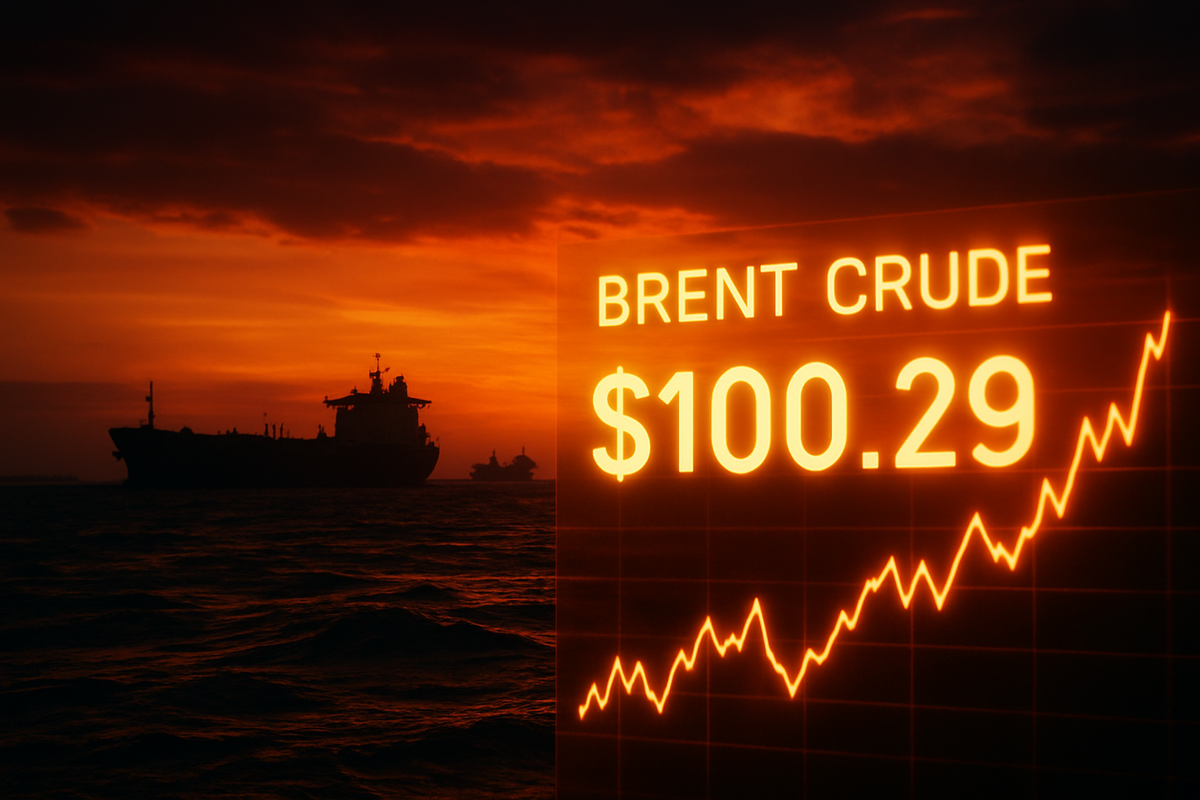
For the first time since the volatile summer of 2022, Brent crude oil prices have breached the psychological $100 per barrel mark, sending shockwaves through global financial markets and reigniting fears of a new era of stagflation. The surge, which saw Brent futures settle at $100.29 in early Friday trading, is the direct result of a rapid military escalation in the Middle East that has effectively severed the world’s most vital energy artery: the Strait of Hormuz.
The breach of the $100 threshold represents a 35% increase in energy costs since the start of the year, a move that analysts warn could derail the fragile post-inflationary recovery of the global economy. As Israel and Iran move from proxy shadow warfare to direct kinetic strikes, the physical blockade of the Strait—through which 21% of the world’s daily oil consumption flows—has transformed a geopolitical "risk premium" into a tangible supply vacuum that may take months to resolve.
A Perfect Storm: The Path to Triple-Digit Oil
The catalyst for today’s price action was the confirmation by the International Energy Agency (IEA) that tanker traffic through the Strait of Hormuz has plummeted by nearly 90% over the last 72 hours. This follows a series of retaliatory missile strikes and the deployment of naval mines in the narrow passage, which serves as the primary exit for crude produced by Saudi Arabia, Iraq, the UAE, and Kuwait. While global inventories had been relatively stable throughout 2025, the sudden removal of approximately 20.5 million barrels per day (bpd) from the market has left refiners in Asia and Europe scrambling for any available spot cargoes.
The timeline of this crisis began in late February 2026, when a series of unclaimed cyberattacks on regional energy infrastructure led to a sharp increase in military posturing. By March 10, direct strikes on naval assets near the Musandam Peninsula forced major shipping insurers to suspend coverage for the region, effectively grounding the fleet of "Very Large Crude Carriers" (VLCCs) that keep the global economy fueled. By the time markets opened on March 13, the realization that alternative pipelines—such as the East-West Pipeline across Saudi Arabia—could only compensate for roughly 5 million bpd of the lost volume triggered a frantic wave of buying.
Market Winners and Corporate Casualties
The immediate reaction on Wall Street and in European bourses has been a sharp divergence between energy producers and fuel-dependent industries. ExxonMobil (NYSE: XOM) and Chevron (NYSE: CVX) saw their shares climb by 4.2% and 3.8% respectively, as investors moved to hedge against inflation using the very companies that stand to reap windfall profits from triple-digit crude. European majors BP (NYSE: BP) and Shell (NYSE: SHEL) also trended higher, though their gains were slightly tempered by their deeper operational exposure to Middle Eastern joint ventures and the skyrocketing cost of maritime insurance.
Conversely, the transportation sector is facing an existential threat. Delta Air Lines (NYSE: DAL) and United Airlines (NYSE: UAL) have both issued profit warnings, noting that their 2026 earnings guidance is "no longer applicable" under the current fuel price regime. With fuel typically accounting for nearly 30% of airline operating costs, the industry is already signaling a potential 15% increase in ticket prices to maintain solvency. Logistics giant FedEx (NYSE: FDX) also saw its stock under pressure as the cost of jet fuel and diesel threatened to erode margins for its global delivery network.
Broader Economic Significance and Historical Echoes
Today’s milestone draws haunting parallels to the energy crisis of 2022 following the invasion of Ukraine. However, economists note that the 2026 crisis is arguably more severe because it involves a physical blockade of a maritime chokepoint rather than just a redirection of trade flows. Unlike the 2022 crisis, where Russian oil eventually found its way to India and China, the closure of Hormuz means that roughly 15 million barrels of oil simply cannot reach the market by any means, creating a "hard" shortage that cannot be easily mitigated by shifting trade routes.
The regulatory implications are already manifesting. The Federal Reserve and the European Central Bank (ECB), which were both widely expected to begin a cycle of interest rate cuts in the second half of 2026, are now forced back into a hawkish corner. Energy-driven inflation is expected to add at least 0.8 percentage points to the global Consumer Price Index (CPI), potentially forcing central banks to maintain "higher for longer" rates despite the looming threat of a recession. Historically, every 10% sustained increase in oil prices has shaved roughly 0.15% off global GDP growth; a 30% spike suggests a significant drag on the 2026 economic outlook.
The Road Ahead: Diplomatic Maneuvers and Strategic Reserves
In the short term, the market's focus shifts to the coordinated response from the IEA and the White House. Rumors are circulating of the largest-ever release from the Strategic Petroleum Reserve (SPR), with figures as high as 400 million barrels being discussed to bridge the gap until maritime security can be restored. However, the efficacy of an SPR release is limited if the tankers cannot physically transit the Strait of Hormuz to deliver the crude to refineries in the Far East.
Long-term, this event is likely to accelerate the pivot toward energy independence and renewable infrastructure in Western economies. Just as the 1973 oil embargo and the 2022 crisis acted as catalysts for policy change, the "March 2026 Shock" may force a massive reallocation of capital into nuclear, hydrogen, and battery storage technologies to insulate national economies from Middle Eastern volatility. For now, the focus remains on the "tanker war" in the Gulf and whether a diplomatic off-ramp can be found before prices reach the $125 "danger zone" seen in previous decades.
Closing Perspective: A Fragile Balance
As Brent crude sits firmly above $100, the global economy enters a period of heightened fragility. The immediate takeaway for investors is that the "peace dividend" of the early 2020s has fully evaporated, replaced by a permanent geopolitical risk premium that must be factored into every asset class. The coming weeks will be a test of both military resolve and economic resilience, as nations grapple with the reality of a world where energy security is no longer guaranteed.
Moving forward, the primary metric for the market will not be the price of oil itself, but the "transit volume" through the Strait of Hormuz. Until the 20 million barrels per day can flow freely again, the $100 price tag is likely to be a floor rather than a ceiling. Investors should maintain a defensive posture, watching for secondary inflation effects in the food and manufacturing sectors, while keeping a close eye on the VIX volatility index, which has already spiked above 30 in response to the day's events.
This content is intended for informational purposes only and is not financial advice