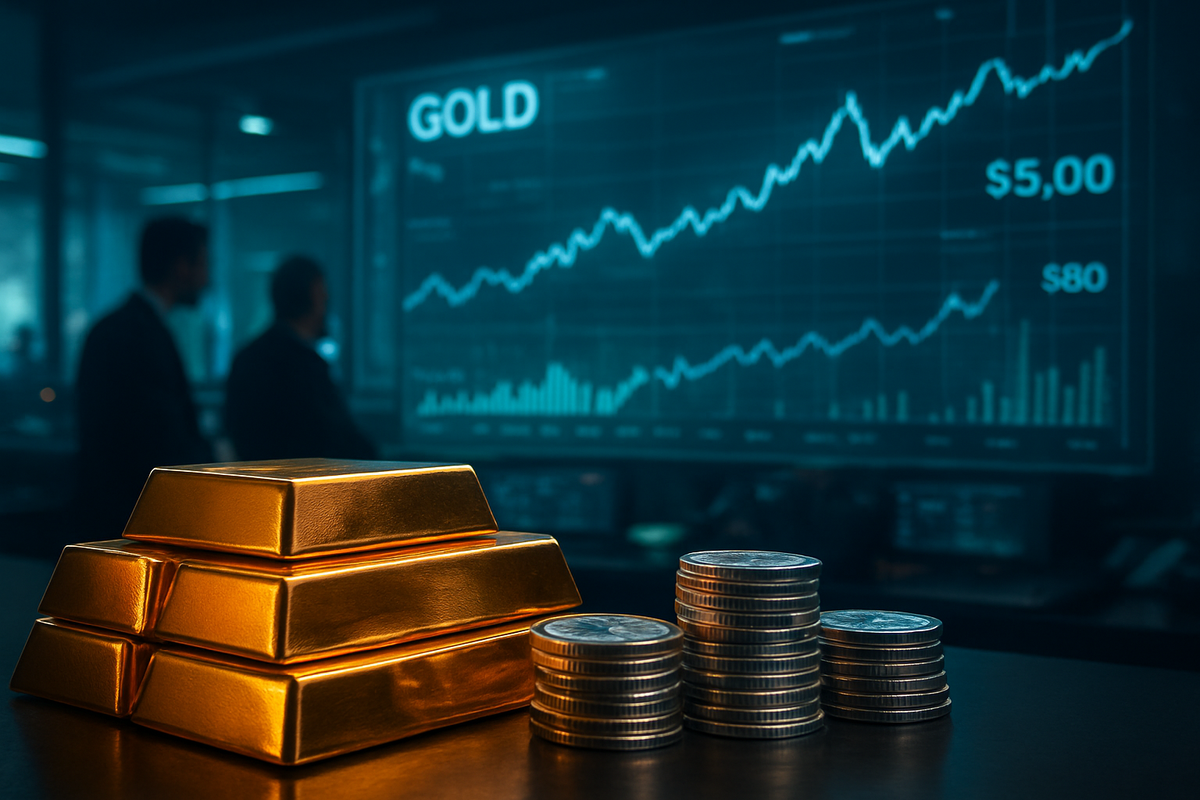
As of March 17, 2026, the precious metals market has entered a historic "New Golden Age," characterized by unprecedented price levels and a fundamental shift in how Wall Street values the mining sector. With gold prices currently stabilizing near the $5,000 per ounce threshold and silver trading around $80 per ounce, junior mining equities have transitioned from speculative laggards into what analysts are now calling "high-yield cash machines." The VanEck Junior Gold Miners ETF (NYSE: GDXJ) has dramatically outperformed both its large-cap counterparts and the spot price of the metals themselves, signaling a period of extreme operational leverage.
This outperformance is driven by "super-margins"—a phenomenon where the gap between production costs and spot prices has widened to record levels. While the spot price of gold has risen roughly 70% over the last 12 months, the GDXJ has surged over 200% in the same period. The market's pivot toward miners is being fueled by massive free cash flow (FCF) generation, aggressive dividend hikes, and a wave of share buybacks that are finally attracting institutional capital back into the sector after a decade of dormancy.
The Great Decoupling: Junior Miners Take the Lead
The road to $5,000 gold and $80 silver began in late 2024, accelerated by a combination of aggressive central bank buying—averaging 70 tonnes per month throughout 2025—and persistent geopolitical instability in the Middle East. By January 2026, gold briefly surged to an all-time high of $5,589.38 before settling into its current range. Silver experienced an even more volatile "supercycle," peaking at $121 per ounce earlier this year before correcting to its present $80 level, driven largely by industrial demand for AI data centers and global solar infrastructure.
During this ascent, the performance of junior miners has been nothing short of explosive. In 2025, the VanEck Junior Gold Miners ETF (NYSE: GDXJ) returned 160%, compared to 115% for the senior-focused VanEck Gold Miners ETF (NYSE: GDX). This "torque" is the result of marginal projects suddenly becoming highly profitable. For a junior miner with an All-In Sustaining Cost (AISC) of $1,800, the jump from $2,500 gold to $5,000 gold represents a 357% increase in profit per ounce, far outpacing the 100% rise in the metal's price. Key stakeholders, including major institutional players like J.P. Morgan and Bank of America, have revised their 2026 targets upward, with some "blue sky" projections for gold reaching as high as $6,000 by year-end.
The 'Cash Machine' Winners: From Explorers to Producers
The winners in this new environment are those companies that have successfully transitioned from exploration to production or expanded their high-grade operations. Pan American Silver (NASDAQ: PAAS) has emerged as a standout, reporting record revenues of $3.6 billion in 2025. With silver AISC dropping as low as $9.51 per ounce at key mines, PAAS is capturing nearly $70 in profit for every ounce of silver sold at current prices. Similarly, Lundin Gold (TSX: LUG) has been dubbed the "yield king" of the GDXJ, declaring a massive Q1 2026 dividend of $1.15 per share, an annual yield of nearly 6%.
On the junior side, newer players like G Mining Ventures (TSX: GMIN) and Rio2 (TSX: RIO) are benefiting from perfect timing. G Mining’s Tocantinzinho mine hit commercial production just as the supercycle began, making it a primary takeover target for "Big Two" producers like Newmont (NYSE: NEM) and Barrick Gold (NYSE: GOLD). Meanwhile, silver-focused plays like Discovery Silver (TSX: DSV) are seeing their Cordero project—one of the world's largest undeveloped silver assets—reevaluated as a "super-margin" asset with long-term AISC projected at less than $12.50 per ounce. Not all have been immune to the volatility, however; B2Gold (NYSEAM: BTG) saw its 2026 AISC guidance rise to over $2,400 per ounce due to royalty escalations triggered by the $5,000 gold price, illustrating that "super-margins" can sometimes be pinched by success-linked costs.
Ripple Effects and the New Institutional Narrative
The significance of this event extends beyond simple price appreciation; it represents a fundamental shift in the industry's narrative. For years, mining companies were criticized for capital mismanagement and "diworsification." Today, they are being rewarded for capital discipline. The sector's 137% dividend growth since 2024 has made GDXJ and the Amplify Junior Silver Miners ETF (NYSE: SILJ) a legitimate alternative to fixed-income and tech-heavy growth stocks. Wall Street analysts from Morgan Stanley and Scotiabank now emphasize "yield-to-gold-price" ratios, viewing these companies as a way to gain direct leverage to metal prices without the storage costs associated with physical bullion.
This shift has also triggered a massive wave of Mergers and Acquisitions (M&A). Senior producers, sitting on record cash piles, are aggressively pursuing juniors to replenish reserves that were depleted during the lean years of the 2010s. The ripple effect is being felt in the broader market as well, where silver’s industrial demand—driven by its "critical mineral" designation for AI chip manufacturing—is causing a supply squeeze that could keep prices elevated even if speculative interest wanes. Historical precedents, such as the 1970s gold bull market, pale in comparison to the current operational efficiency and cash flow generation of modern miners.
The Road Ahead: Scenarios for the Rest of 2026
Looking toward the latter half of 2026, the primary question for investors is whether these "super-margins" are sustainable. Short-term volatility is expected as the market digests the "flash crash" of early 2026, but the structural drivers—central bank demand and the silver-to-AI link—remain robust. Strategic pivots are already underway; many juniors are using their current windfalls to fund aggressive organic growth and debt reduction rather than just returning cash, a move intended to provide a buffer should prices retreat toward the $4,000 level.
The most likely scenario involves continued consolidation. Large-cap miners like Hecla Mining (NYSE: HL), Coeur Mining (NYSE: CDE), and Equinox Gold (NYSEAM: EQX) are expected to be both predators and prey in a rapidly tightening market for high-quality assets. Investors should watch for "royalty creep" and energy-driven inflation, particularly if oil prices remain above $100 per barrel, as these factors could erode the record margins seen in early 2026.
Wrap-Up: A Permanent Shift in Valuation?
The outperformance of GDXJ and junior silver miners marks a turning point in the 2026 financial landscape. The key takeaway for investors is that the mining sector has finally decoupled from its reputation as a "value trap" to become a source of high-yield growth. With gold at $5,000 and silver at $80, the operational leverage provided by the juniors is unparalleled in the current market.
Moving forward, the market's focus will likely shift from price discovery to operational execution. Investors should keep a close eye on quarterly free cash flow reports and dividend announcements from holdings like Wheaton Precious Metals (NYSE: WPM), Alamos Gold (NYSE: AGI), and IAMGOLD (NYSE: IAG). While the "super-cycle" has already minted new fortunes, the durability of these "high-yield cash machines" will depend on their ability to maintain low AISC in the face of a shifting global economy.
This content is intended for informational purposes only and is not financial advice.